
New Patent Scans Surroundings for Eye Health Risks Using Gaze Direction
Samsung is working on a wearable device that watches where your eyes are pointed, aims a camera in that direction, and then analyzes what you're looking at for potential risks to your eye health.
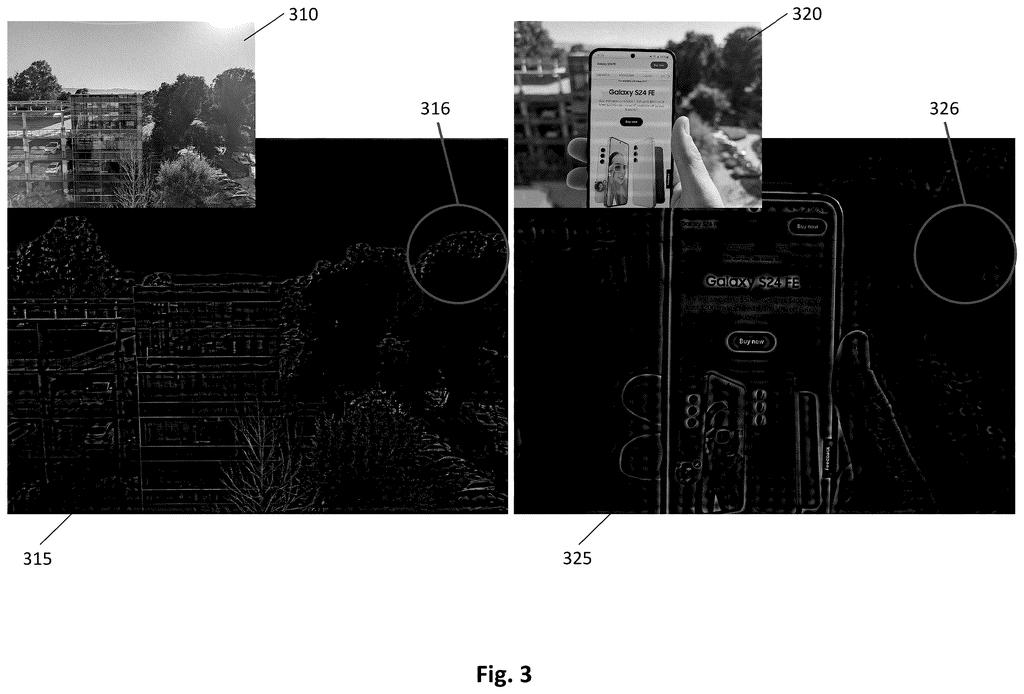
What Samsung's gaze-tracking eye health system actually does
Imagine wearing a pair of glasses that notice you're staring at a bright screen or harsh light source, and log that as a potential problem for your eyes. That's roughly what Samsung is describing in this patent.
The device estimates where you're looking at any given moment, then steers an outward-facing camera to capture a clear image of whatever is in your line of sight. From that image, it picks out visual details in your environment that could affect your eye health, things like screen brightness, lighting conditions, or other factors your doctor might care about.
The idea is that passive, automatic monitoring could catch eye-strain risks you'd never think to report yourself. You're not pressing a button or running a scan. The glasses do the work by following your gaze.
estimating a gaze of a wearer of a device comprising an outward facing camera; focusing the camera based on the estimated gaze of the wearer; capturing, by the focused camera, one or more focused images of an environment of the wearer …
Translation: The device tracks where you look and snaps a clear picture of what is right in front of your eyes.
How the camera locks focus using your gaze direction
The patent describes a three-step loop running on a wearable device, most likely glasses or a headset, that has both inward-facing sensors (to track your eyes) and an outward-facing camera (to photograph the world in front of you).
- Gaze estimation: The device figures out where in the environment you are currently looking, probably using infrared eye-tracking sensors already common in VR headsets.
- Camera focusing: Instead of capturing a wide, unfocused shot of everything in front of you, the camera is told to focus specifically on the object or area you're actually gazing at. This means the image is sharp where it counts.
- Environmental feature detection: The system analyzes the focused image for visual features (qualities of the scene like brightness, contrast, flicker, or proximity) that the patent ties to eye health outcomes.
The patent doesn't spell out every health condition it targets, but the USPC classification (351/209 covers ophthalmic testing equipment) makes clear this is designed with clinical or wellness applications in mind. The core technical insight is that pointing the camera where the user is actually looking produces far more relevant data than a generic wide-angle snapshot.
… determining, from at least one of the one or more focused images of the environment of the wearer, one or more visual features of the environment of the wearer related to the eye health of the wearer.
Translation: It analyzes those photos to find things in your surroundings that might affect your vision.
What this means for wearable health monitoring
Eye strain and screen-related vision problems are increasingly common, and most people have no way to track what their eyes are actually exposed to throughout the day. A wearable that logs environmental risk factors passively, without any effort from you, could eventually give eye doctors a real picture of your daily visual environment rather than relying on what you remember to report.
Samsung has been investing in its Galaxy Ring and health-sensor ecosystem, and a patent like this fits a broader pattern of moving biometric monitoring beyond the wrist. If this technology ends up in a pair of smart glasses, it would put Samsung in direct competition with health-focused wearable camera platforms. The challenge is getting the gaze-estimation and image analysis accurate enough to be clinically meaningful rather than just a novelty.
This is a genuinely interesting health-monitoring idea because the gaze-directed camera focus is a clever solution to a real problem: most wearable cameras capture too much irrelevant visual data to be useful for targeted health analysis. Whether Samsung can make the gaze-to-focus pipeline fast and accurate enough to matter in real-world conditions is the open question, and the patent gives no detail on that.
There are more where this came from
We read every patent application Big Tech publishes and send you the ones worth knowing. Plain English, free, every week.
The drawings
5 drawing sheets from US 2026/0224105 A1 · click any drawing to enlarge


Want this weekly breakdown for a company we don't cover? Patentlyze Pro →
Be the first to weigh in