
Samsung Patents a Segmented Grating Design for Clearer AR Waveguide Displays
Getting light to spread evenly across an AR lens is one of the hardest unsolved problems in wearable displays. Samsung's latest patent takes a fresh structural approach: instead of one continuous grating, use several carefully sized ones.
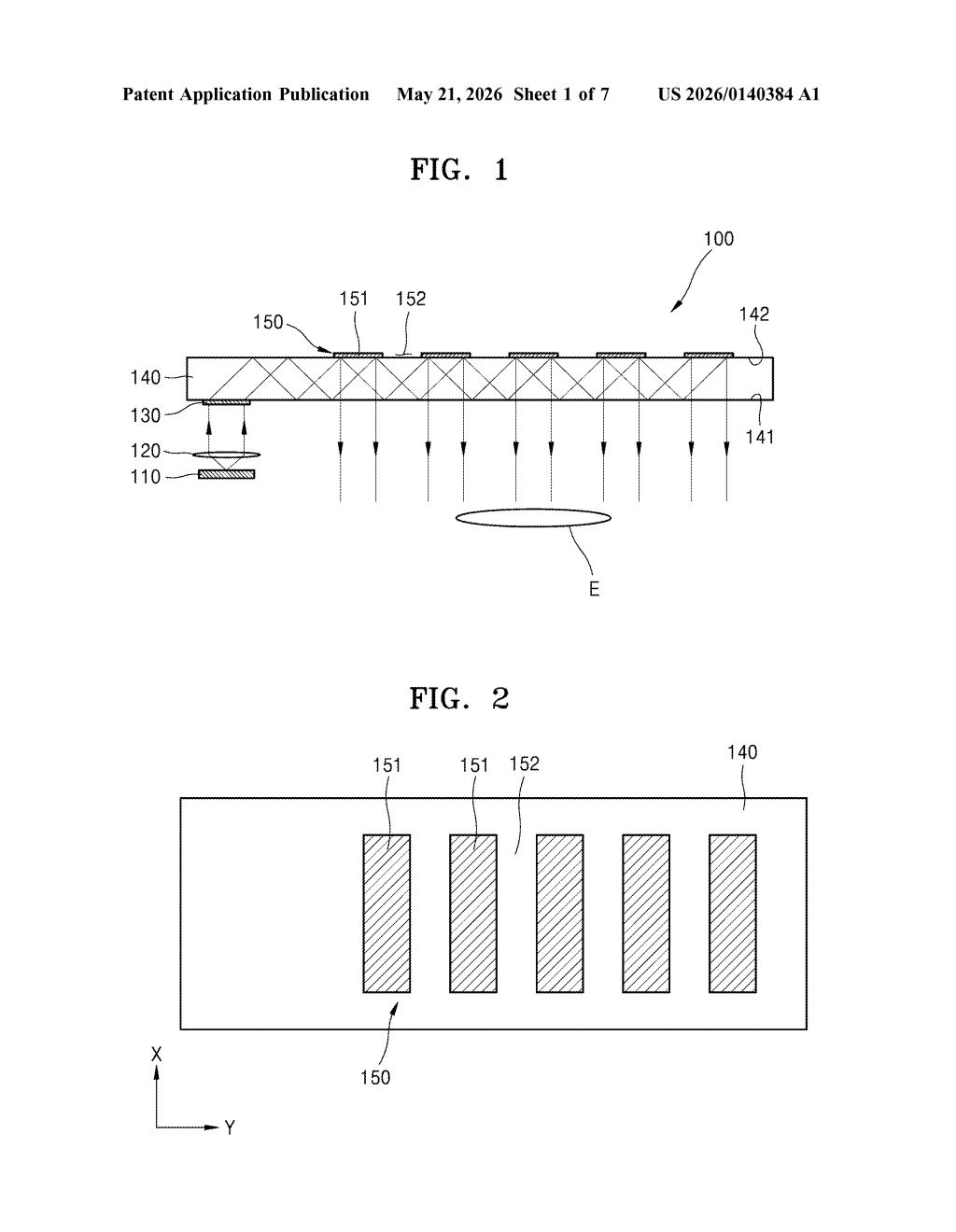
What Samsung's split-grating AR lens actually does
Imagine putting on a pair of AR glasses and noticing the image looks bright in the center but washes out or dims toward the edges. That uneven brightness is a real engineering headache, and it comes down to how the lens bounces light from a tiny projector out to your eye.
Samsung's patent describes a waveguide — the thin, glass-like layer inside an AR lens — that uses multiple separate grating regions instead of one big continuous one to redirect light out toward your eye. Think of a grating like a microscopic diffraction pattern etched into the glass. By splitting it into several distinct zones, Samsung can tune each zone independently.
The clever part: those zones get progressively larger in the direction light is traveling through the waveguide. That graduated sizing helps compensate for the natural drop in light intensity as it moves through the lens, so the brightness you see stays more consistent from one edge of your field of view to the other.
How the graduated grating regions balance light output
The patent describes a near-eye display apparatus built around a waveguide — a thin optical slab that traps and guides light via total internal reflection (bouncing light inside the glass like a fiber optic cable). An input coupler injects light from a display element (like a micro-OLED or microLED panel) into the waveguide, and an output coupler diffracts that light back out toward the user's eye to form the visible image.
The core claim is about the output coupler's geometry. Instead of a single continuous diffraction grating, the output coupler comprises a plurality of grating regions spaced apart from each other — discrete islands of diffractive structure rather than a solid block. Critically, the areas of those regions increase along the propagation direction of the light inside the waveguide.
Why does size matter? As light travels through the waveguide, each grating region it hits extracts some percentage of the remaining light. If all regions were the same size, the first region would grab a large fraction and the last region would have very little left to work with — resulting in uneven brightness. By making later regions progressively larger:
- Earlier (smaller) regions extract a modest amount from the still-bright beam
- Later (larger) regions compensate by having more diffractive area to capture from the dimmer remaining beam
- The net effect is a more uniform luminance across the full eye-box
The apparatus also includes a standard image processor and display element pipeline feeding the waveguide system.
What this means for next-gen AR glasses displays
Waveguide uniformity is one of the core reasons AR glasses still look noticeably worse than a phone screen held at arm's length. Hotspots, dimming at the periphery, and color non-uniformity are complaints tied directly to how output couplers are structured. A segmented, graduated grating design gives Samsung an engineering lever to tune each zone of the display independently — which is meaningfully harder to do with a monolithic grating.
For Samsung, this sits squarely in the competitive space with Meta's Ray-Ban smart glasses successors, Apple's Vision Pro, and Google's rumored return to AR eyewear. Better waveguide uniformity is a prerequisite for any AR glasses that could realistically replace a phone screen for daily tasks. Whether this specific approach makes it into a product is unknown, but the filing signals Samsung is doing serious optical engineering work below the surface.
This is solid, focused optical engineering — not a broad platform play. Segmenting the output coupler to compensate for propagation losses is a real and non-obvious approach to a well-documented problem in waveguide AR. It's worth watching as a signal that Samsung's display division is doing serious groundwork for AR hardware, even if there's no announced product to attach it to yet.
There are more where this came from
We read every patent application Big Tech publishes and send you the ones worth knowing. Plain English, free, every week.
Want this weekly breakdown for a company we don't cover? Patentlyze Pro →