
Sony Patents a Mixing Tool That Shows Which Sounds Are Drowning Each Other Out
When you're mixing a scene where a car horn blares next to a whispered voice, how do you know if the whisper is even audible? Sony has filed a patent for a tool that answers that question automatically.
How Sony's audio masking display helps sound engineers
A sound engineer sits at a mixing board, trying to balance dozens of audio elements across a 3D soundscape. She adjusts a violin, but can't tell whether it's being swallowed up by the orchestra surrounding it. That guesswork eats hours.
Sony's patent describes a system that visualizes auditory masking between different sound objects in a mix. In plain terms: when one sound is loud enough at a certain pitch to cover another nearby sound, the human ear simply can't hear the quieter one. Sony's tool calculates exactly how much of that covering is happening, and shows it on screen alongside the original frequency display for each sound.
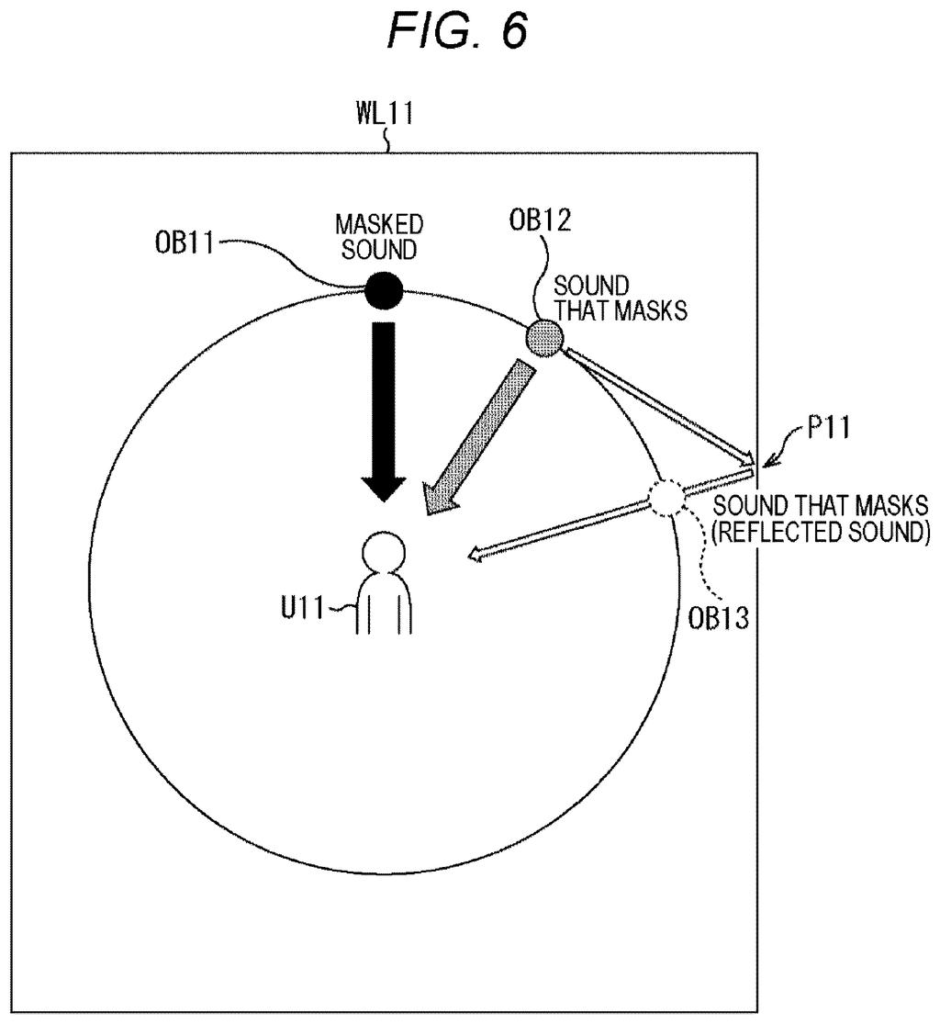
The key ingredient is position. The system doesn't just look at how loud things are; it factors in where each sound is placed in 3D space. A sound directly behind you masks differently than one off to the side. By combining location data with frequency analysis, the tool gives engineers a clear picture of what listeners will actually hear.
… calculates, as an inter-object masking frequency characteristic, an auditory masking amount at each frequency of a target object with one or more other objects on a basis of a frequency spectrum and object position information of the target object …
Translation: It figures out how much one sound is hiding another based on their frequencies and positions.
How the system calculates inter-object masking by position and frequency
The patent introduces an information processing apparatus built around two core components.
First, a masking information calculation unit takes a "target" sound object (say, a vocal) and computes how much each frequency of that sound gets masked (covered up) by every other sound object in the scene. This calculation is grounded in auditory masking, the well-documented psychoacoustic effect where a louder sound at a given frequency prevents the human ear from detecting quieter sounds nearby in pitch or time. The unit uses both the frequency spectrum (which pitches are present and how loud) and object position information (where each sound is located in 3D space) for every object involved.
The result is called an inter-object masking frequency characteristic, essentially a curve showing, frequency by frequency, how much the target sound is being drowned out by its neighbors.
Second, a display control unit overlays that masking curve directly onto the target sound's frequency spectrum on screen. Engineers can see at a glance which parts of a sound will be inaudible to listeners before committing to a final mix.
- Inputs: frequency spectrum and 3D position for each sound object
- Processing: per-frequency masking amount calculation across all object pairs
- Output: a visual display combining the target spectrum with the masking characteristic
… an information processing apparatus and method, an encoding apparatus, an audio reproducing apparatus, and a program that enable content to be produced in a shorter time …
Translation: The system helps creators finish mixing audio much faster than usual.
What this means for 3D audio production workflows
The production of object-based 3D audio (the format behind Dolby Atmos and Sony's own 360 Reality Audio) involves placing individual sounds at precise positions in a virtual space. The more objects in a scene, the harder it becomes to tell by ear alone what a listener will actually perceive. Engineers currently rely on experience and repeated test listens to catch masking problems, which is slow and error-prone.
A display that makes masking relationships visible could meaningfully cut down the back-and-forth in post-production. For game audio, film sound, and music production studios handling complex object-based mixes, that time saving adds up. Sony's track record in spatial audio patents suggests this is part of a broader push to build out professional tooling around its 360 Reality Audio ecosystem.
This is the 19th Sony filing we've tracked in our audio coverage since May, joining applications like headphones that switch sound modes and a directional microphone shell.
Mixing professional audio with dozens of independently positioned sound objects is an expensive guessing game. When one sound partially drowns out another, the effect depends on where each source sits in three-dimensional space, and no engineer can hold all those relationships in their head at once. Missed collisions mean rework, and rework on high-end productions costs real money and time.
Sony's approach is to surface that hidden information visually, showing engineers exactly where one sound is eating into another before they trust their ears to catch it. The scope is deliberately narrow: it diagnoses, it does not decide.
A tool that converts an invisible acoustic problem into something you can see and act on directly attacks the costly part of the workflow. Whether the diagnosis is fast and clear enough to earn a place in daily practice is the only question that matters now.
There are more where this came from
We read every patent application Big Tech publishes and send you the ones worth knowing. Plain English, free, every week.
The drawings
18 drawing sheets from US 2026/0281644 A1 · click any drawing to enlarge


Want this weekly breakdown for a company we don't cover? Patentlyze Pro →