
New VR Patent Optimizes Eye-Scanning Light Settings for Tracking and Login
Inside a VR headset, your eyes are doing two very different jobs at once: telling the software where you're looking, and proving you're actually you. Sony wants to use a different camera setup for each task.
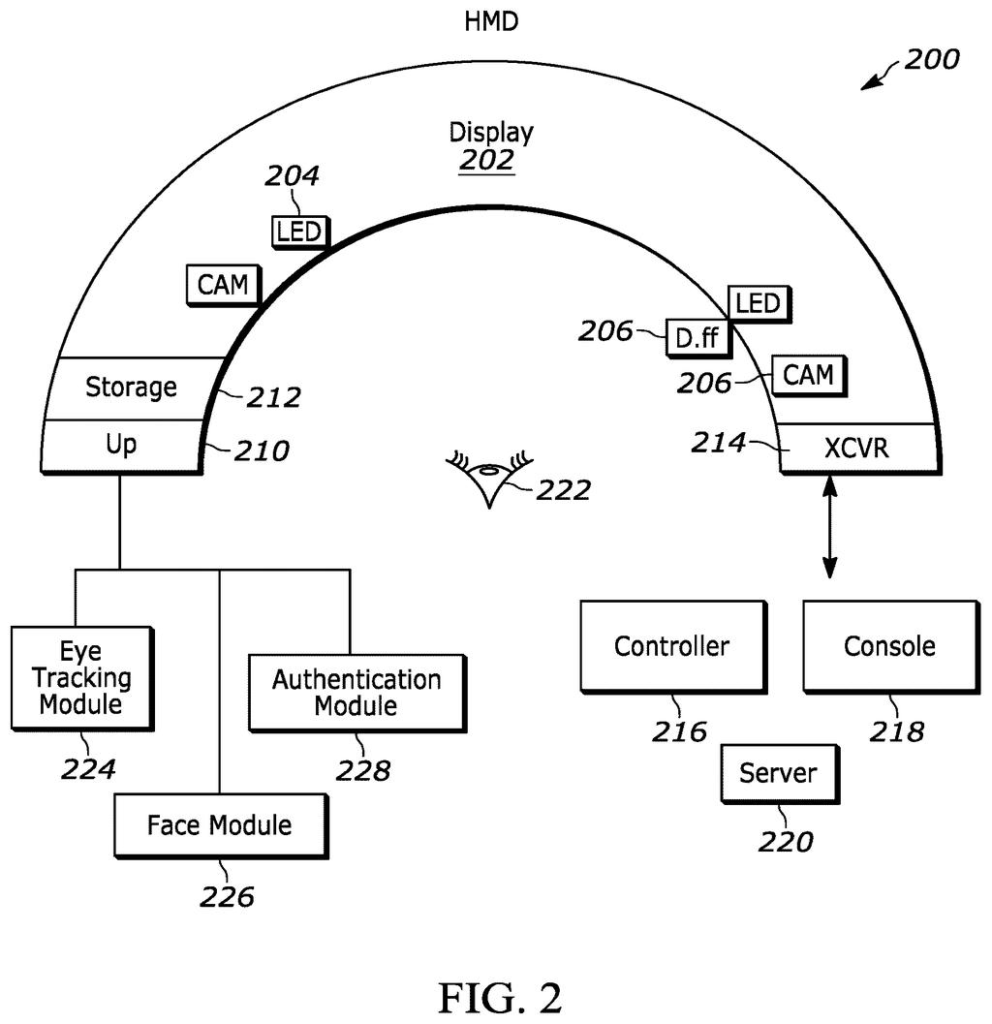
How Sony's headset tells eye-tracking from face login
Imagine your VR headset has a tiny camera pointed at your eye. Right now it might be watching where your gaze goes so menus follow your focus. But the same camera might also be trying to confirm it's you wearing the headset, not your roommate.
Those two jobs actually need different lighting. Good eye-tracking wants fast, low-key illumination so it can sample your gaze dozens of times per second. Authentication wants a sharp, well-lit image that can reliably match your iris pattern. Using one fixed setup is a compromise for both.
Sony's patent describes a system that actively switches which LEDs turn on, how bright they are, and how the camera exposes the image, depending on which task the headset is currently doing. The result is each function gets conditions tuned for it, rather than a one-size-fits-all setting.
Techniques for optimizing which LEDs in a HMD to use, the brightness of those LEDs, and camera exposure are divulged based on the particular function to be performed.
Translation: The system adjusts headset lights and cameras depending on the current task.
How the LED and exposure profiles switch per function
The patent describes a head-mounted device (HMD) with multiple LEDs arranged around an eye-facing camera. A controlling system can pick which of those LEDs to activate, how bright to run them, and what camera exposure to use.
Critically, those choices are packaged into distinct parameter sets, one per function:
- Eye-tracking mode: likely favors fast exposure cycles and specific LEDs that create corneal reflections the tracker can follow in real time.
- Authentication mode: likely favors a configuration that captures fine iris or retinal detail with enough clarity to verify identity.
When the system needs to switch tasks, it swaps in the corresponding parameter set rather than using a single fixed configuration. The patent's claim is broad enough to cover any two distinct functions with different lighting or exposure needs, so additional modes (like fatigue detection or prescription-lens calibration) could theoretically slot in the same framework.
The identity of which light sources to use is explicitly listed as part of each parameter set, meaning some LEDs may be turned off entirely for one task and on for another, not just dimmed.
… controlling the one or more light sources to illuminate the eye of the wearer of the HMD based at least in part a second set of parameters for a second function, wherein the second set of parameters includes the identity of the one or more light sources.
Translation: Different headset lights are used when switching between tasks like tracking and login.
What this means for PlayStation VR authentication
For PlayStation VR or any future Sony headset, this is the plumbing behind features that users will actually notice: accurate gaze-based UI control and secure log-in without typing a password. If both functions share a single camera configuration, one of them is always running on a compromise. A switching system means neither has to sacrifice quality for the other.
It also has a privacy angle worth watching. A separate, tighter parameter set for authentication could make it clearer to the system (and in principle to the user) exactly when identity-verification imaging is happening versus routine gaze-tracking. That kind of mode separation could matter as regulators start asking harder questions about biometric data collection inside consumer headsets.
This is quiet but sensible infrastructure work. Multi-function eye cameras are already in headsets, and the problem Sony is solving (one lighting setup is bad at two jobs) is real. It's not a headline feature, but it's the kind of detail that separates a headset that feels polished from one that feels like a prototype.
There are more where this came from
We read every patent application Big Tech publishes and send you the ones worth knowing. Plain English, free, every week.
The drawings
9 drawing sheets from US 2026/0228996 A1 · click any drawing to enlarge


Want this weekly breakdown for a company we don't cover? Patentlyze Pro →
Be the first to weigh in