
Sony Files Patent for a Camera Chip That Stays Mostly Asleep Until Something Moves
Sony's new patent application teaches a low-power camera lookout to stop second-guessing itself by pooling its answers over a few thousandths of a second. The goal is fewer wrong calls without a long wait.
What Sony's always-on camera lookout actually does
You're out of town, and the camera over your front door stares at an empty porch for ten hours straight. Running a full image analyzer that whole time would burn a lot of power. So camera makers use a cheap lookout that watches for something interesting and wakes the heavy machinery only when it spots, say, a person.
Sony's patent is about making that lookout quieter without making it worse at its job. The more you silence a brain-style chip to save power, the more it says nothing most of the time, and the more it starts to guess wrong. Sony's fix is to stop judging every single tick of the clock. Instead, the chip collects each answer slot's readings over a short window (the example uses four ticks) and keeps the strongest signal.
Sony says this gives fewer wrong calls without a long wait for an answer. The filing also describes a version that checks sound or vibration sensors in case the camera misses someone.
… each configured to generate an output signal on the basis of an input signal from an intermediate layer every time a predetermined unit time elapses; and a statistic calculation unit configured to perform, for each of the output-side neurons, a calculation of a statistic of the output signals generated within a predetermined frame period longer than the unit time.
Translation: The chip checks incoming signals at regular intervals and calculates overall activity across longer time frames.
How the chip pools readings over a short window
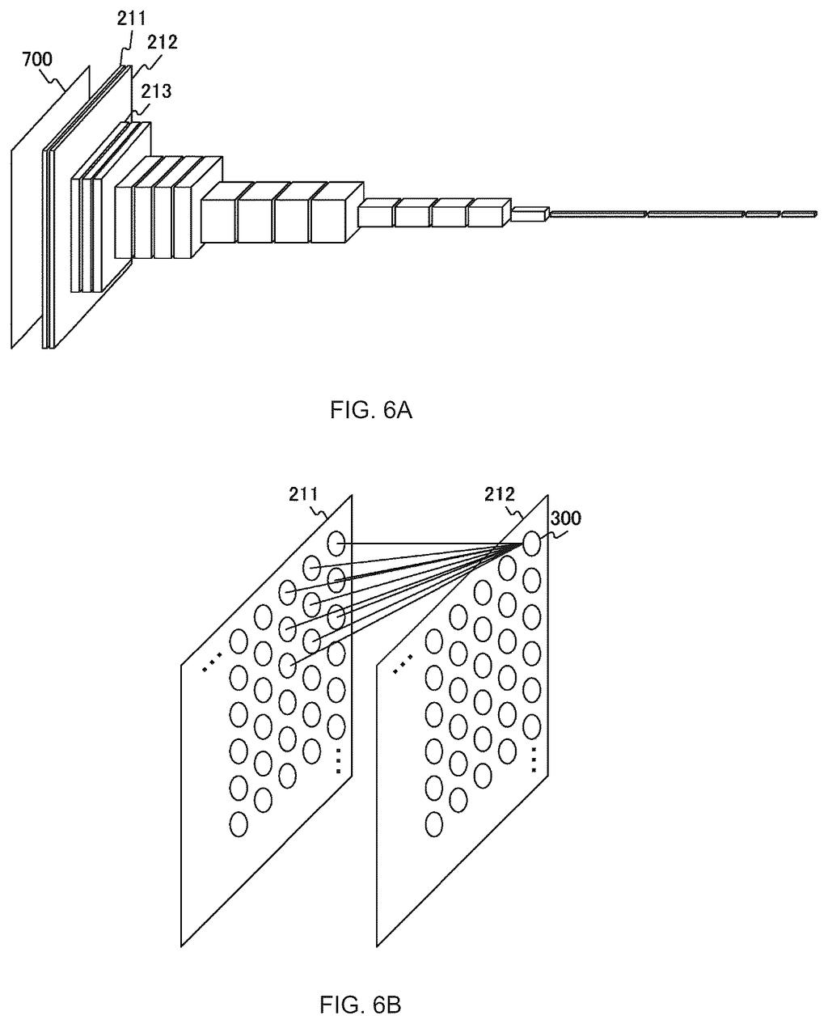
The invention centers on a simple detector: a small neural network (circuitry loosely modeled on brain cells) that watches the camera feed and answers one basic question, such as whether a person is in view. Its last layer has a fixed number of output-side neurons, eight in the filing's example, each standing for one possible answer. Every tick (about 1 millisecond in the example) each one produces a reading.
Because the network is built to stay quiet and save power, many readings are zero, so picking a winner at one instant often goes wrong. A statistic calculation unit fixes this by collecting each neuron's readings across a longer frame period and boiling them down to one number: the largest value, the sum, or the average. A standard scoring step (softmax, which turns raw scores into a pick) then produces the detection result.
From there, the rest of the system takes over:
- A rule selection unit wakes a detail detector that counts people, finds where they are, or recognizes a specific individual.
- An evaluator judges what people are doing and can log it or send an alert.
- The image sensor can change its output or resolution based on what the lookout found.
The filing also describes a neuron with a limiter and feedback loop, a window length that adjusts on the fly, and optional sound or vibration sensors as a backup check.
Why battery-powered cameras and cars care
Cameras that never switch off have a power problem. A doorbell, a home camera or a car sensor can't run its full image analysis around the clock, so a cheap lookout has to do the watching. If that lookout makes more mistakes as it gets thriftier, you lose either battery life or accuracy. Sony's approach tries to keep both, and the filing says it avoids long waits for an answer.
The filing's own example of where this could go is vehicle cameras that spot pedestrians and obstacles. It also describes security-style uses like logging a specific person's visit. For you, the payoff would show up as battery-powered cameras that last longer between charges and cry wolf less often. No product is named in the filing.
Sony's 15th filing we've tracked in AI vision since May adds to a run that includes one catching AI sharpening errors and one reading viewer emotions.
Claim 1 is short and wide. It asks for a camera device with a detector that has a set number of output units, each producing a reading at every tick, plus a part that boils those readings down to one number per unit over a longer window. It never says which number (the description lists the biggest value, the sum or the average), how long the window is, or that the neurons must be spiking ones. Those narrower details show up in later claims.
If granted as written, that breadth would reach any camera product built with that arrangement, whatever window length or arithmetic it picked. Summarizing readings over a short window is a familiar move in data work, so the interest sits in applying it to a camera's always-on lookout.
One separate claim covers a different invention: a neuron circuit with a limiter and a feedback loop. The verdict: a modest, practical fix with a generous claim wrapped around it.
Get our take in your Top Stories
Liked this breakdown? Add Patentlyze as a preferred source on Google, and our plain-English take shows up more often in your Top Stories the next time Sony patent news breaks.
There are more where this came from
We read every patent application Big Tech publishes and send you the ones worth knowing. Plain English, free, every week.
The drawings
27 drawing sheets from US 2026/0320992 A1 · click any drawing to enlarge


Show the other 19 sheets


Want this weekly breakdown for a company we don't cover? Patentlyze Pro →
Be the first to weigh in