
Sony
Sony · AI / ML · Filed Sep 9, 2025 · USPTO published Oct 1, 2026 · Oct 1 release
Sony Patents a System That Reads Your Emotions to Change What's Playing
Sony is working on a way for your TV, smart home, or entertainment system to read your emotional state in real time and automatically adjust what it's doing, using a type of camera that captures the tiniest flickers of facial movement.
- Publication number
- US 2026/0299676 A1(US20260299676A1)
- Applicant
- Sony Group Corporation
- Filed · Published
- Sep 9, 2025 · Oct 1, 2026
- Inventors
- Shan LIN, Piergiorgio SARTOR, Diederik Paul MOEYS
- Status when we published
- Examiner raised objections; the company can respond
- Document
- 18 claims
- US classification
- 345/156
- Examiner
- AU, SCOTT D (Art Unit 2624)
- Parent application
- National Stage Entry of PCT/EP2024/057058 (filed Mar 15, 2024)(PCTEP2024057058)
What Sony's emotion-sensing service adjustment actually does
Imagine you're watching a movie and you're clearly not into it, your expression has gone flat, your attention has drifted. What if your TV noticed before you even reached for the remote?
Sony's patent describes a system that uses a special type of camera called an event-based sensor to watch for emotional cues in real time. Unlike a regular camera that takes frames like a flipbook, this sensor only captures the parts of a scene that actually change, so it can pick up tiny, fast facial movements that a normal camera would miss. The system analyzes those movements to figure out your emotional state.
Once it has a read on how you're feeling, it adjusts whatever service you're using: maybe the music changes, the lighting shifts, or the content recommendation queue updates. The patent covers not just humans but also robots, vehicles, and smart home systems as potential users of this loop.
… capturing optical event data of the human using an event-based sensor; analyzing the optical event data to detect predefined emotional patterns; determining information on an emotional state of the human …
Translation: A specialized camera watches you to figure out what kind of mood you are currently in.
How the event-based sensor detects emotional patterns
At the center of this patent is an event-based sensor, sometimes called a neuromorphic or dynamic vision sensor. Instead of capturing a full image 30 times per second the way your phone camera does, it only records pixels that change in brightness at the exact moment they change. This makes it extremely fast and low-power, and well-suited to tracking the subtle, rapid facial micro-expressions that signal emotions like surprise, discomfort, or boredom.
The system analyzes the stream of optical event data coming off that sensor and looks for predefined emotional patterns (essentially templates of what certain emotional states look like in this kind of data). When it matches a pattern, it builds a picture of the person's current emotional state.
That emotional-state information then feeds into a service-adjustment layer. The patent deliberately leaves "service" broad:
- Entertainment systems (what's playing, volume, content type)
- Smart home systems (lighting, temperature, ambience)
- Vehicles and robots (behavior or interaction style)
The claim doesn't specify exactly how the adjustment is made or what algorithm classifies the emotions, which keeps the scope of the patent wide but also means the system could be implemented many different ways.
… adjusting a service consumed by a human, a robot, a vehicle, an entertainment system and a smart home system.
Translation: The technology can change how your entertainment system or smart appliances behave based on your feelings.
What this means for Sony TVs and smart home gear
For everyday Sony products, think PlayStation, Bravia TVs, or Sony's smart speaker lineup: this is a path toward devices that adapt to you rather than waiting for you to tap a button. If the system works well enough, it could make content discovery feel less like filing paperwork and more like having something that simply knows when you want something different.
The broader claim structure, covering robots, vehicles, and smart homes alongside individual humans, suggests Sony sees this sensor-plus-emotion loop as a platform ingredient rather than a one-product trick. Sony keeps filing on sensor-based human-computer interaction, and this filing fits that pattern: the same core technology could surface in multiple product lines under different branding.
Sony's 13th filing in the AI vision work we've tracked since May adds to a run that includes one cutting subjects from photos and one learning many tasks at once.
Source: US 2026/0299676 A1 at the USPTO (PDF). Full patent text and figures are in the official publication.
Get our take in your Top Stories
Liked this breakdown? Add Patentlyze as a preferred source on Google, and our plain-English take shows up more often in your Top Stories the next time Sony patent news breaks.
Add Patentlyze on Google
One click.
There are more where this came from
We read the new patents from Big Tech, carmakers and more and send you the ones worth knowing. Plain English, free, every week.
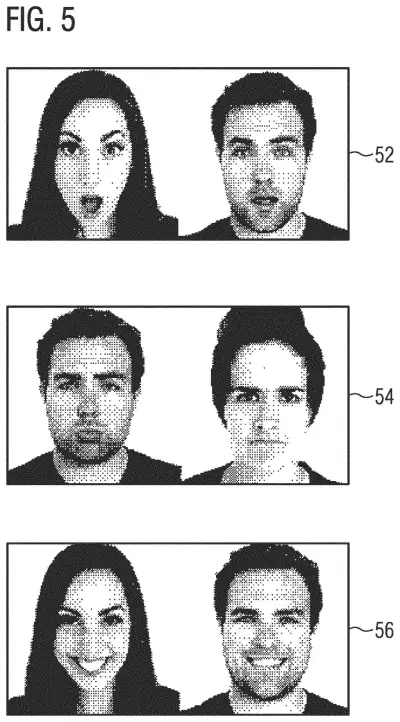
The drawings · 12 sheets
12 drawing sheets from US 2026/0299676 A1 · click any drawing to enlarge


Show the other 4 sheets


More from Sony
All 722 Sony patents →
More in AI vision
All 351 AI vision patents →
Samsung
Samsung Patents an AI Photo Eraser That Reshapes Its Own Selection Before Filling In the Background
Qualcomm
Qualcomm Patents a Way to Stop AI From Wasting Time on Still Video Frames
Samsung
Samsung Patents a Video Repair System That Uses Distance Sensing to Fill Missing Frames
Samsung
No comments yet