
Samsung Patents Stretchy Material That Keeps Electronic Circuits Working When Bent
Most semiconductors crack when you bend them. Samsung is patenting a polymer-based alternative that can stretch, opening the door to electronics that conform to curved or moving surfaces.
What Samsung's stretchable transistor material actually does
Imagine trying to sew a circuit board into a shirt. Traditional chips are rigid and brittle, so the moment fabric flexes, connections break. The workaround researchers have chased for years is building transistors from specially designed plastics, called organic semiconductors, that can bend and even stretch without losing their electrical properties.
Samsung's patent covers a new version of this kind of plastic, engineered at the molecular level with a specific repeating chemical structure. The goal is a material that conducts electricity reliably while also being physically flexible enough for panels that wrap around surfaces or move with the body.
In plain terms, Samsung is trying to make the transistors inside a screen or sensor panel out of something closer to a rubbery plastic than a brittle silicon chip. If it works at production scale, it's the kind of ingredient that could eventually show up in foldable displays, health-monitoring patches worn on skin, or any device where rigid electronics are a problem.
How the polymer's chemical structure enables flexible circuits
The patent describes a specific organic semiconductor polymer, which is a long repeating chain of carbon-based molecules engineered to carry electrical current. Unlike silicon, which is mined and sliced into rigid wafers, these polymers can in principle be deposited as thin films onto flexible or elastic surfaces.
The claimed molecule has a precisely defined repeating unit with four adjustable side chains (labeled R1 through R8 in the patent). Those side chains control how the polymer dissolves, how it packs together at the molecular level, and ultimately how well it conducts electricity. The core of the structure also includes atoms drawn from sulfur, selenium, or tellurium (the X1 through X4 positions), which are known to improve how efficiently electrons move through organic materials.
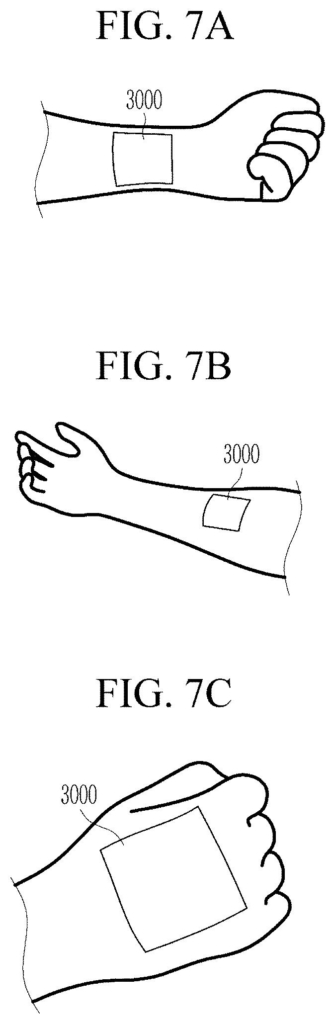
The practical output is an organic thin-film transistor (OTFT), which is the basic switching element in any display or sensor array. Samsung's filing also references a stretchable panel as a target application, meaning a screen or sensor grid that can physically deform without the transistors failing.
- Tunable side chains for processing and performance control
- Chalcogen atoms (S, Se, Te) to boost charge-carrier mobility
- Thin-film deposition suited to flexible substrates
- Target applications: stretchable panels and wearable electronic devices
What this means for wearables and bendable displays
For consumers, the clearest payoff would be in wearable health sensors and next-generation foldable or rollable displays. Devices that need to flex repeatedly, like a screen that wraps around a wrist or a patch that monitors heart rate on moving skin, currently rely on engineering tricks to protect rigid chips from stress. A genuinely stretchable transistor material would remove that constraint by design.
For Samsung specifically, this sits at the intersection of two areas the company has invested in publicly: flexible display panels (it already ships foldable phones) and wearable health technology. Developing the semiconductor material in-house, rather than sourcing it, would give Samsung more control over the performance and cost of future stretchable-display products.
This is deep materials science, not a product announcement, and the gap between a patented polymer structure and a shipping consumer device is measured in years and hundreds of engineering problems. That said, Samsung filing this kind of foundational chemistry patent is a signal that it is working on stretchable electronics at the ingredient level, not just the system level. Worth tracking if you follow flexible display or wearable tech.
There are more where this came from
We read every patent application Big Tech publishes and send you the ones worth knowing. Plain English, free, every week.
The drawings
15 drawing sheets from US 2026/0215146 A1 · click any drawing to enlarge


Want this weekly breakdown for a company we don't cover? Patentlyze Pro →
Be the first to weigh in