
New AI Patent Teaches Models to Transfer Knowledge Across Tasks
Most AI models are trained from scratch for every new task, which is expensive and slow. IBM's new patent describes a training process that lets a model build up general knowledge first, then carry it over to new problems without starting over.
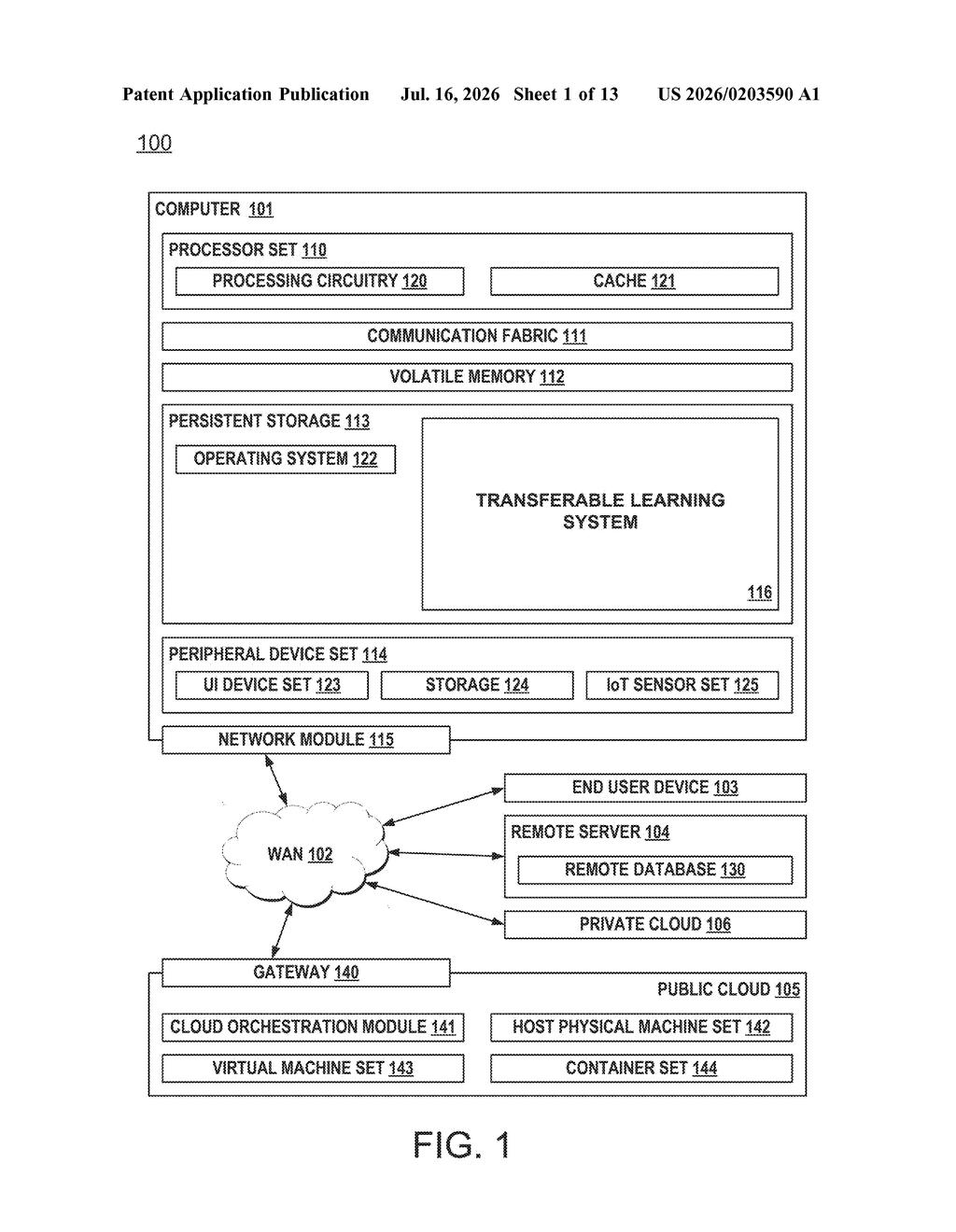
How IBM's mixed-data AI pre-training actually works
Imagine hiring someone who already knows how to read a spreadsheet, spot patterns, and write summaries. You still have to train them on your specific job, but you don't have to teach them the basics from scratch. That's the core idea here.
IBM is patenting a method that pre-trains an AI model using a mix of data you've labeled (examples with known answers) and data you haven't labeled yet (raw examples with no answers attached). The model learns general-purpose representations of that data during this early phase.
Once the pre-training is done, the model's internal knowledge can be picked up and transferred to a new, related task, with much less additional training needed. The goal is to make AI development cheaper and faster, especially in situations where labeled data is scarce.
Inside IBM's three-part encoder-decoder training loop
The patent describes a three-part architecture that works together during pre-training:
- Feature extractor: Processes both labeled and unlabeled data to pull out meaningful signals, the structural patterns in the data that are useful for prediction.
- Feature encoder: Compresses those extracted signals into dense numerical summaries called embeddings (think of them as compact fingerprints of each data point).
- Decoder: Takes those embeddings and tries to reconstruct the original features, a self-supervised check that forces the encoder to preserve useful information.
- Prediction head: Uses the same embeddings to generate actual task predictions, like classifying a record or estimating a value.
All three components are trained simultaneously, and their internal parameters (the numerical weights that define what the model has learned) are updated together. The result is a pre-trained model that has absorbed generalizable structure from the data.
The meta-learning angle (learning how to learn) is that this pre-trained model is explicitly designed to be transferable. It can be fine-tuned on a new dataset with minimal additional effort, rather than rebuilt from the ground up.
What this means for the cost of building AI systems
Labeled data is expensive. Every labeled example in a training set typically requires a human expert to verify or annotate it, which can cost real money and time. A system that learns efficiently from a combination of labeled and unlabeled data directly reduces that cost, and a model that transfers well to new tasks reduces it further.
For IBM, which sells AI infrastructure and AutoML tools to enterprise clients, this kind of transferable pre-training is practically relevant. If your customers are constantly spinning up new AI models for different business problems, a more efficient pre-training pipeline could be a real selling point. Whether this specific approach makes it into a shipping product is another question, but the direction is clear.
This is solid, incremental AI research from IBM's machine learning group, covering a well-established area (semi-supervised pre-training with transfer) rather than anything surprising. It's not a headline-grabbing idea, but the specific combination of a shared encoder trained simultaneously against a reconstruction loss and a prediction loss is a credible engineering approach to a real problem. Worth noting for anyone following IBM's AI tooling strategy, but don't expect a press release.
There are more where this came from
We read every patent application Big Tech publishes and send you the ones worth knowing. Plain English, free, every week.
Want this weekly breakdown for a company we don't cover? Patentlyze Pro →