
Samsung Patents Earbuds That Change What You Hear Based on Which Camera You're Using
Samsung is working on earbuds that pay attention to which camera on your phone is running, then automatically adjust how much of the outside world you can hear. It's a surprisingly practical idea hiding inside a dense patent.
How Samsung's camera-aware audio mixing actually works
Imagine you're wearing wireless earbuds and you switch your phone to selfie mode to record a quick video. Right now, your earbuds have no idea what your phone is doing. Samsung wants to change that.
The patent describes a system where your phone and earbuds work together to decide what audio you should hear at any given moment. If the earbuds pick up your own voice coming through from the other person's end (say, an echo during a call), the phone strips that out and uses it to clean up what the microphone captures. If there's no voice involved, the phone checks which camera is active and adjusts the audio mix accordingly, boosting ambient sound when you're filming your surroundings, for example.
In plain terms: your earbuds would automatically get louder or quieter about the world around you depending on what your phone's camera is pointed at and whether you're talking to someone.
How the phone blends mic audio with earbud signals
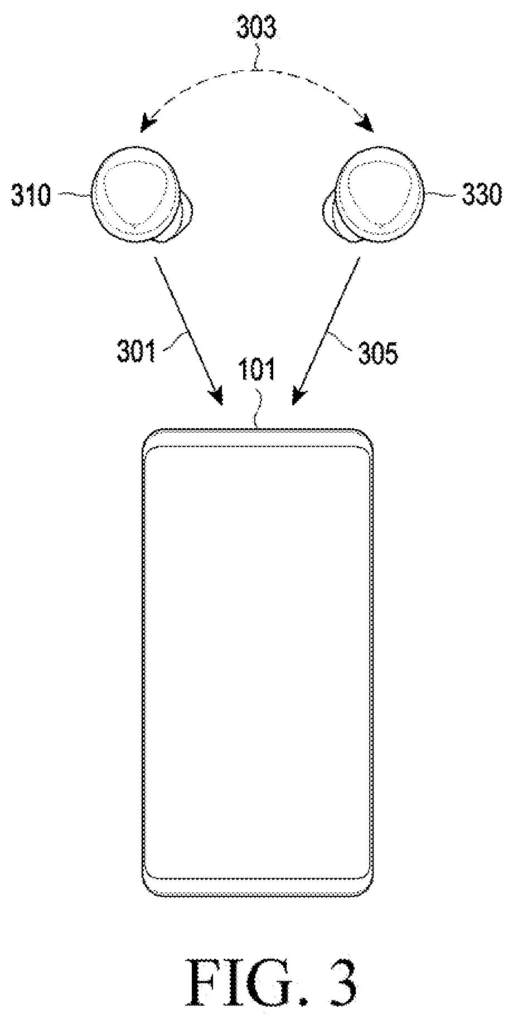
The patent describes a phone (called the "electronic device") that communicates with a pair of TWS earbuds (True Wireless Stereo, the kind with no wire connecting the two buds). The system uses two separate audio streams:
- First audio signal: audio coming in from the earbuds themselves, which may contain the user's own voice picked up by the earbuds' mics.
- Second audio signal: audio captured by the phone's own microphone, which picks up the surrounding environment.
The processor checks whether the user's voice is present in the earbud audio stream. If it is, the system extracts that voice signal and uses it to modify what the phone mic captures, essentially syncing the two audio sources. Think of it as cleaning up an echo by telling the phone "this is what the person's voice actually sounds like."
If the user's voice is not detected in the earbud stream, the system then looks at camera state. If the front camera is running (selfie or video call mode), it adjusts audio weighting one way. If the rear camera is running (filming the world), it emphasizes ambient sound differently. The patent doesn't spell out exactly which direction each camera triggers, leaving room for implementation choices.
What this means for Galaxy Buds and video calls
For anyone who uses Galaxy Buds during video calls or while shooting content on their phone, this kind of automatic audio adjustment could reduce the manual fiddling with transparency modes and volume settings that most people just ignore. The camera-as-context idea is particularly interesting: your phone already knows whether you're looking at yourself or the world, so using that signal to shape what you hear is a logical extension of ambient sound controls that already exist on premium earbuds.
This also hints at tighter integration between Samsung's phone hardware and its audio accessories. Right now, Galaxy Buds and Galaxy phones share some features via the Galaxy Wearable app, but audio mixing decisions are largely made on the earbuds themselves. This patent would shift some of that intelligence to the phone, where it has more context about what the user is actually doing.
This is a modest but genuinely useful idea. The camera-state trick is clever because the phone already has that information and using it to shape audio requires no extra hardware. Whether Samsung ships this as a meaningful feature or buries it in a settings menu nobody opens is the real question, but the underlying logic is sound.
Get our take in your Top Stories
Liked this breakdown? Add Patentlyze as a preferred source on Google, and our plain-English take shows up more often in your Top Stories the next time Samsung patent news breaks.
There are more where this came from
We read every patent application Big Tech publishes and send you the ones worth knowing. Plain English, free, every week.
The drawings
9 drawing sheets from US 2026/0212876 A1 · click any drawing to enlarge


Show the other 1 sheets

Want this weekly breakdown for a company we don't cover? Patentlyze Pro →