
Zoox Patents a System That Fixes Radar Speed Errors for Self-Driving Cars
Radar is a self-driving car's first line of defense against collisions, but it has a well-known blind spot: speed measurements can come back ambiguous or wrong. Zoox has filed a patent for a system that catches and corrects those errors before they reach the car's decision-making brain.
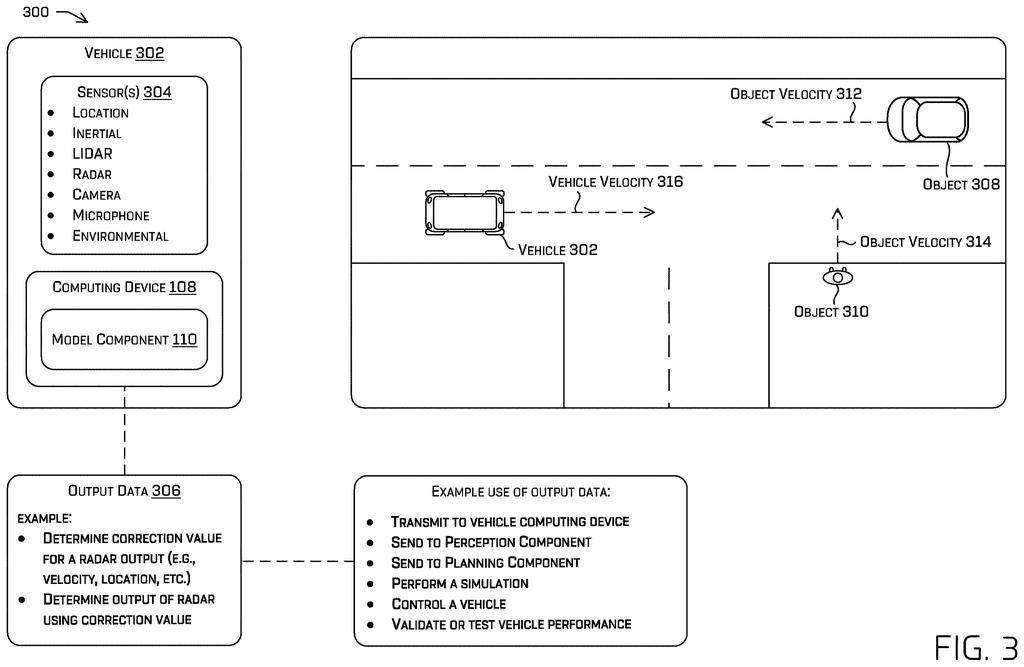
How Zoox's radar correction helps a car track moving objects
You're riding in a self-driving taxi and a cyclist cuts across the intersection ahead. The car's radar picks up the cyclist, but the speed reading comes back garbled. The car needs to know, right now, whether that person is moving at 5 mph or 25 mph before it decides to brake.
That's the problem Zoox is trying to solve. Radar devices measure speed using something called the Doppler effect (the same principle that makes a passing ambulance sound higher-pitched as it approaches). But the math can produce multiple plausible answers at once, and the system has to pick the right one. Zoox's patent describes a model that looks at the raw radar data, narrows down the possible speed values, and picks the most likely correct one.
The corrected speed then feeds into the vehicle's broader planning system, which uses it to predict where every nearby object will be in the next few seconds. Get the speed wrong and the car might brake too late or swerve unnecessarily. Get it right and the ride stays smooth and safe.
… determining, based at least in part on the Doppler interval information, a modification to the initial velocity estimate of the object; and determining, based at least in part on the modification, a refined velocity of the object …
Translation: The system tweaks the initial speed estimate using Doppler data to calculate a much more accurate final speed.
How the model picks the right Doppler correction value
Radar measures an object's speed by detecting how the frequency of a reflected radio wave shifts as the object moves closer or farther away. This is Doppler velocity. The catch is that radar systems have a limited measurement range, and any speed outside that range wraps around and produces an ambiguous reading. Engineers call this Doppler ambiguity, and it means the sensor might report one speed when the real speed is actually several multiples higher or lower.
Zoox's system addresses this with a model that does three things in sequence:
- It takes in the raw radar data and identifies a Doppler interval, essentially the range of possible correction amounts that could turn the ambiguous reading into a true speed.
- It generates a set of candidate correction values within that interval, each representing a different possible true speed.
- It selects the most plausible candidate and applies it to produce a refined velocity estimate.
The refined estimate is then handed off to the vehicle computing device, the onboard system that predicts the future positions of pedestrians, cyclists, and other cars and decides how the vehicle should respond. The patent's independent claim frames this as a general computation pipeline, leaving room for the selection model to be a learned neural network or a rule-based filter.
The object velocity can be used by a vehicle computing device for predicting vehicle actions to control a vehicle.
Translation: The autonomous car uses this corrected speed to predict what is happening and steer itself safely.
What better speed readings mean for passenger safety
For passengers, the payoff is straightforward: a car that knows how fast things are moving around it can plan earlier and brake more smoothly. The failure mode this prevents is not dramatic crashes in clear weather but the subtler, harder-to-reproduce cases where an object's speed was misread and the car either hesitated or reacted to something that wasn't really a threat.
Zoox operates a fully driverless robotaxi service, so there is no human backup to catch sensor errors. Every layer of perception has to be right on its own. A radar pipeline that actively corrects its own speed estimates is a quiet but important part of making that work at scale, especially in dense urban environments where fast-moving cyclists and scooters are common.
That makes this Amazon's 25th filing we've tracked since May in our self-driving sensing race watchlist, after Zoox applications on scoring polite lane changes and matching driving to plain-English descriptions.
Doppler ambiguity, in plain terms, means a radar system can mistake how fast a nearby object is moving, which leads to a car that hesitates, brakes unexpectedly, or misjudges a fast-moving vehicle nearby. Amazon's patent describes a way to catch and correct those mistakes before they affect how the car behaves.
You would almost certainly never notice it working. You would notice it failing, in the form of a sudden lurch, a phantom brake, or a car that seems slow to read what is happening around it.
That asymmetry is the whole argument for why this matters. The filing is narrow and focused on one specific failure mode, but fixing low-level perception errors like this one is what separates a ride that feels confident from one that feels like it is guessing.
There are more where this came from
We read every patent application Big Tech publishes and send you the ones worth knowing. Plain English, free, every week.
The drawings
7 drawing sheets from US 2026/0276806 A1 · click any drawing to enlarge


Want this weekly breakdown for a company we don't cover? Patentlyze Pro →
Be the first to weigh in