
Google's New Patent Hides Smart Glasses Wiring Inside the Lens Itself
Google has a patent for smart glasses that ditch the internal wires running through the frame — and instead route electrical signals directly through a thin conductive trace printed onto the lens itself. It's a surprisingly elegant solution to one of wearables' most persistent engineering headaches.
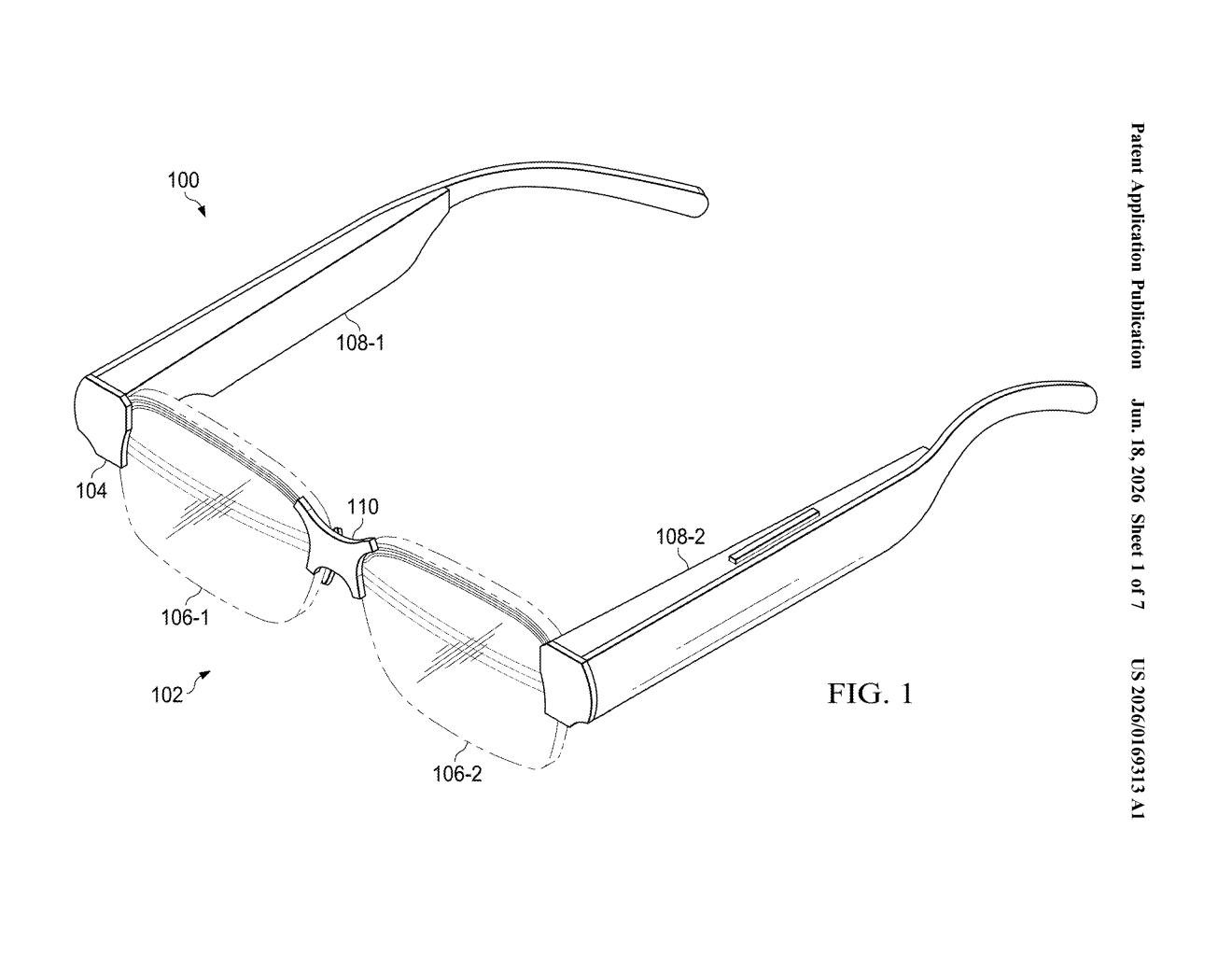
What Google's lens-as-wire glasses design actually does
Imagine a pair of regular-looking glasses where one temple (the arm that hooks over your ear) holds a battery and a chip, and the other temple holds a speaker or sensor. Today, those two sides need to communicate — and that means running a wire through the frame, which adds bulk, weight, and failure points.
Google's patent describes a different approach: instead of threading a wire through the frame, it prints a hair-thin conductive trace directly onto the surface of the lens. The trace is the wire. It runs from one side of the frame, across the lens, to the other side — carrying electrical signals along the way.
The result is a pair of glasses that can carry power and data between its components without any extra wiring hidden in the frame. That means the frame itself can be thinner, lighter, and simpler — which is exactly what you want in glasses you're going to wear all day.
How conductive traces turn a lens into a signal pathway
The patent describes an eyewear frame split into at least two main structural pieces — typically the two temples (the arms) and the bridge (the part that sits on your nose). One of those pieces houses an electrical component like a battery, processor, or radio.
Rather than running a wire through the frame body to connect components on opposite sides, Google proposes laying a conductive trace — essentially a printed metal pathway, similar to the kind used on circuit boards — directly on the surface of the optical lens. That trace runs from one side of the lens to the other, bridging the two frame components electrically.
The patent covers a few key configurations:
- Temple-to-temple (left arm to right arm, across the lenses)
- Temple-to-bridge (one arm to the nose piece)
- Multiple traces on a single lens, or traces on both lenses
The traces are described as sitting at the surface of the optical element, which suggests they could be embedded in a coating layer — potentially thin enough to remain invisible to the wearer. The lens still functions optically; the trace is an added electrical layer, not a replacement for the optics.
What this means for the next generation of smart glasses
Smart glasses have always had a weight and bulk problem. Fitting a battery, speakers, cameras, and a processor into a frame that still looks like normal eyewear means every millimeter counts. Routing wires through the frame takes up space and adds weight — and the hinges and joints where wires bend are also common failure points.
By turning the lens into a conductor, Google could make the frame itself much simpler — fewer internal channels, thinner arms, lighter overall weight. This kind of engineering refinement is often what separates a prototype that people tolerate from a product people actually wear every day. Google's existing smart glasses projects, including those developed under its broader hardware push, have consistently struggled with the weight-versus-functionality trade-off. This patent is a direct attack on that problem.
This is the kind of quiet, structural engineering work that actually determines whether a wearable lives or dies in the market. It doesn't add a flashy new feature — it removes a constraint. If Google can make smart glasses that feel like regular glasses by simplifying the frame with lens-embedded wiring, that's a meaningful step toward a product people might actually wear.
There are more where this came from
We read every patent application Big Tech publishes and send you the ones worth knowing. Plain English, free, every week.
Want this weekly breakdown for a company we don't cover? Patentlyze Pro →