
Sony Patent Uses Event-Based Sensors to Sharpen Imaging of Fast-Moving Cells
Photographing a single cell rushing through a laser beam is surprisingly hard. Sony thinks a type of sensor borrowed from high-speed robotics cameras can fix that.
How Sony's cell scanner corrects for timing errors
Imagine trying to photograph a marble rolling past at high speed using a regular camera. You'd almost certainly get blur. Now shrink that marble down to a single blood cell, and you start to understand the problem labs face every day when they analyze biological samples.
Sony's patent describes a system that shines light on individual biological particles (cells, for example) and captures how those particles react to the light. Instead of a normal camera that takes full-picture snapshots, it uses a special sensor that only records changes in brightness, pixel by pixel, the moment they happen. That makes it far better at keeping up with fast-moving particles.
The clever part: because the timing of those brightness changes can drift slightly, the system automatically tries several small timing corrections, builds a separate image for each one, and then picks the sharpest result. It's a bit like bracketing shots in photography, but applied to time rather than exposure. The winner becomes the data used to identify or classify the cell.
How the system picks the sharpest image from timed corrections
The system has five main components working in sequence:
- Irradiation unit: A light source (likely a laser) that illuminates biological particles flowing through the system, causing them to emit or scatter light.
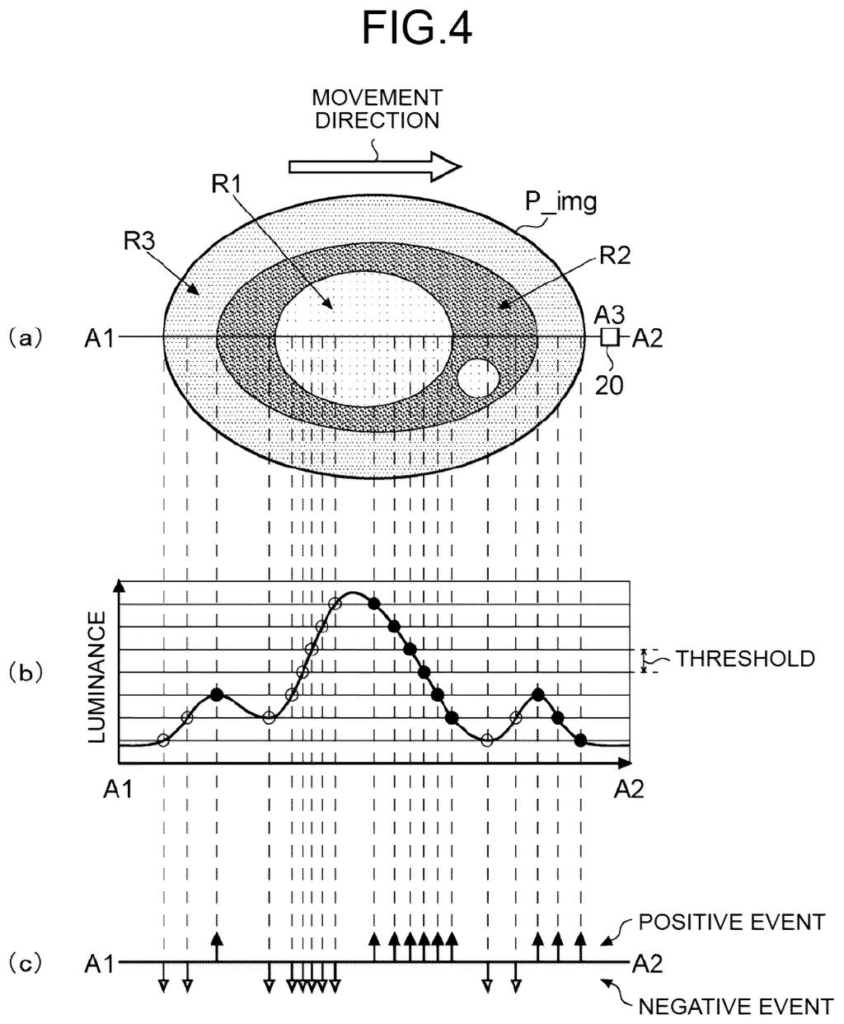
- Event-based detector: An array of pixels arranged in a grid. Unlike conventional image sensors that capture all pixels at once at a fixed frame rate, each pixel here fires independently the instant it sees a change in brightness. This is called an event camera or dynamic vision sensor. Each triggered pixel logs its location and the exact timestamp of the change.
- Generation unit: Takes the raw stream of timestamped pixel events and applies multiple small time corrections to some of them. For each correction amount, it reconstructs a full image of the particle. This compensates for timing mismatches that can occur when a particle moves slightly faster or slower than expected through the beam.
- Evaluation unit: Scores each reconstructed image for quality, likely looking for sharpness or coherence.
- Processing unit: Uses the top-scoring image to extract meaningful biological information about the particle, such as its size, surface markers, or fluorescence profile.
The core insight is that event cameras produce data tied to time, so a small timing error produces a blurry reconstruction. Trying many corrections and picking the best one acts as an automatic focus mechanism operating in the time domain.
What this means for flow cytometry and lab diagnostics
This kind of system is directly relevant to flow cytometry, a standard lab technique that identifies and counts cells by passing them one at a time through a laser. Conventional cameras struggle with the speed involved, which can limit how precisely cells are classified. An event-based sensor that self-corrects its own timing errors could produce sharper cell images without slowing the sample stream down.
For patients, faster and more precise cell analysis means quicker diagnostic turnaround times for things like cancer screening or immune cell counts. For labs, it could reduce the need to slow sample flow rates just to get a clean image. Sony already makes image sensors used widely in medical and scientific equipment, so this is a natural extension of that business.
This is a genuinely interesting application of event-camera technology, which has mostly lived in robotics and autonomous vehicles, being pulled into life-science instrumentation. Sony's sensor business gives it a real path to commercializing this. The time-correction bracketing approach is clever and practical rather than flashy.
There are more where this came from
We read every patent application Big Tech publishes and send you the ones worth knowing. Plain English, free, every week.
The drawings
15 drawing sheets from US 2026/0210833 A1 · click any drawing to enlarge


Want this weekly breakdown for a company we don't cover? Patentlyze Pro →