
Samsung's New Patent Gives Red, Green, and Blue Pixels Their Own Resting Voltage
Every pixel on your screen sits at a resting voltage between frames — and Samsung thinks setting a different resting point for red, green, and blue pixels could make displays noticeably more efficient.
What Samsung's per-color idle voltage actually does
Imagine your screen like a city of tiny colored lights — red, green, and blue dots that switch on and off millions of times per second. Between those switches, each dot sits at a quiet "idle" state, waiting for its next instruction. That waiting state requires a small holding voltage, and right now most displays use the same holding voltage for every color.
Samsung's patent describes a system that figures out the right idle voltage for each color separately, adjusting based on how bright the overall screen is at any given moment. Red pixels might need a slightly different resting point than blue ones to work most efficiently.
The practical goal is to waste less energy during those idle moments — which, across millions of pixels refreshing constantly, can add up to real-world power savings. It's the kind of low-level tuning that doesn't come with a flashy feature name but can quietly extend battery life or reduce heat in a phone or tablet.
How the park voltage determiner picks each color's value
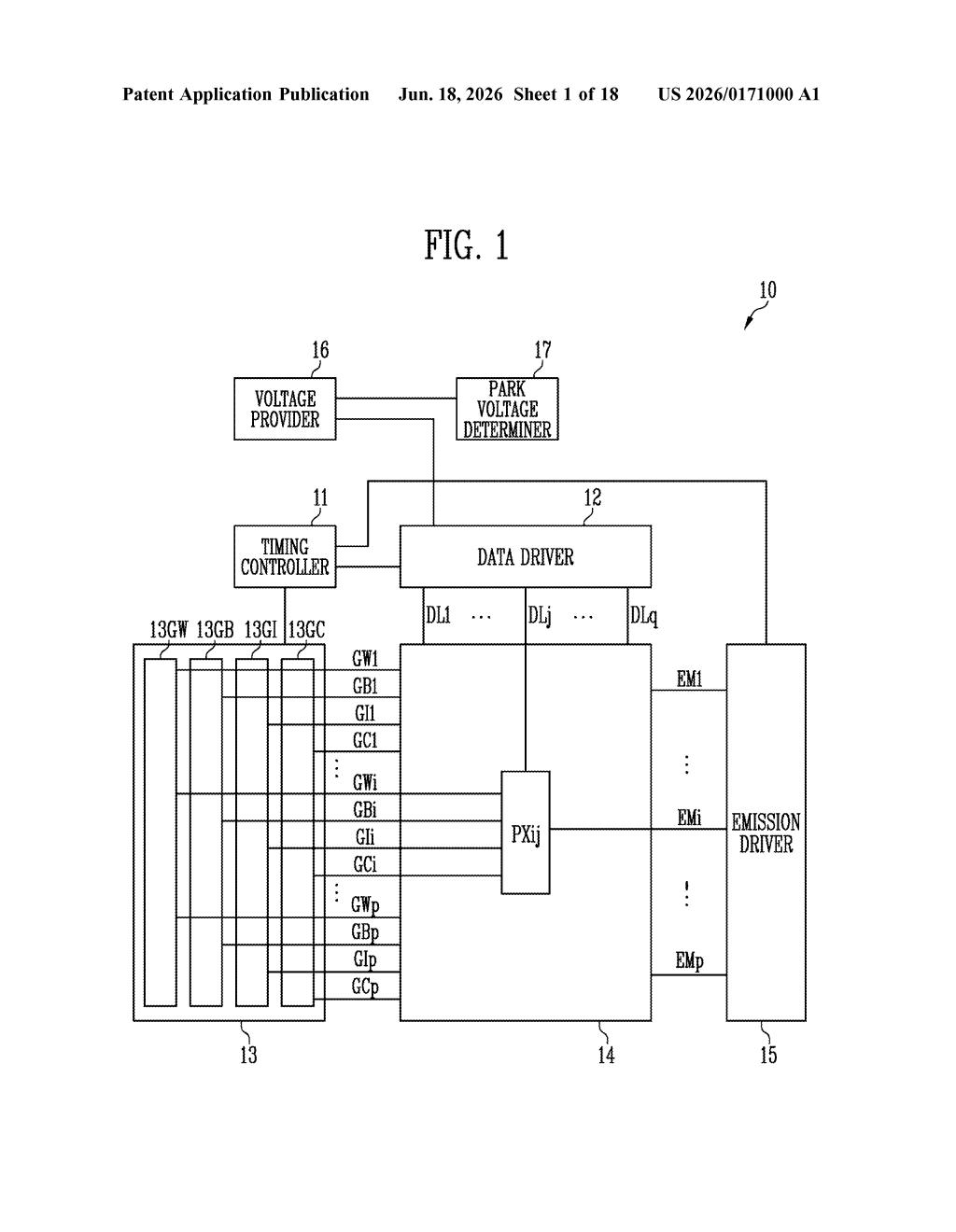
The patent describes a display system with four main components working together:
- Pixel unit: the grid of red, green, and blue sub-pixels connected to data lines (the wires that deliver voltage commands).
- Data driver: the chip that decides whether to send a real image voltage or a "park voltage" — the idle holding voltage — to each data line.
- Voltage provider: the circuit that actually generates and supplies the park voltage.
- Park voltage determiner: the new piece — a logic block that independently calculates the correct park voltage for each color channel based on the screen's current brightness level.
The key word is independently. Today's displays typically apply one uniform park voltage across all colors. This system lets the red channel, green channel, and blue channel each get a tailored idle voltage that's appropriate for their specific pixel characteristics and for whatever brightness the display is running at that moment.
The brightness input matters because pixels behave differently at low brightness versus high brightness — the optimal resting point shifts, and a fixed park voltage becomes a compromise rather than a precise setting.
What this means for OLED power efficiency in Samsung screens
For Samsung Display — which supplies OLED panels to Samsung phones, tablets, and many other brands — this kind of low-level efficiency tuning matters a lot. Park voltage is applied to data lines constantly, even when pixels aren't actively changing, so getting it wrong (even slightly) means wasted current multiplied across every pixel, every refresh cycle, all day long.
For you as a user, this type of improvement doesn't show up as a new feature in a spec sheet. It shows up as slightly better battery life or a display that runs a little cooler under sustained use. Given how much screen-on time drives battery drain in modern devices, incremental efficiency gains at the display hardware level are genuinely worth pursuing.
This is a real engineering problem with a real proposed solution — display idle voltages are legitimately worth optimizing, and the per-color approach is logical given that red, green, and blue OLED materials have different electrical characteristics. That said, this is deep infrastructure work unlikely to produce anything a consumer would ever notice directly. It's the kind of patent that matters to display engineers, not to anyone buying a phone.
There are more where this came from
We read every patent application Big Tech publishes and send you the ones worth knowing. Plain English, free, every week.
Want this weekly breakdown for a company we don't cover? Patentlyze Pro →