
AMD Patents a System That Learns Film Grain From Photos and Copies It Exactly
Film grain is one of those things that's easy to feel but surprisingly hard to fake. AMD has filed a patent for a system that studies real grain from reference images and teaches itself to reproduce it — mathematically.
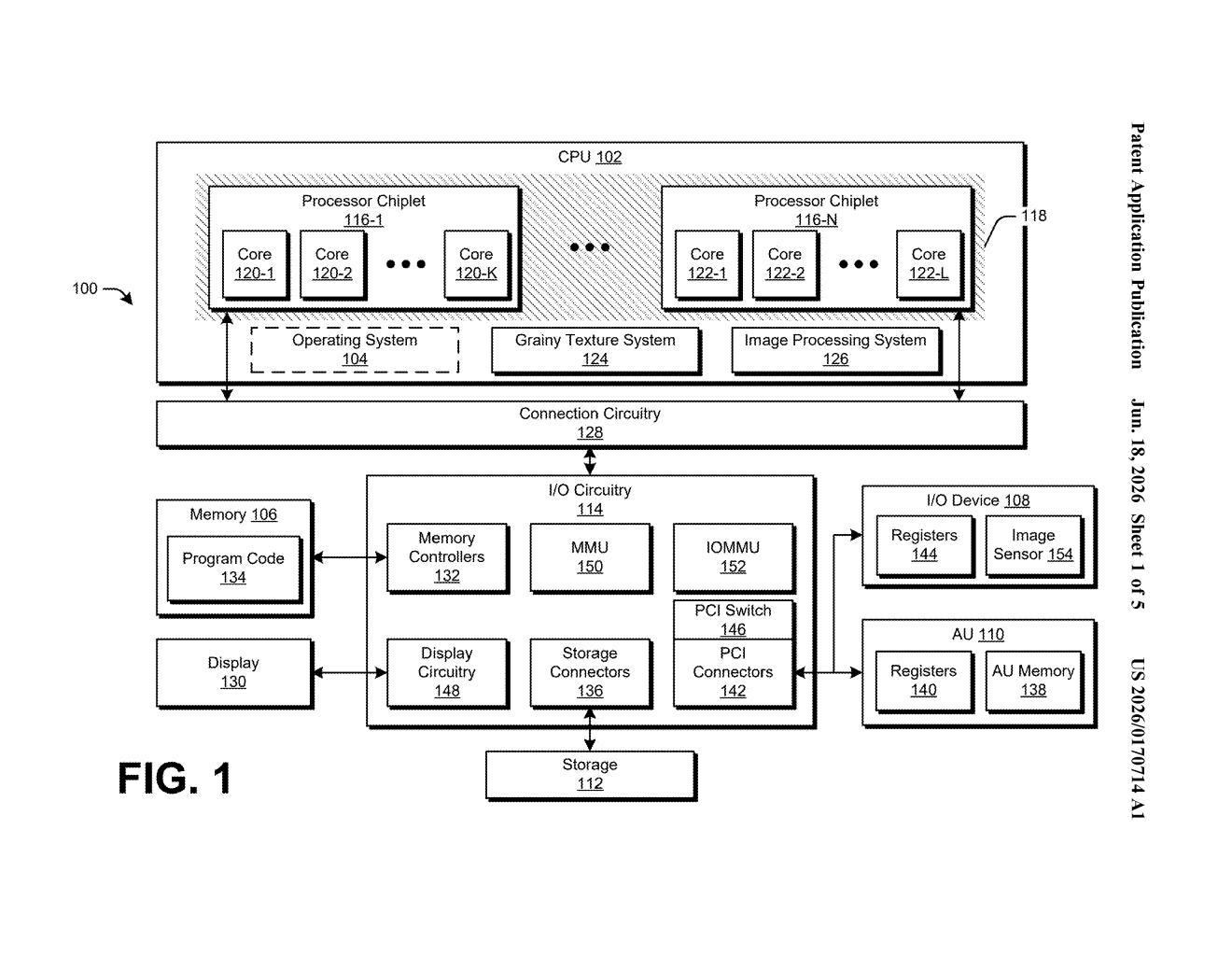
What AMD's film grain learning system actually does
You know that subtle, slightly rough texture you see in old photographs or certain films? That's grain, and it's not random noise — it has a specific character. Some grain is coarse and punchy; other grain is fine and soft. Getting it to look right in a digital image is harder than it sounds.
AMD's patent describes a system that looks at a set of reference images containing the grain style you want, studies how that grain behaves across different brightness levels, and distills all of that into a handful of numbers — what the patent calls grainy texture parameters. Those numbers can then be applied to any image to give it that same grain character.
The clever part is that the system separates two things that are usually tangled together: how grainy an image looks at different frequencies (think: fine detail vs. coarse clumps), and how the grain changes depending on whether a part of the image is dark or bright. Controlling those two things independently means you can dial in a very specific look without unintended side effects.
How the frequency-domain grain analysis works
The system starts by pulling a set of training images that already have the target grain style. It then finds flat regions in those images — areas with little real detail, like a plain wall or an overcast sky — because those regions isolate the grain signal from the underlying image content.
In those flat regions, it computes a power spectral density (essentially a map of how much energy exists at each spatial frequency — think of it like a sound equalizer, but for visual texture instead of audio). That frequency map becomes the target spectrum.
From there, the system calculates gain values for a set of pre-defined grain bases — building-block grain patterns at different scales. Those gain values are then broken into two separate controls:
- Band power values — how strong the grain is at each spatial frequency (coarse vs. fine texture)
- Brightness power values — how the grain intensity scales with luminance (dark areas vs. bright areas)
Together, those values form the grainy texture parameters that can be stored and applied to generate new images with the same grain fingerprint as the original training set.
What this means for games, video, and image rendering
Film grain is having a serious moment. Game developers, streaming platforms, and image post-processing pipelines all use grain — either to add cinematic feel, hide compression artifacts, or match a specific aesthetic. Right now, adding convincing grain is largely a manual, artist-driven process or relies on pre-baked textures. A data-driven system that can learn a grain style from samples and encode it compactly changes that workflow.
For AMD, which makes the GPUs that run many of these rendering pipelines, a built-in grain-learning tool could integrate directly into display processing or game rendering engines. If this ends up in hardware or driver-level post-processing — similar to how Nvidia's DLSS adds sharpening passes — it could mean more consistent, tunable grain applied in real time without extra artist labor.
This is a fairly specialized but genuinely useful patent — the kind of thing that matters a lot to the people who care about it (visual effects artists, game rendering engineers, display tuning teams) and is invisible to everyone else. The separation of frequency content from luminance dependency is the real technical contribution here; most grain tools don't give you that much control without manual tweaking. Worth watching if you follow AMD's GPU software stack.
There are more where this came from
We read every patent application Big Tech publishes and send you the ones worth knowing. Plain English, free, every week.
Want this weekly breakdown for a company we don't cover? Patentlyze Pro →