
Apple Patents a System That Tailors 3D Video to Your Eye Spacing
Everyone's eyes are a slightly different distance apart, and that gap matters a lot when you're watching 3D video. Apple is patenting a way to serve each viewer a version of a 3D film tuned specifically to their own eye spacing.
What Apple's eye-spacing 3D video fix actually does
Imagine watching a 3D movie where every object looks perfectly placed in space, right at the right depth, because the video was adjusted specifically for your eyes. That's the goal here.
The distance between your pupils (called interpupillary distance, or IPD) affects how your brain perceives depth. A 3D video filmed with cameras set a certain distance apart may look fine to one person and uncomfortable or flat to another. Apple's patent describes a system where a streaming service stores multiple versions of the same 3D video, each recalculated for a different eye spacing.
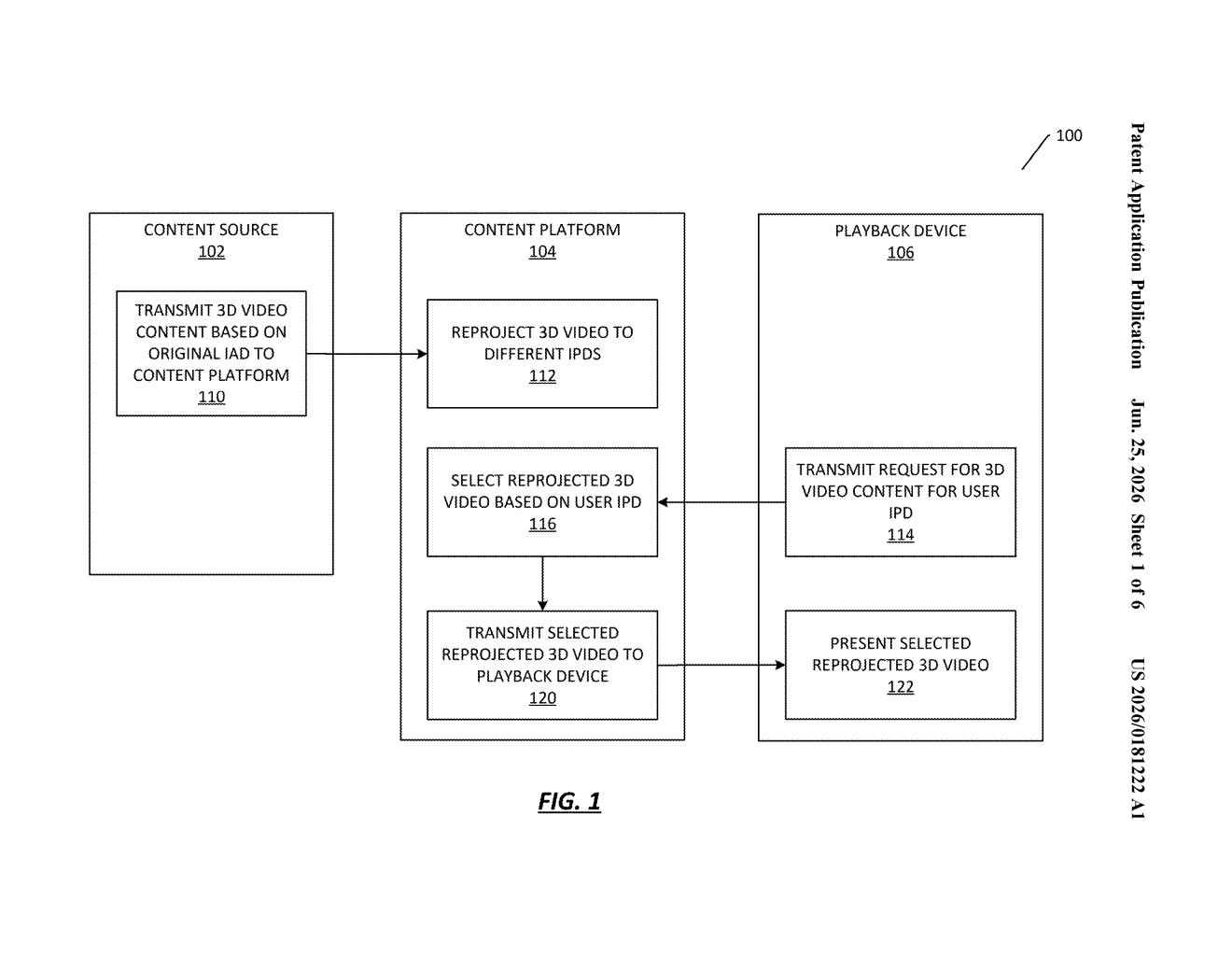
When you put on a headset like Vision Pro and hit play, the device tells the streaming service your preferred eye spacing. The service then sends back the version of the video matched to you, rather than a one-size-fits-all stream. It's a bit like how music streaming can serve different audio quality levels, but for 3D depth instead of bitrate.
How the headset requests and receives a personalized 3D stream
The patent describes a pipeline with two parts: a server side that pre-generates multiple versions of a 3D video, and a client side (the headset) that requests the right one.
On the server, a 3D media item captured at one interaxial distance (the physical gap between the two camera lenses that recorded it) is reprojected at several other interpupillary distances. Reprojection means mathematically shifting the left- and right-eye views relative to each other and to a reference depth plane, so the perceived 3D geometry matches a different eye spacing. The server stores all these versions alongside the original.
On the headset side, when playback is requested, the device:
- Reads the user's preferred or measured interpupillary distance
- Sends that value as part of a request to the media service
- Receives back the pre-rendered version that most closely matches that measurement
The claim is specifically written for a head-mounted device (HMD), meaning the personalization happens at request time rather than being baked into a generic stream. This avoids real-time rendering on-device, which would be computationally expensive, by doing the heavy reprojection work ahead of time on the server.
What this means for comfort and depth on Vision Pro
3D headsets like Apple Vision Pro already let users physically adjust the lenses for their eye spacing, but the video content itself is usually filmed at a fixed camera separation. When your eyes are significantly closer together or farther apart than the cameras were, depth can feel wrong or even cause eye strain. A personalized stream fixes that at the content level, not just the hardware level.
For Apple, this matters commercially too. If Vision Pro is going to compete as a serious video platform, 3D content needs to feel comfortable for a wide range of viewers. Serving custom streams per user is the kind of infrastructure investment that signals Apple is thinking about 3D video as a long-term product, not a demo feature.
This is a genuinely practical patent for spatial video on Vision Pro. Eye-spacing variation is a real physiological problem for 3D viewing, and pre-generating server-side streams is a smart tradeoff between quality and on-device compute cost. It's not flashy, but it's the kind of infrastructure detail that separates a headset people actually enjoy from one they return after a week of headaches.
There are more where this came from
We read every patent application Big Tech publishes and send you the ones worth knowing. Plain English, free, every week.
Want this weekly breakdown for a company we don't cover? Patentlyze Pro →