
Microsoft Patent Targets Response Delays by Shifting AI Resources Before Demand Spikes
When you send an AI model a picture instead of a text prompt, the computing resources it needs change dramatically. Microsoft has patented a system that anticipates those shifts before they happen and moves processing power around automatically.
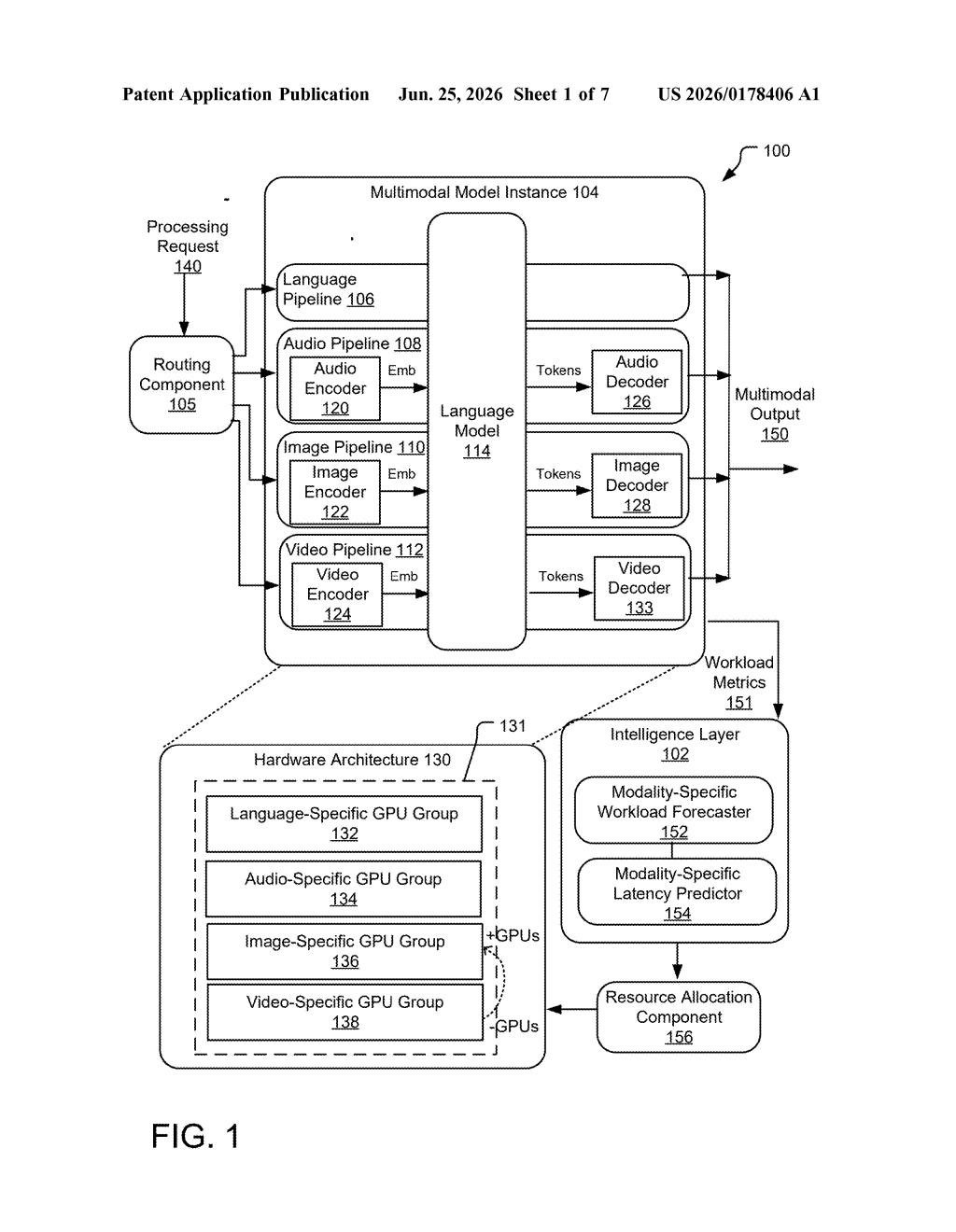
How Microsoft's AI platform predicts its own workload
Imagine a restaurant kitchen where some cooks specialize in hot food and others in cold dishes. If a sudden wave of dessert orders comes in, the kitchen manager needs to reassign people fast, or customers wait. AI platforms face the same problem: they handle text, images, audio, and video through separate processing pipelines, and demand for each one can spike unpredictably.
Microsoft's patent describes a cloud AI platform that watches how much of each type of work is flowing through at any given moment, then uses that history to predict what's coming next. If image processing is about to get busy, the system starts moving computing resources toward that pipeline before the slowdown hits.
The goal is simpler than it sounds: keep response times short even when the mix of requests changes, and avoid wasting computing power sitting idle on a pipeline that's currently quiet. It's essentially a traffic-management system built into the AI service itself.
How the intelligence layer forecasts and reallocates resources
The patent describes a model-as-a-service (MaaS) platform, which is a cloud setup where an AI model runs continuously and serves many customers at once. The model in question is multimodal, meaning it handles multiple types of input: text, images, audio, video, and so on.
Each input type runs through its own dedicated processing pipeline, backed by a reserved pool of compute hardware (think GPU clusters). The problem is that demand for each pipeline fluctuates independently throughout the day.
The system's key component is an intelligence layer that does three things:
- Tracks token utilization per modality over time (tokens are the small units AI models process; more tokens means more work)
- Generates a workload prediction expressed as time-series distributions, essentially a forecast of how busy each pipeline will be in the near future
- Converts that workload forecast into a latency prediction (a prediction of how slow each pipeline will get if resources stay where they are)
A resource allocation component then acts on those predictions, dynamically shifting computing resources between pipelines before latency actually degrades. The reallocation is driven by predicted need, not a reaction to slowdowns that have already occurred.
What this means for AI cloud costs and response times
For anyone using a cloud AI service, response speed is everything. If the platform serving your app slows down because image requests suddenly spiked while your text pipeline sat half-idle, that's a real problem. This patent describes infrastructure designed to prevent that kind of imbalance automatically, without manual intervention.
From a cost perspective, the same logic works in reverse: resources sitting unused on a quiet pipeline are waste. Shifting them toward busier pipelines means the same hardware does more useful work. For Microsoft's Azure AI services, which compete directly with Amazon and Google, that efficiency argument is also a pricing argument. The more efficiently the platform runs, the more margin there is to compete on price or performance.
This is infrastructure plumbing, not a flashy product announcement, but it's the kind of patent that actually ships and makes a measurable difference. Multimodal AI workloads are genuinely hard to balance because image and audio tokens are computationally heavier than text tokens and arrive in bursts. A predictive allocation system that acts ahead of the slowdown is a real operational improvement, and it fits squarely into Microsoft's Azure AI Services roadmap.
There are more where this came from
We read every patent application Big Tech publishes and send you the ones worth knowing. Plain English, free, every week.
Want this weekly breakdown for a company we don't cover? Patentlyze Pro →