
Microsoft Patent Enables Multiple AI Models to Collaborate Within a Single Notebook
Microsoft is patenting a way to bake AI prompts directly into notebook files, so non-programmers can change a data analysis or chart simply by editing plain-English instructions, without ever touching the underlying code.
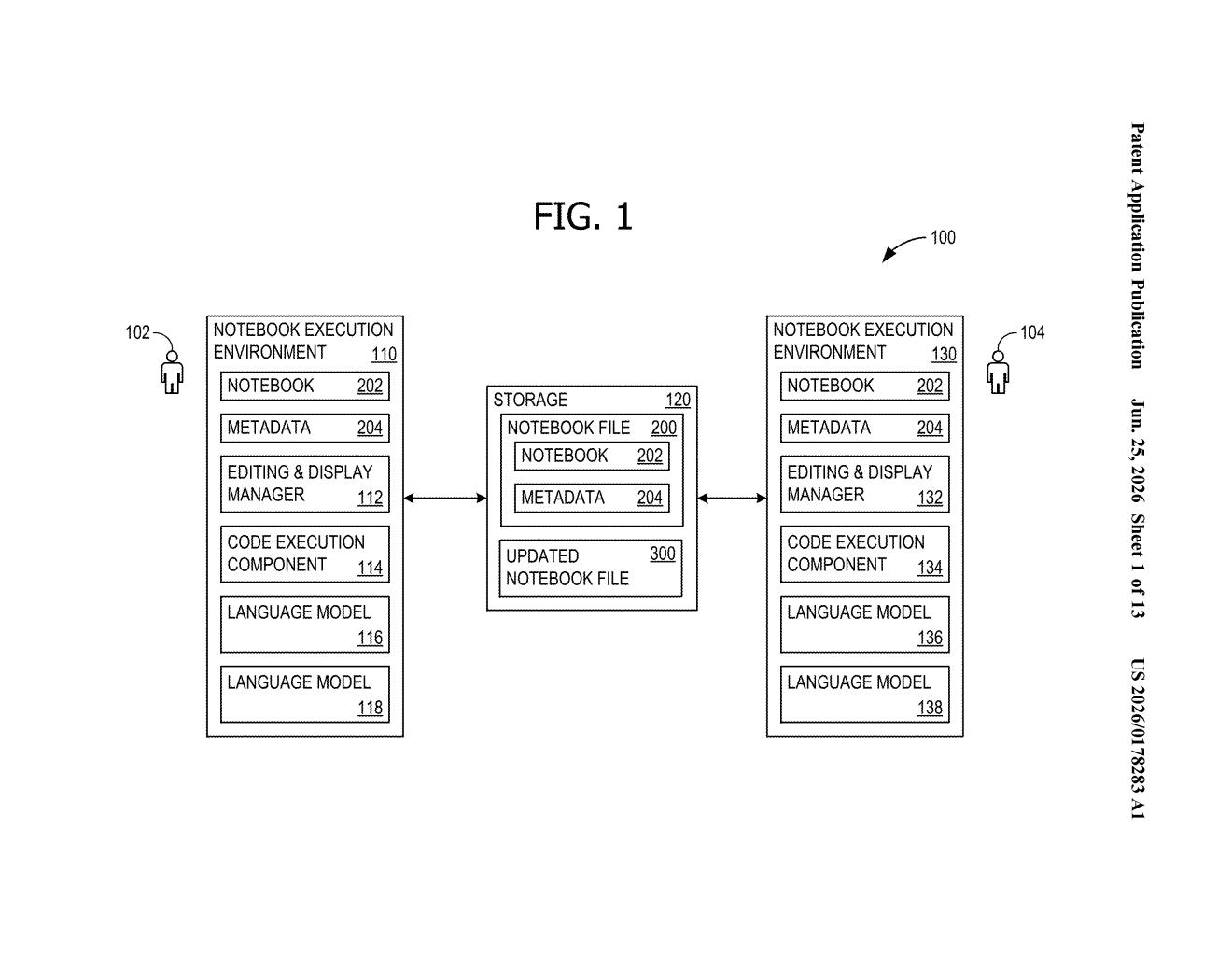
What Microsoft's AI notebook layer actually does
Imagine a colleague sends you a data report built in a Jupyter-style notebook. You want to change a chart, but the only way to do that today is to edit the Python code that generated it. If you're not a developer, you're stuck.
Microsoft's patent describes a new kind of notebook where the AI prompts that created the code are saved right alongside it, as a distinct layer in the file. A reviewer can just rewrite the plain-English prompt and let the AI regenerate the code automatically. No programming required.
The system also lets multiple AI models work together inside the same notebook: one model might write the data-processing code, while another generates images or classifies results. The output from one model can even feed directly into the next model's prompt, creating a simple assembly line of AI tasks inside a single shareable file.
How the prompt cell layer chains AI models together
The patent describes a notebook system (think Jupyter or Observable notebooks) that adds a formal prompt cell layer alongside the existing cell types (markdown text, code, and output). When a user writes a plain-English prompt in a prompt cell, the system passes it to a designated language model (an AI like a code-generation assistant), which produces a code cell. That code cell is then executed to produce an output.
Critically, the prompt is saved inside the notebook file itself, not discarded after the code is generated. This means the full chain from human intent to AI-generated code to result is preserved and portable.
The patent also specifies that:
- Different language models can handle different cells (one for code generation, one for image generation or classification)
- The output of one model's cell can be included in the prompt sent to a different model, enabling chained AI workflows
- The notebook file remains editable across different notebook execution environments, meaning the format is not locked to one platform
This cross-environment compatibility is called out explicitly in the first claim: a notebook saved in one environment must be further editable in a second, different environment.
What this means for non-coders reviewing data work
Today, AI coding assistants generate code and then effectively disappear from the document. The prompt is gone, and all a reviewer sees is opaque code. Microsoft's approach treats the prompt as a first-class artifact of the notebook, which changes who can realistically review and modify AI-assisted work. A project manager or domain expert can adjust outcomes without a developer as an intermediary.
For Microsoft, this fits squarely into its broader push to embed Copilot-style AI across its productivity and developer tools. Fabric, Azure notebooks, and VS Code are all plausible homes for this kind of feature. The multi-model chaining aspect is particularly interesting: it hints at a future where notebooks orchestrate several specialized AI models the way a spreadsheet formula chains functions.
This is a genuinely useful idea rather than an abstract AI patent. The core insight, that AI prompts should be saved as a persistent, editable layer in the document rather than thrown away after code generation, solves a real collaboration problem in data science and research workflows. The multi-model chaining piece is the more ambitious part, and whether that ships in a practical form depends on how well Microsoft can surface it in tools people already use.
There are more where this came from
We read every patent application Big Tech publishes and send you the ones worth knowing. Plain English, free, every week.
Want this weekly breakdown for a company we don't cover? Patentlyze Pro →