
Samsung Patents an AI That Adjusts Its Own Settings to Model Molecular Behavior
Training an AI to predict how atoms behave is expensive and finicky. Samsung's new patent describes a system that figures out, on its own, how wide a lens the AI needs to see each atom's neighborhood, and then adjusts that lens mid-training.
What Samsung's molecular simulation AI actually does
Imagine trying to predict whether a bridge will hold by studying each bolt, but you keep having to decide how many neighboring bolts to include in each calculation. Too few and you miss important stress patterns. Too many and the math gets impossibly slow.
That's roughly the problem Samsung is tackling here, but at the atomic scale. Researchers use software called molecular dynamics simulations to model how atoms in materials (like a new semiconductor or battery compound) move and interact. Training an AI to run those simulations requires a setting called a "cutoff radius," which controls how far each atom looks for neighbors when calculating energy and force.
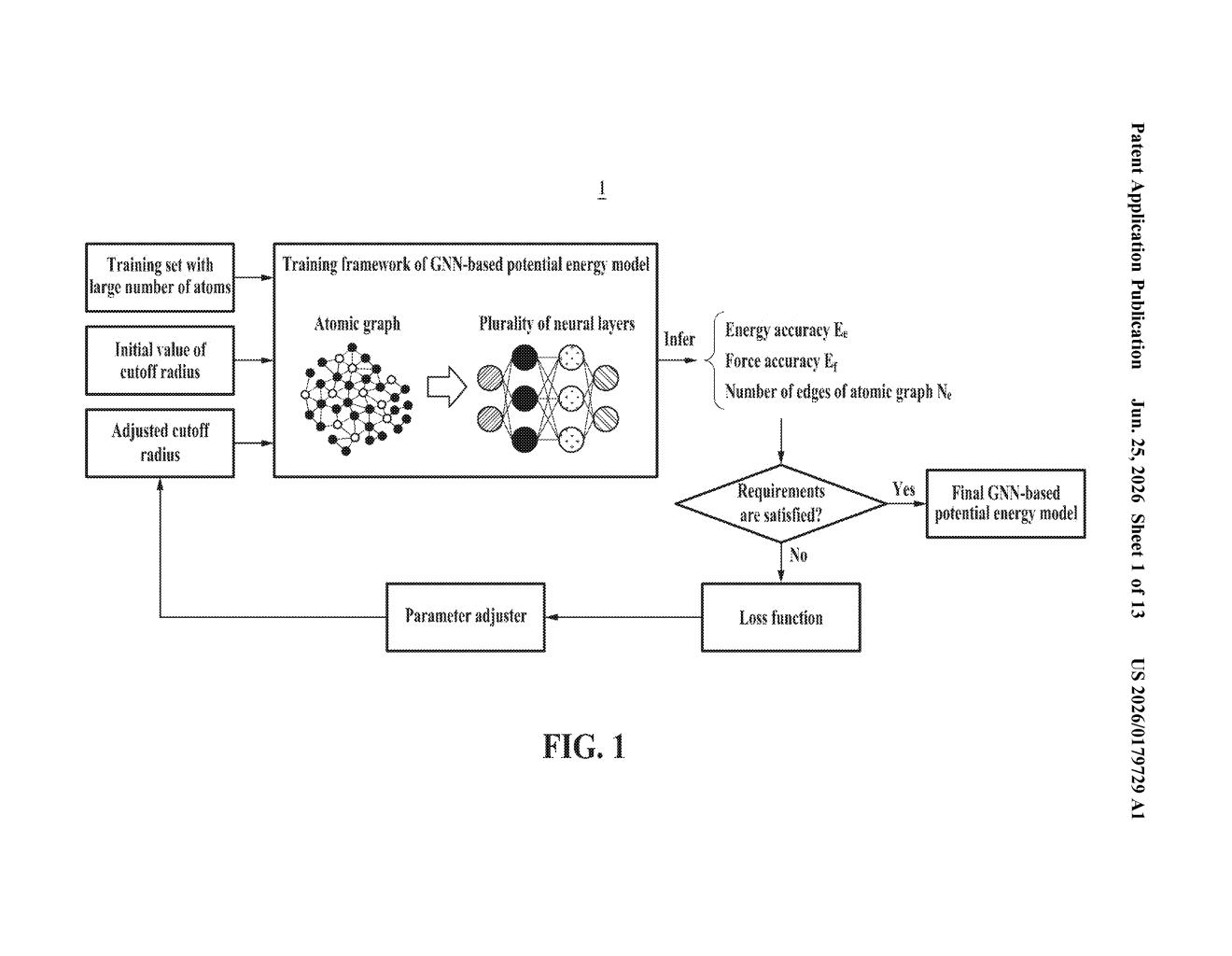
Samsung's patent describes a system that picks the best starting radius automatically by studying the training data, runs an initial training pass, and then uses what the AI learned to set a different, better-tuned radius for the next phase. Instead of a researcher guessing that setting by hand, the system self-corrects as it goes.
How the cutoff radius adjusts between training passes
The patent centers on training a machine learning potential energy model, which is an AI that predicts the energy and forces acting on atoms in a material without running slow traditional physics calculations from scratch.
The key input the system manages is the cutoff radius (think of it as the "attention radius" around each atom: the model only considers neighboring atoms within this distance when computing interactions). Set it too small and the model misses long-range effects. Set it too large and the model becomes computationally heavy.
Here is the sequence the patent describes:
- The system scans the training dataset and picks a key sample, a representative data point that captures the most important structural features of the simulation.
- From that sample, it calculates a first cutoff radius and builds an atomic graph (a network diagram where atoms are nodes and edges represent interactions within that radius).
- It trains the potential energy model using that graph.
- It then runs the trained model, examines the resulting energy and force parameters it predicted, and uses those outputs to derive a second, different cutoff radius for a refined training pass.
The two-phase approach means the model starts with a reasonable radius and then corrects itself based on actual physics outputs rather than a static human-chosen value.
What this means for chip design and materials research
Molecular dynamics simulations are central to materials science and semiconductor research, exactly the kind of work Samsung does when designing new chip materials, battery chemistries, or thin-film coatings. Today, setting the cutoff radius is a manual, expert-driven step that slows down the research pipeline. A system that automates it could let researchers run more simulation experiments faster and with less hand-tuning.
For the broader field of AI-driven scientific computing, this kind of adaptive training approach, where the model's own outputs inform its next training configuration, is a direction several labs are exploring. Samsung staking out this territory in a patent suggests it is building infrastructure for AI-assisted materials discovery in-house.
This is a narrow but real engineering improvement in a field that matters a lot to Samsung's core semiconductor business. It won't grab consumer headlines, but automating one of the most tedious expert-judgment steps in molecular simulation training is genuinely useful work. The self-adjusting radius idea is clean and the patent is specific enough to be credible.
There are more where this came from
We read every patent application Big Tech publishes and send you the ones worth knowing. Plain English, free, every week.
Want this weekly breakdown for a company we don't cover? Patentlyze Pro →