
Sony Patents a Camera That Reads Dozens of Colors and Adjusts Its Own Brightness
Most cameras expose a shot by averaging three colors: red, green, and blue. Sony's new patent describes a sensor that does the same job across dozens of distinct color channels simultaneously, and then uses all of that data to decide how long to leave the shutter open.
What Sony's multi-channel exposure system actually does
Imagine trying to photograph a piece of fruit to check if it's ripe inside. A normal camera sees three colors and gives you a pretty picture, but a specialized sensor can pick up ten, twenty, or more distinct bands of light, each revealing something different about what's in the scene. The tricky part is telling the camera how bright or dark things actually are when you have that many channels to account for.
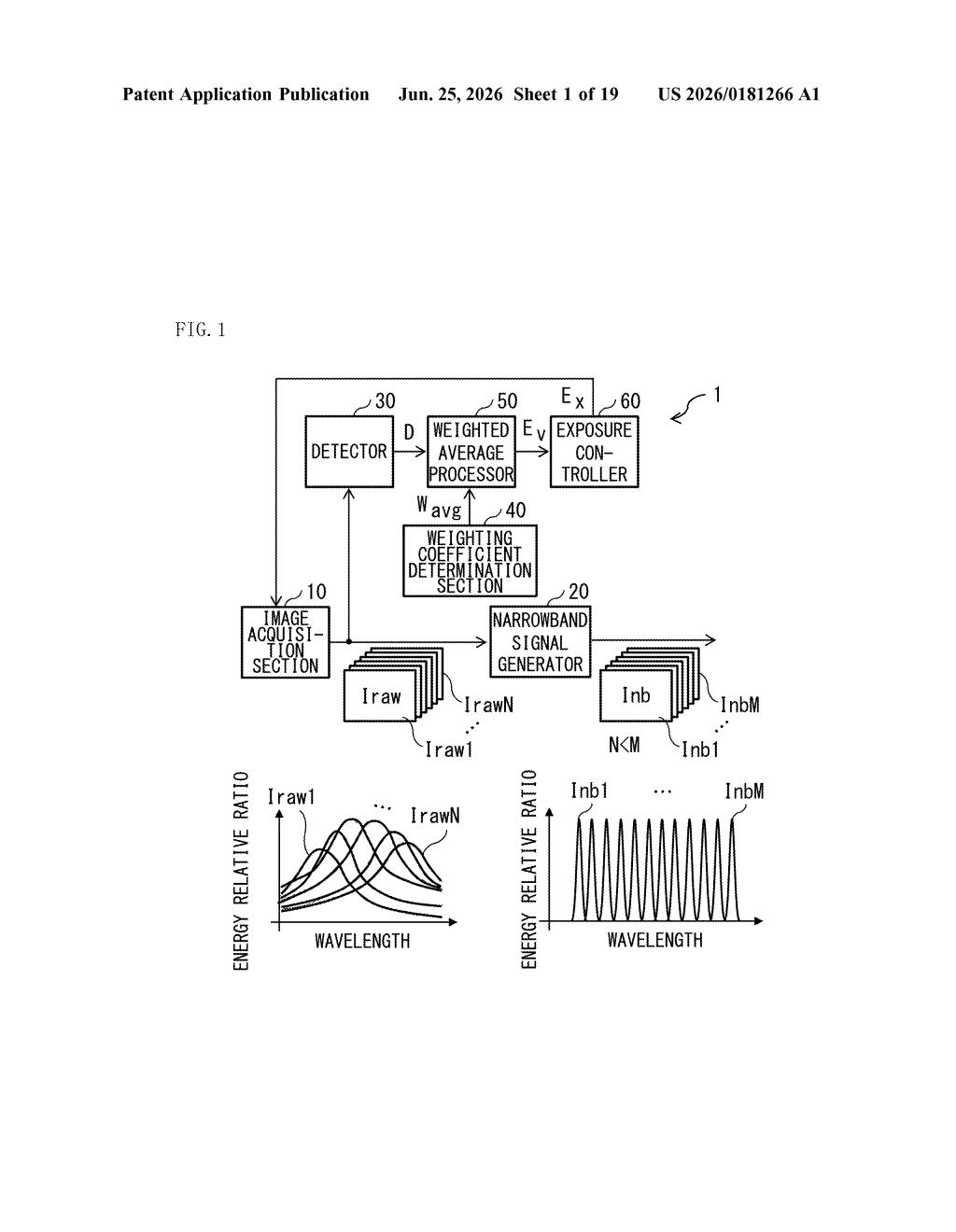
Sony's patent tackles exactly that. The sensor captures signals across multiple wavelength bands. A processing block then mathematically expands those readings into an even larger set of very narrow color slices. A controller takes a weighted average across all of those readings and uses the result to set the exposure, the same way your phone automatically adjusts brightness before you take a photo.
The end result is that the camera can get the exposure right for scientifically precise, multi-color imaging without a human manually dialing in settings for each channel.
How the coefficient matrix expands color channels for exposure math
The patent describes a three-part imaging system:
- Multispectral sensor section: captures N wavelength signals as raw pixel data. Unlike a standard RGB sensor with three color channels, this sensor outputs a larger set of wavelength bands across the visible and potentially near-infrared spectrum.
- Narrowband signal generator: takes those N signals and applies a coefficient matrix (a table of mathematical weights) to derive M narrowband signals, where M is greater than N. This is essentially a linear transform that synthesizes finer, more precise color slices from the broader sensor readings, similar to how an equalizer can extract specific frequency bands from a mixed audio signal.
- Controller: performs weighted average processing on either the raw wavelength signals or derived detection values, calculates an evaluation value (an overall brightness or scene metric), and feeds that back into the sensor's exposure control loop.
The key engineering insight is that standard auto-exposure algorithms are designed for RGB cameras. When you have many more channels, each with different sensitivity and scene relevance, you need a smarter averaging strategy. The weighted average step lets the system prioritize certain wavelength bands over others when deciding how to expose the shot.
What this means for industrial and medical imaging
This kind of sensor is not found in consumer smartphones today. Multispectral cameras show up in industrial inspection lines, agricultural drones, medical endoscopes, and scientific instruments, anywhere that color beyond red-green-blue carries useful information. Getting exposure right in those settings currently requires careful manual calibration or custom firmware.
A self-correcting exposure system built around the full spectral output of the sensor would make these cameras faster to deploy and more reliable in varying lighting conditions. If Sony is building this into a future imaging module, it could lower the bar for companies that want to add multispectral sensing to a product without hiring a team of optical engineers to tune it.
This is a narrow but genuinely useful patent for Sony's semiconductor business, which supplies image sensors to a wide range of industrial and medical device makers. It is not a consumer camera feature, but it solves a real operational headache for anyone deploying multispectral imaging at scale. Worth tracking if you follow industrial vision systems.
There are more where this came from
We read every patent application Big Tech publishes and send you the ones worth knowing. Plain English, free, every week.
Want this weekly breakdown for a company we don't cover? Patentlyze Pro →