
Sony
Sony · Biotech · Filed Apr 25, 2025 · USPTO published Jun 25, 2026 · Jun 25 release
Sony Patents a System That Tracks Environmental Decline by Scanning Plant Root Bacteria
Sony is best known for televisions and PlayStation consoles, but a newly published patent reveals the company is working on technology to assess the health of entire ecosystems by analyzing the microscopic life living on and around plants.
- Publication number
- US 2026/0179110 A1(US20260179110A1)
- Applicant
- Sony Group Corporation
- Filed · Published
- Apr 25, 2025 · Jun 25, 2026
- Inventors
- Tatsuya Kawaoka, Ryota Sakayama, Godai Suzuki, Masatoshi Funabashi
- Status when we published
- Waiting for an examiner
- Document
- 20 claims
- US classification
- 702/19
- Parent application
- National Stage Entry of PCT/JP2023/038248 (filed Oct 24, 2023)(PCTJP2023038248)
How Sony's ecosystem tool uses plant microbes as a health signal
Imagine a forest restoration project where scientists want to know if the ecosystem is actually recovering. You can count the deer and the birds, but the early warning signs often live underground, in the invisible communities of bacteria and fungi wrapped around plant roots.
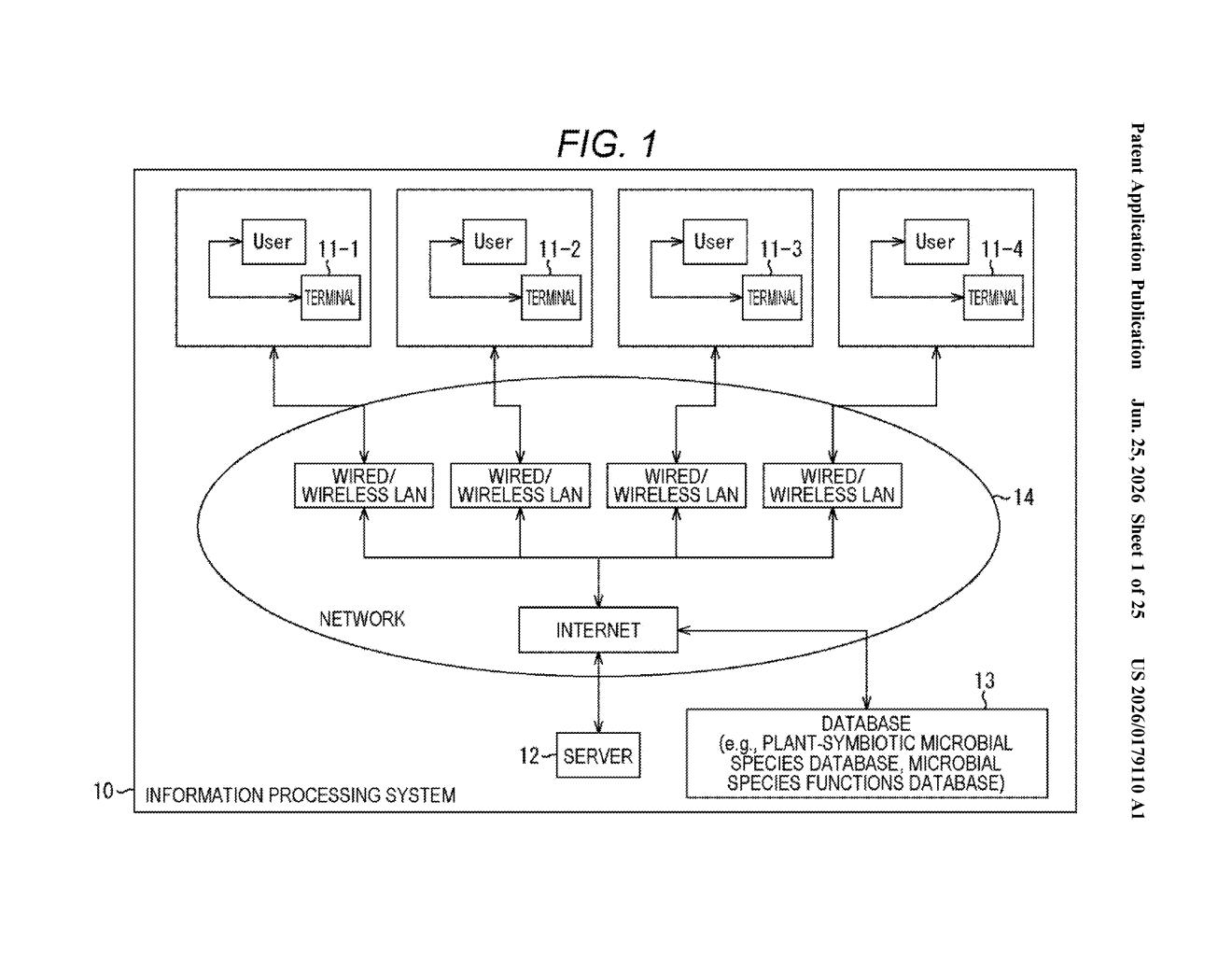
Sony's patent describes an information processing system that does exactly that kind of assessment. It looks at how microbes that live in close partnership with specific plants are interacting with other organisms in the same environment, and uses those interaction patterns to judge the overall state of the ecosystem.
Think of it like checking a patient's gut bacteria to get a picture of their general health, except the patient is a meadow or a wetland. The idea is that the microbial web around plants acts as a sensitive indicator of whether an ecosystem is thriving, stressed, or broken.
How the assessment unit maps microbial interactions to ecosystem state
The core of the patent is an ecosystem assessment unit, a software component that takes in data about biological interactions and outputs a judgment about the state of a given ecosystem.
The key input is the relationship between plant-symbiotic microbial species (bacteria, fungi, and other microbes that live in direct partnership with specific plant species) and the broader community of organisms sharing that environment. These symbiotic microbes are highly sensitive to environmental conditions, making them useful proxies for ecosystem stress.
The system is designed to be applied to what Sony calls an ecosystem assistance system, a platform meant to help engineers or ecologists deliberately construct or restore a desired ecosystem state. The patent does not specify the exact data sources (soil sampling, remote sensing, etc.) but focuses on the computational logic for interpreting interaction data.
- Identifies target plant species in the ecosystem
- Maps the microbial species living symbiotically with those plants
- Analyzes how those microbes interact with other biological species present
- Outputs an assessment of overall ecosystem condition
What this means for environmental monitoring and restoration
Environmental monitoring today often relies on expensive field surveys or satellite imagery that misses fine-grained biological detail. A system that can interpret microbial interaction data computationally could make ecosystem health checks faster and more scalable, useful for reforestation projects, agricultural land management, or conservation planning.
For Sony specifically, this patent sits well outside the company's consumer electronics core, pointing to activity in Sony's research divisions around environmental technology. The patent is early-stage and abstract, covering the concept of the assessment logic rather than a finished product, so practical applications are still some distance away.
Source: US 2026/0179110 A1 at the USPTO (PDF). Full patent text and figures are in the official publication.
Get our take in your Top Stories
Liked this breakdown? Add Patentlyze as a preferred source on Google, and our plain-English take shows up more often in your Top Stories the next time Sony patent news breaks.
Add Patentlyze on Google
One click.
There are more where this came from
We read every patent application Big Tech publishes and send you the ones worth knowing. Plain English, free, every week.
More from Sony
All 707 Sony patents →
More in Biotech
All 24 Biotech patents →
Verily (Google)
Google's Health Arm Patents a Layered Brain Implant That Holds Its Own Layers Together
Verily (Google)
Verily Patents a Contact Lens Case That Knows When You Skip a Wear
Verily (Google)
Verily Life Sciences Patents a Cancer-Detection Method That Reads Your Breath
Sony