
Sony
Sony · Wearable · Filed Oct 17, 2025 · USPTO published Oct 1, 2026 · Oct 1 release
Sony Patents Earbuds That Filter Out Noise from Your Health Readings
Your earbuds already have a microphone and a motion sensor. Sony wants to put both of those to work cleaning up the health data your earbuds collect, because right now that data gets corrupted by sound and movement in ways most people never realize.
- Publication number
- US 2026/0294341 A1(US20260294341A1)
- Applicant
- SONY GROUP CORPORATION
- Filed · Published
- Oct 17, 2025 · Oct 1, 2026
- Inventors
- Mao KATSUHARA, Takanori ISHIKAWA, Yukinojo KITAKAMI, Yota KOMORIYA
- Status when we published
- Waiting for an examiner
- Document
- 20 claims
- US classification
- 600/301
- Parent application
- National Stage Entry of PCT/JP2024/014279 (filed Apr 8, 2024)(PCTJP2024014279)
What Sony's noise-canceling health sensor earbuds actually do
Imagine you're out for a run and your earbuds are trying to measure your heart rate. Every footstrike, every gust of wind, every word you shout to a friend rattles the sensor and muddies the reading. The number you see may be off by more than you'd expect.
Sony's approach, described in this patent, is to use the earbud's existing microphone and motion sensor as a kind of reality check. When those sensors pick up sound or movement, the device uses that information to subtract that noise from the health reading in real time, leaving a cleaner signal behind.
The result is that biological readings, things like heart rate or other body signals captured while you're wearing the earbuds, should be more accurate even when your environment is loud or you're moving around. No extra hardware required, just smarter use of what's already inside the earbud.
A hearable device comprising: a microphone; an inertial sensor; a biological sensor that measures a biological signal of a user; and a noise reduction unit that executes noise reduction of the biological signal using an output signal from at least one of the microphone or the inertial sensor as a reference signal.
Translation: The earbuds use sound and motion sensors to clean up the data coming from your health monitor.
How the earbud cross-references mic and motion data
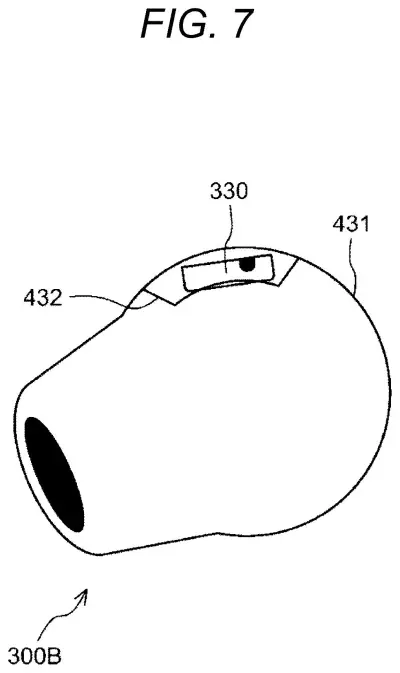
The patent covers a hearable device (the technical term for an earbud or in-ear device with onboard electronics) that combines three sensors: a microphone, an inertial sensor (an accelerometer or gyroscope that detects motion), and a biological sensor that picks up a body signal from the wearer, most likely heart rate or a related measurement.
The core idea is a noise reduction unit, a processing layer that takes the audio and motion data as a reference signal. A reference signal is essentially a recording of the interference, not the thing you want to measure, but the background noise that's corrupting it. By comparing the biological reading against that reference, the system can identify which parts of the reading are real body data and which parts are artifacts caused by ambient sound or physical movement.
This technique is a well-established signal-processing method called adaptive noise cancellation (the same family of tricks used to cancel wind noise in phone calls), applied here to health sensors instead of audio.
- Microphone captures ambient sound that may vibrate or interfere with the sensor
- Inertial sensor captures body movement and vibration from exercise or physical activity
- Noise reduction unit uses both as reference signals to clean the biological reading
What cleaner biometric data means for earbud health features
For anyone using earbuds to track health metrics during exercise, this matters in a direct way: you'd get readings you can actually trust, even mid-run or in a noisy gym. Right now, earbud-based heart rate and similar sensors are often less reliable than wrist-worn devices, partly because movement and sound corrupt the signal. A fix that works without adding new hardware is a meaningful step.
Sony already makes earbuds under its WF and WH lines. Fitting this kind of biometric cleanup into existing earbud chip designs, without requiring a new sensor array, would make it easier to add credible health-tracking features to consumer earbuds at scale, which is a race most major audio brands are already running.
Sony's ninth filing we've tracked since July on our body-reading wearables watch follows a dual-sensor body signal read and a rotating wrist display, adding another layer to how the company is approaching body-sensing hardware.
Source: US 2026/0294341 A1 at the USPTO (PDF). Full patent text and figures are in the official publication.
Get our take in your Top Stories
Liked this breakdown? Add Patentlyze as a preferred source on Google, and our plain-English take shows up more often in your Top Stories the next time Sony patent news breaks.
Add Patentlyze on Google
One click.
There are more where this came from
We read the new patents from Big Tech, carmakers and more and send you the ones worth knowing. Plain English, free, every week.
The drawings · 7 sheets
7 drawing sheets from US 2026/0294341 A1 · click any drawing to enlarge


More from Sony
All 722 Sony patents →
More in Hardware
All 2,375 Hardware patents →
Google
Google Patents a Way to Measure Blood Pressure Using Radar and a Wearable Together
Samsung
Samsung Patents a Device That Tracks Your Health Signs After You Take Medication
Google
Google Patents Earbuds That Use Ear-Canal Sound to Track Chewing, Sleep, and Jaw Grinding
Meta
No comments yet