
Sony's New Patent Cuts Projector Scanning to Only What the Image Needs
Sony has filed a patent for a projector that deliberately restricts its own scanning area, drawing images only within a sub-region of the maximum space the hardware could cover. The idea is deceptively simple: stop wasting effort on empty space.
What Sony's adaptive scan-range projector actually does
A projector sits in a conference room, sweeping light across a full wall even when the slide only needs a fraction of that space. All that extra scanning burns time and power on nothing.
Sony's patent describes a system that sets a smaller active drawing zone inside the projector's total capable range. The projector has a rendering section that scans and draws the image, and a scanning range setting section that tells it to work within a tighter boundary. Your image gets drawn inside that tighter zone, and the hardware stops bothering with the rest.
The result is a projector that can match its workload to the actual size and position of the image, rather than always running at full capacity. That kind of flexibility could matter a lot in compact or embedded projection systems where every bit of efficiency counts.
… a scanning range setting section that sets a scanning range of a region smaller than a maximum scannable range in which the scanning is possible, wherein the rendering section renders the image in a rendering range provided in the scanning range.
Translation: The projector identifies the specific area where an image exists and ignores the rest of the screen to save energy.
How the scanning range section shrinks the render window
The patent's first independent claim covers an image display apparatus built around two key pieces working together.
First, there is a rendering section: a component that scans a region and draws an image based on incoming image data. In a laser or MEMS-based projector, this is typically a mirror or beam that sweeps across a surface line by line, painting pixels as it goes.
Second, there is a scanning range setting section: a control layer that defines a scan window smaller than the hardware's maximum possible sweep. Think of it as telling a painter to work only inside a taped-off rectangle rather than covering the whole canvas.
The image is then rendered inside a rendering range that sits within that already-restricted scanning range. So the system has two nested boundaries: the hardware maximum, then the software-defined scan window, then the actual image area inside that window.
- Maximum scannable range: the physical limit of the hardware
- Scanning range: the software-set active zone, smaller than the maximum
- Rendering range: where the image actually lands, inside the scanning range
This layered approach gives the system fine control over where and how large the projected image is, without relying solely on the hardware's physical limits.
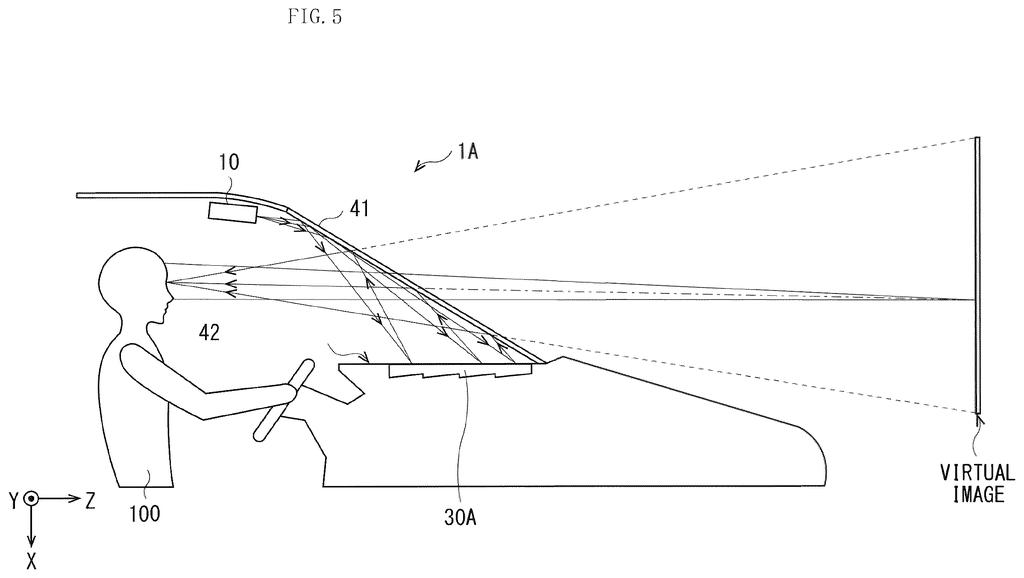
… a reflective mirror that reflects a light flux outputted from the display apparatus in a predetermined direction; and a retroreflector that reflects the light flux incident via the reflective mirror substantially in an incident direction.
Translation: The device uses a mirror and a special reflector to bounce light back toward the source to create the image.
What this means for compact and embedded projectors
For consumer or embedded projectors, being able to restrict the active scan area means the device can run more efficiently when displaying smaller images, potentially reducing heat, extending component life, and improving image quality by concentrating the scan on the relevant zone. It also opens the door to projectors that reposition or resize images in software without mechanical adjustment.
The claim as written is fairly broad: it covers any image display apparatus with a rendering section and a scanning range setting section that constrains the scan to a sub-region. That breadth could give Sony leverage over a wide range of laser-scanning and MEMS projector designs, and it sits alongside a steady stream of new Big Tech patents targeting efficiency gains in projection and display hardware.
Claim 1 is written at a high level of abstraction: any image display device with a rendering section and a sub-maximum scanning range setting section would read on it. That breadth is the most interesting thing here, because it could cover far more than a traditional living-room projector; compact laser projectors embedded in headsets, automotive HUDs, and retail displays could all fall within scope. If granted as written, this could give Sony a meaningful position in the growing market for embedded and portable projection, where scan efficiency is a first-order engineering priority.
There are more where this came from
We read every patent application Big Tech publishes and send you the ones worth knowing. Plain English, free, every week.
The drawings
21 drawing sheets from US 2026/0235870 A1 · click any drawing to enlarge


Want this weekly breakdown for a company we don't cover? Patentlyze Pro →
Be the first to weigh in