
Google Patents a Method to Test Product Changes Without Exposing Individual User Data
Every time a tech company tests a new feature or ad, it collects real data about real people. Google is patenting a system that lets it run those experiments and still draw useful conclusions, without handing over anything that could be traced back to you.
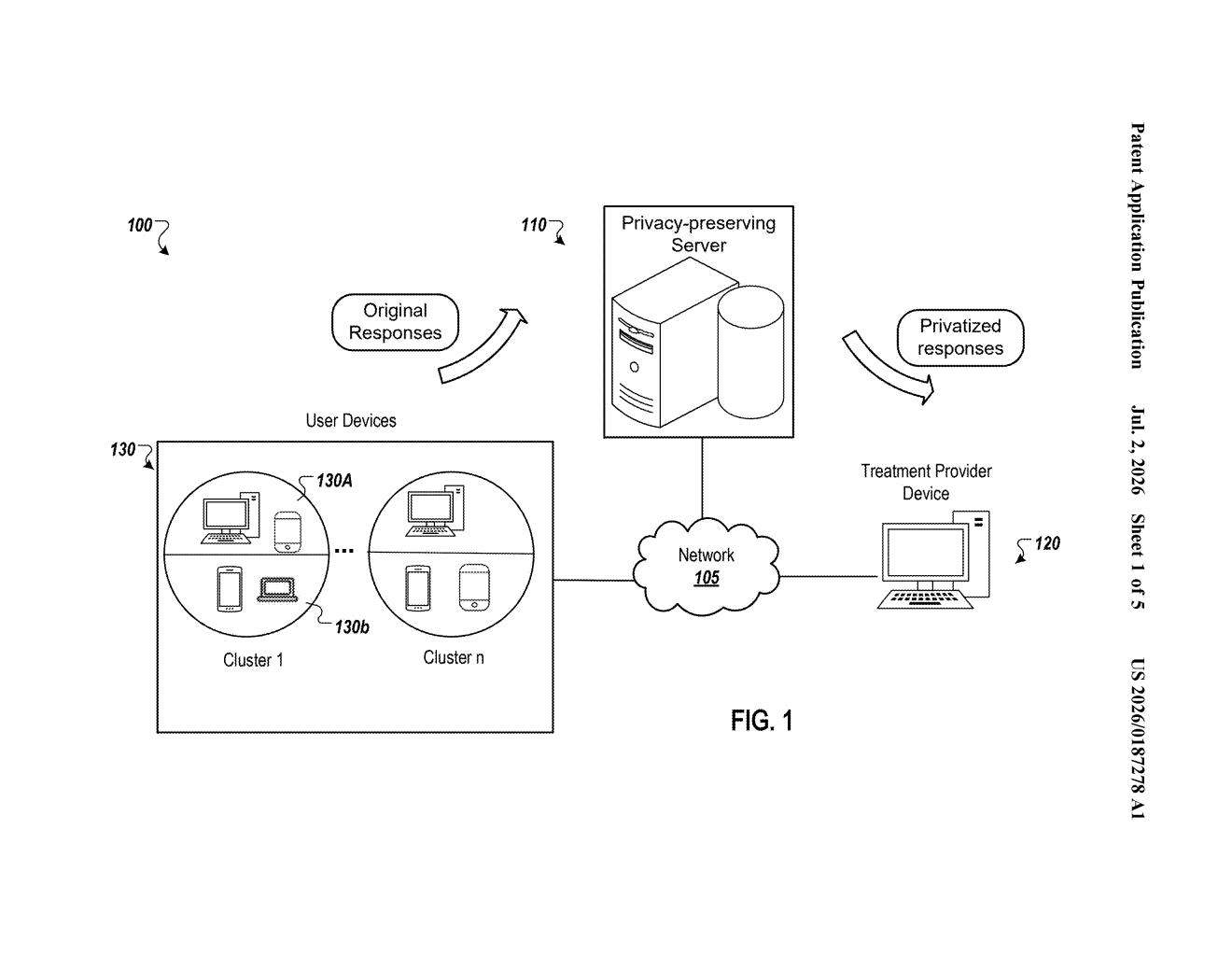
What Google's privacy-safe experiment system actually does
Imagine a company wants to know whether showing you a red button instead of a blue one makes you more likely to click. To answer that, they split users into two groups: one group sees the old version, the other sees the new one. Then they compare what each group did. That kind of test is called an A/B test, and companies run them constantly.
The problem is those tests produce logs of individual behavior. Google's patent describes a system that sits between the users and the company running the experiment. Before the results go anywhere, the system deliberately adds statistical noise to the data, scrambling it just enough that no one can pin a specific response to a specific person.
The clever part: the noise is added at the group level, not randomly. Users are sorted into clusters, and the noise is calibrated to each cluster's own response patterns. That way the overall result of the experiment stays accurate enough to be useful, even though the individual data points have been deliberately blurred.
How the noise-injection and cluster system shields users
The patent describes a privacy-preserving server that acts as a trusted middleman in an A/B testing pipeline. Here's the sequence:
- Users are pre-sorted into clusters (think of these as statistical neighborhoods of people with similar behavior patterns).
- One group of users (the control group) sees an item without any change; another group (the treated group) sees the item with the change being tested.
- The server collects responses from both groups and, for each cluster, builds two response distributions (basically a histogram of how people in that cluster reacted).
- The server then adds calibrated noise to each distribution, a technique rooted in differential privacy (a mathematical guarantee that any single person's data can't be reverse-engineered from the final output).
- When outputting data, each individual response is replaced with either the real response or a random draw from the noisy distribution. The result is a set of privatized responses that still faithfully represent group-level trends.
The company running the experiment receives this privatized dataset and uses it to draw a causal inference (a conclusion about whether the treatment actually caused a change in behavior, not just correlated with one). The math still works because the noise is structured, not random chaos.
What this means for ad experiments and user privacy
A/B testing is the backbone of nearly every product and advertising decision in tech. The data those tests generate is sensitive: it reflects individual behavior, preferences, and responses to persuasion. Regulators in Europe and elsewhere have been putting pressure on exactly this kind of data collection.
A system that lets companies run statistically valid experiments on privatized data could become a compliance tool, letting Google and its advertising customers argue that their experimentation pipelines don't expose individual users. For you as a user, the practical effect would be that your clicks and responses feed aggregate conclusions without your specific behavior ever leaving the anonymized pool.
This is genuinely useful infrastructure work, not flashy AI. Differential privacy has been an academic topic for years, but applying it specifically to causal inference in A/B testing (where you need clean effect estimates, not just aggregate stats) is a real engineering challenge. If this ships, it could become a credible privacy argument for Google's ad business at exactly the moment regulators are asking hard questions about behavioral data.
Get our take in your Top Stories
Liked this breakdown? Add Patentlyze as a preferred source on Google, and our plain-English take shows up more often in your Top Stories the next time Google patent news breaks.
There are more where this came from
We read every patent application Big Tech publishes and send you the ones worth knowing. Plain English, free, every week.
Want this weekly breakdown for a company we don't cover? Patentlyze Pro →