
Microsoft Patents a System That Builds an AI-Written Page for Complex Search Queries
When your search question is too complex for a list of links, Microsoft's new patent describes a system that decides to skip the links entirely and generate a full written document as the answer.
What Microsoft's AI search document builder actually does
Imagine you search for something like "how should I prepare for knee replacement surgery" and instead of getting ten blue links, you get a structured, written article that actually answers your question, complete with sections on preparation, recovery, and what to ask your doctor. That's the core idea here.
Microsoft is patenting a system that watches your search as it happens, decides whether your question is complex enough to deserve a full generated document instead of a links page, and then builds that document on the fly using several small AI models working at the same time.
The key words there are "small" and "at the same time." Rather than routing every query through one giant AI, the system uses multiple lighter models running in parallel, which keeps costs down and results coming back faster. You get a direct written answer plus organized topic sections, all assembled before you've even had time to scroll.
How the system runs AI tasks in parallel to build the page
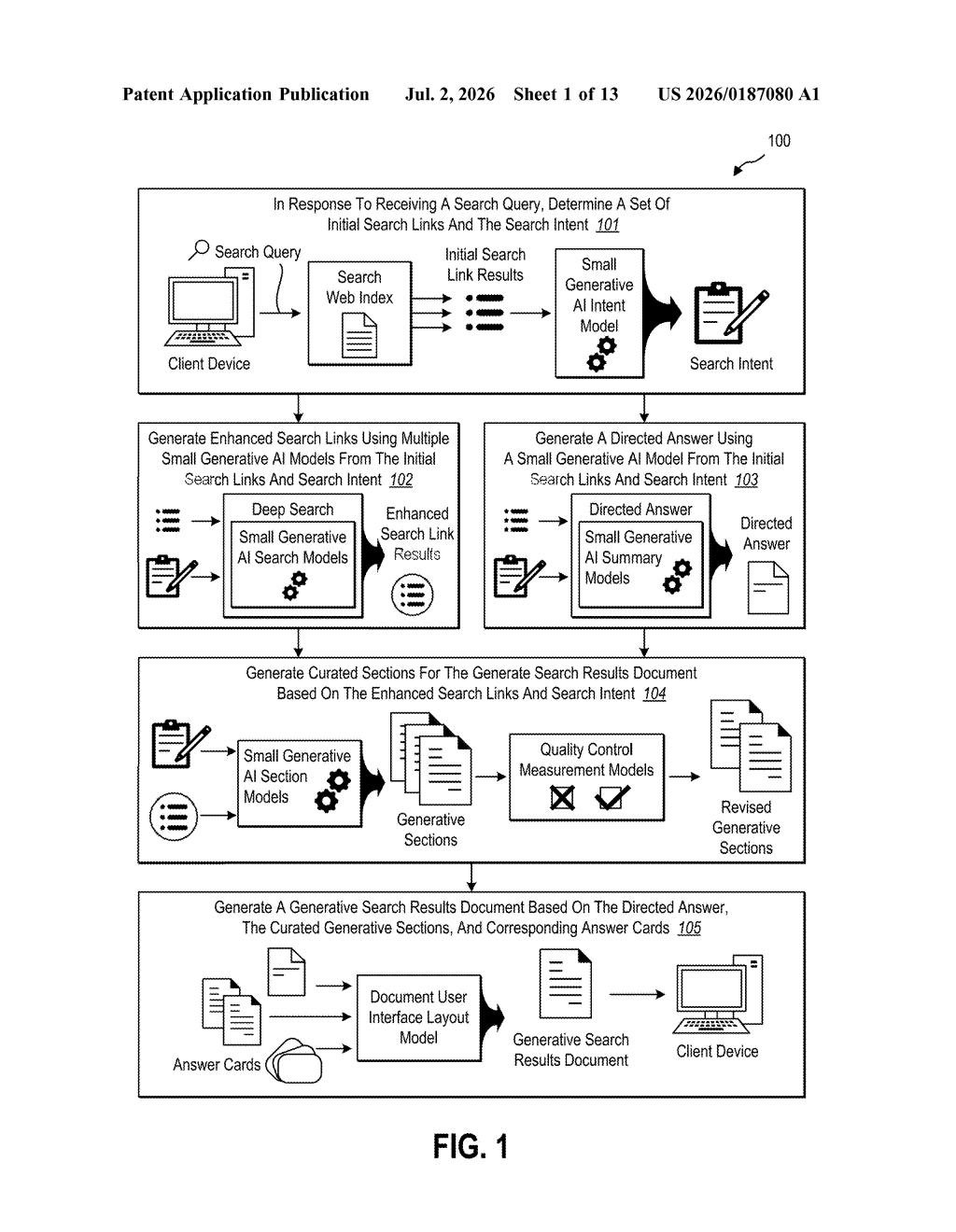
The patent describes a generative document system that sits on top of a traditional search engine. When a query comes in, it first checks whether the question clears what the patent calls a "generative document threshold" (basically: is this question complex enough that a written document would serve the user better than a ranked list of links?). If not, you get ordinary search results.
If the query clears that bar, several things happen at once rather than in sequence:
- One AI model figures out the user's search intent (what they're really asking, not just what words they typed)
- Another pulls enhanced search results, meaning deeper or more curated sources beyond the initial link set
- A third model generates a directed answer, a concise direct response to the core question
- The system then curates the enhanced results into topic sections and assembles everything into a single structured document
The parallel processing detail matters technically: by running the intent analysis and the directed-answer generation at the same time rather than one after another, the system shaves meaningful time off the total response. The patent also emphasizes using small AI models rather than a single large one, which reduces computing cost per query at scale.
The final output combines the direct answer at the top with organized sections pulling from curated sources below.
What this means for the future of Bing search results
This is essentially Microsoft's blueprint for turning Bing (and by extension Copilot search) into something that looks less like a search engine and more like an on-demand research assistant. The system doesn't just cite sources, it writes around them and organizes them into a coherent document tailored to your specific question. For users, that means fewer click-throughs required to get an actual answer.
The emphasis on small, parallel AI models is also significant for Microsoft's business. Running a large language model on every single search query would be extremely expensive at Bing's scale. By routing only qualifying queries to a lightweight multi-model pipeline, the system tries to make AI-generated answers economically viable for high-volume search, not just the occasional premium query.
This is a direct look at how Microsoft plans to make AI-generated search results fast and affordable enough to deploy at scale, not just in demos. The parallel small-model architecture is the genuinely interesting engineering bet here, and it signals that Microsoft thinks full-page AI answers will be a normal search format, not a special feature.
Get our take in your Top Stories
Liked this breakdown? Add Patentlyze as a preferred source on Google, and our plain-English take shows up more often in your Top Stories the next time Microsoft patent news breaks.
There are more where this came from
We read every patent application Big Tech publishes and send you the ones worth knowing. Plain English, free, every week.
Want this weekly breakdown for a company we don't cover? Patentlyze Pro →