
Nvidia Patents an AI System That Rebuilds 3D Scenes From a Set of Photos
Nvidia has filed a patent for a neural network that can take a batch of ordinary photos and reconstruct the full 3D geometry of the scene they show, without needing GPS data, camera calibration files, or a slow back-and-forth matching process.
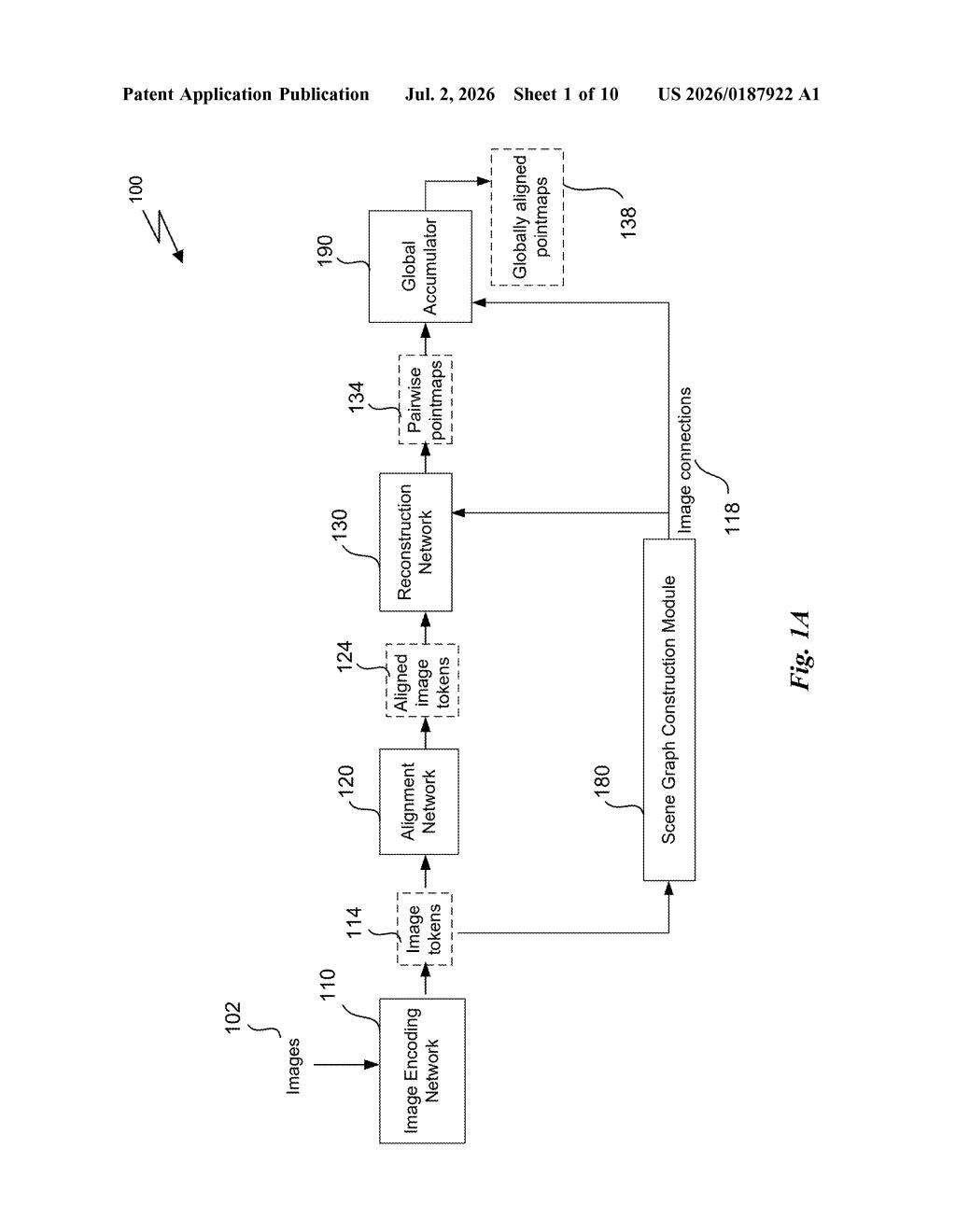
How Nvidia's photo-to-3D reconstruction actually works
Imagine you take twenty photos of a building from different angles and hand them to a computer. Normally, figuring out the 3D shape of that building from those flat pictures is slow and fiddly: the software has to compare every pair of images, figure out how they overlap, and stitch it all together piece by piece. Nvidia's patent describes a faster, smarter way to do that.
Instead of working through the photos one pair at a time, the system processes all the images together, letting every photo "know about" every other photo before any serious reconstruction work begins. It then builds a map of which photos are most relevant to each other and focuses its detailed work on those pairings.
The end result is a set of 3D point maps, basically a point-cloud model of the original scene, generated more efficiently than traditional methods. This kind of technology is useful anywhere a machine needs to understand physical space from cameras alone: self-driving cars, robots, augmented-reality headsets, or 3D scanning apps.
How the alignment network syncs every photo at once
The patent describes a feed-forward neural network pipeline (meaning data flows in one direction, start to finish, without iterative loops) for structure-from-motion, the computer-vision task of inferring a 3D scene from 2D photographs taken from different positions.
The system works in four main steps:
- Tokenization: Each input image is converted into a set of compact numeric representations called "image tokens," similar to how a large language model breaks text into word chunks before processing.
- Global alignment in latent space: An "alignment network" processes all image tokens together, so every image's tokens are updated with context drawn from every other image. "Latent space" just means the network does this in its own internal numeric world, not by comparing raw pixels.
- Scene graph construction: The system builds a graph (a map of connections) that identifies which pairs of images share relevant visual overlap, so it doesn't waste compute on pairs that show completely different things.
- Pairwise decoding and 3D point map generation: Only the relevant pairs are decoded in detail, producing "point maps" (a grid of 3D coordinates for each pixel) that are then assembled into a full 3D model of the scene.
The key claim is that doing the alignment step before detailed pairwise decoding produces more accurate and consistent 3D reconstructions than architectures that align after the fact.
What this means for robotics, AR, and 3D capture
Structure-from-motion is a foundational problem in computer vision. It sits at the core of how robots map environments, how AR headsets anchor virtual objects to real surfaces, and how autonomous vehicles build a 3D picture of the road from cameras rather than expensive lidar sensors. A faster, more accurate feed-forward approach could make real-time or near-real-time 3D reconstruction practical on hardware that can't afford long processing delays.
For Nvidia specifically, this work fits squarely into its push to put AI inference at the center of robotics and autonomous systems. Isaac, Nvidia's robotics platform, and its investments in physical AI broadly would benefit from a more efficient 3D scene understanding backbone. If this approach performs as described, it could also find its way into 3D content creation tools, drone mapping software, or next-generation AR platforms.
This is solid, earnest research-grade work in a problem space that genuinely matters for robotics and AR. It won't generate headlines about a flashy consumer product, but global alignment before decoding is a real architectural choice that addresses a known weakness in existing structure-from-motion pipelines. Worth watching if you follow Nvidia's physical-AI strategy.
Get our take in your Top Stories
Liked this breakdown? Add Patentlyze as a preferred source on Google, and our plain-English take shows up more often in your Top Stories the next time Nvidia patent news breaks.
There are more where this came from
We read every patent application Big Tech publishes and send you the ones worth knowing. Plain English, free, every week.
Want this weekly breakdown for a company we don't cover? Patentlyze Pro →