
Nvidia's New Patent Walls Off the Safety System on a Chip So a Crash Can't Touch It
Nvidia is patenting a way to carve a single chip into walled-off sections with different safety rules, so a software crash in one zone can't silently kill the safety system running next to it.
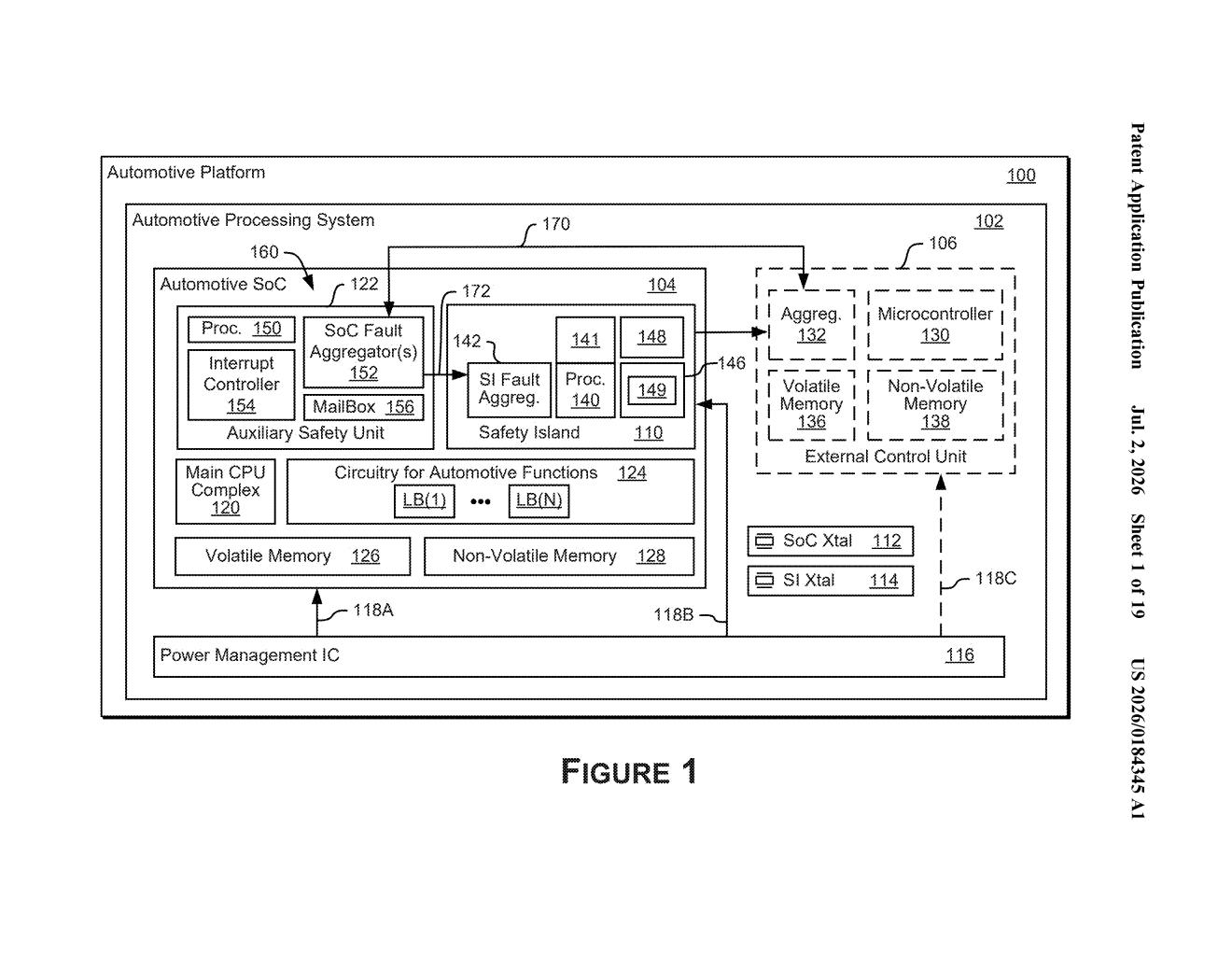
What Nvidia's chip safety wall actually does
Imagine a power plant where the emergency shutdown system runs on its own separate wiring, completely cut off from the computers that run day-to-day operations. If a regular computer crashes, the shutdown system still works. Nvidia wants to do the same thing inside a single chip.
This patent describes a chip split into two electrically separated sections. One section handles normal processing tasks; the other handles safety-critical work and plays by stricter rules. If something goes wrong in the normal section and it doesn't clean up the problem fast enough, a built-in countdown timer fires off an alert to the safety section, which can then warn the outside world.
The key idea is that the safety section stays trustworthy even when the rest of the chip is having a bad day. For something like a self-driving car, where a chip failure could be dangerous, that kind of hard separation matters a lot.
How the timer and error signals work across chip zones
The patent describes a System on a Chip (SoC) divided into two electrically isolated sections, each operating under a different risk classification level (think of these as different grades of safety certification, similar to the ISO 26262 automotive safety standard).
The first section handles general processing. When it detects a fault, it sends an error signal to the second section and simultaneously starts a countdown timer. The idea is: the first section should acknowledge and clear that fault within a set window of time.
- If the fault is cleared in time, the timer resets and normal operation continues.
- If the fault is not cleared in time, the timer fires a separate "timeout error signal" to the safety section.
- The safety section then notifies an external system, such as a vehicle's central safety controller, that something has gone wrong and wasn't handled.
The critical engineering detail is the electrical isolation between the two sections. They are not just logically separated in software; they are physically separated on the chip so that a failure in the general-purpose section cannot corrupt or disable the safety section. This is a standard requirement in functional safety engineering for systems where failures can injure people.
What this means for self-driving car chip design
Nvidia's chips power a large share of the self-driving and driver-assistance systems being tested today. Those applications are subject to strict functional safety standards that require safety-critical hardware to be provably independent from non-safety hardware. A chip that can demonstrate hard electrical isolation between zones is much easier to certify under those standards, which is a real-world bottleneck in getting autonomous systems to market.
For you as a driver or passenger, this is the kind of invisible plumbing that determines whether a self-driving system fails gracefully or fails dangerously. A chip that can reliably report its own faults to an external controller, even when part of the chip is malfunctioning, is a meaningful safety building block.
This is unglamorous but genuinely important work. Functional safety certification is one of the hardest practical barriers to shipping autonomous vehicle hardware, and patents like this are exactly the kind of foundational engineering Nvidia needs to build a credible safety story alongside its raw compute leadership. It won't make headlines, but it may matter more than the next GPU benchmark.
Get our take in your Top Stories
Liked this breakdown? Add Patentlyze as a preferred source on Google, and our plain-English take shows up more often in your Top Stories the next time Nvidia patent news breaks.
There are more where this came from
We read every patent application Big Tech publishes and send you the ones worth knowing. Plain English, free, every week.
Want this weekly breakdown for a company we don't cover? Patentlyze Pro →