
Google Patents a Smarter Echo Canceller for Wireless Speaker Calls
When you take a call through a Bluetooth or Wi-Fi speaker, your phone's microphone picks up your own voice bouncing back off that speaker — and your caller hears a ghostly echo. Google's new patent targets exactly that problem with a timing-aware fix.
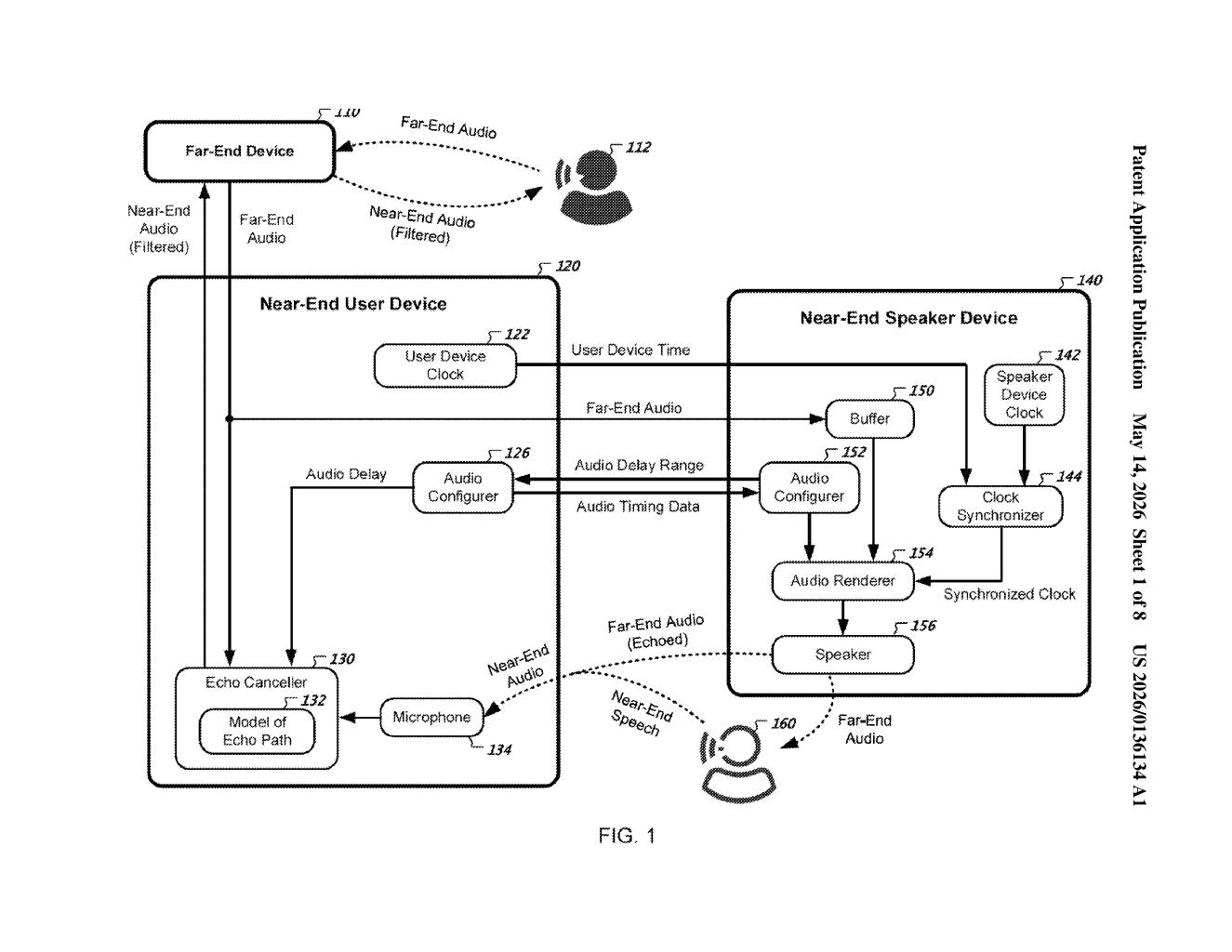
What Google's wireless speaker echo fix actually does
Imagine you're on a video call with your laptop audio routed to a Nest Audio speaker across the room. The person you're talking to keeps complaining they can hear themselves — that's the echo your microphone is picking up from the speaker and sending right back.
Normally, your phone or laptop tries to cancel that echo by keeping track of what audio it sent out and subtracting a simulated version of it from what the mic picks up. The problem with wireless speakers is that they introduce an unpredictable delay — the audio might arrive at the speaker a few milliseconds late, or early, throwing off the whole calculation.
Google's patent fixes this by having your phone tell the wireless speaker exactly when to play the audio, and then using that timing information to align its echo-cancellation model. That way, even if the speaker introduces a delay, your device knows about it in advance and can subtract the echo accurately — so the person on the other end hears you, not themselves.
How timing signals anchor Google's echo path model
The patent describes a system where the near-end device (your phone or tablet) does three things simultaneously when routing call audio to a wireless speaker:
- It sends the far-end audio (what the remote caller said) to the wireless speaker wirelessly.
- It sends an indication of the exact time the speaker should play that audio — essentially a synchronized timestamp.
- It runs an acoustic echo canceller locally, using both a model of the echo path (the physical distance and acoustics between the speaker and the phone's mic) and that timestamp to predict when the echo will arrive at the microphone.
The core insight is the signal aligner component. Traditional echo cancellation assumes the speaker plays audio the instant it's sent. Wireless speakers don't — they buffer, decode, and introduce variable latency. By anchoring the echo model to the scheduled playback time rather than the transmission time, the canceller stays accurate even when Bluetooth or Wi-Fi introduces jitter (small, unpredictable timing variations).
The patent also mentions a doubletalk determiner — a subsystem that detects when both the near-end user and the far-end caller are speaking simultaneously (a common scenario that confuses naive echo cancellers). This suggests the system is designed to handle real conversation dynamics, not just clean one-at-a-time audio.
What this means for Pixel phones and Google speaker calls
If you've ever used a smart speaker as a call audio output device — whether through Google Meet, Duo, or any Bluetooth-paired setup — you've probably run into this exact problem. The echo cancellation on your phone was designed for its own built-in speaker, not a separate wireless one sitting three feet away with its own audio pipeline.
For Google, this patent is strategically interesting because it spans the Pixel phone and Nest speaker ecosystem. A Pixel phone that intelligently coordinates with a Nest Audio or Nest Hub during calls would be a meaningful quality-of-life improvement — and a differentiator versus using a generic Bluetooth speaker with any other phone.
This is a genuinely useful engineering problem with a clean solution. The timing-indication approach is elegant — instead of trying to measure or estimate the wireless speaker's delay after the fact, the system simply tells the speaker when to play and remembers that promise. It's the kind of detail that doesn't make a headline but absolutely affects whether a call sounds good. Worth watching if you care about Google's smart home audio ecosystem.
Get our take in your Top Stories
Liked this breakdown? Add Patentlyze as a preferred source on Google, and our plain-English take shows up more often in your Top Stories the next time Google patent news breaks.
There are more where this came from
We read every patent application Big Tech publishes and send you the ones worth knowing. Plain English, free, every week.
Want this weekly breakdown for a company we don't cover? Patentlyze Pro →