
Google Patents a Unified Signal Framework for In-Car Software Integration
Every car is a tangle of sensors, ECUs, and proprietary protocols — and right now, getting an app to talk to all of them is a mess. Google's latest patent tries to fix that with a single, clean abstraction layer.
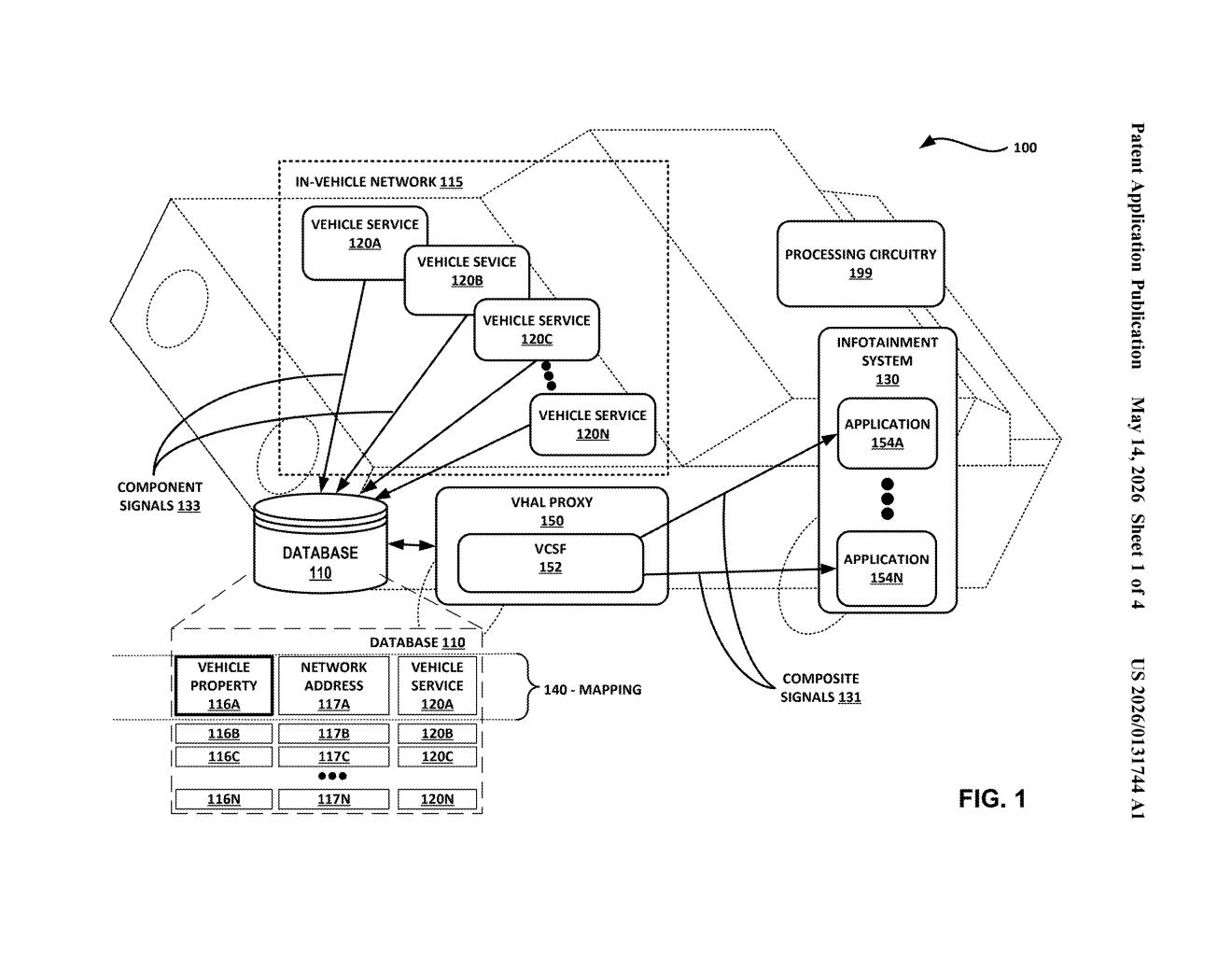
What Google's vehicle signal abstraction actually does
Imagine your navigation app wants to know if your car is in reverse, and your battery app wants to know the current charge level, and your seat-comfort app wants to read cabin temperature. Today, each of those apps might need to dig into completely different, manufacturer-specific systems to get that data — it's like every appliance in your house needing its own custom electrical socket.
Google's patent describes a framework called the Vehicle Composite Signal Framework (VCSF) that sits between all those raw vehicle sensors and the apps running on your car's computer. It collects low-level "component signals" from all the different vehicle systems — brakes, battery, HVAC, whatever — and translates them into standardized, composable signals that any app can easily consume.
The key word is "composable" — the system can combine multiple raw signals into a single, higher-level signal. Instead of an app asking "what is the raw voltage on bus 3?", it just asks "what's the battery level?" and the framework handles the messy translation work underneath.
How the VCSF maps raw sensor signals to app-ready properties
The patent describes a two-layer software architecture running on the vehicle's onboard processing hardware. The bottom layer is a Vehicle Hardware Abstraction Layer (VHAL) — essentially a dictionary that maps the car's physical components and services to standardized "vehicle properties." Think of it like a universal translator that knows that manufacturer A calls it "BattVoltRaw" and manufacturer B calls it "EV_CHARGE_PCT", but both mean battery level.
Sitting on top of that is the Vehicle Composite Signal Framework (VCSF), which is the active logic layer. It:
- Continuously collects component signals from multiple vehicle services (individual subsystems like the drivetrain, HVAC, or safety systems)
- Uses the VHAL's property mapping to understand what each raw signal actually means
- Combines or transforms those signals into composite signals — higher-level, cleaned-up data objects that are useful to app developers
- Delivers those composite signals to applications running on the vehicle's compute stack
The abstraction is important here. By inserting this middleware layer, Google decouples application logic from hardware specifics. An app built on this framework wouldn't need to know whether it's running in a Ford, a Honda, or a Volvo — the VCSF smooths all of that out.
What this means for Android Automotive and in-car apps
This is core plumbing for Android Automotive OS, Google's operating system that runs natively inside vehicles (distinct from Android Auto, which mirrors your phone). For Android Automotive to work across dozens of car brands and models, Google needs exactly this kind of abstraction layer — a way to write apps once and have them work regardless of the underlying hardware.
For you as a driver, this is the invisible infrastructure that would let your apps behave consistently no matter what car you're in. For developers, it's potentially a much simpler API surface for building in-car software. The broader competitive picture is clear: Google is trying to do for car software what Android did for mobile — create a standardized platform that commoditizes the hardware differences between manufacturers.
This is unglamorous but important infrastructure work. A unified signal abstraction layer is exactly the kind of foundational piece Google needs to make Android Automotive a serious platform rather than a fragmented one-off integration per automaker. It's not a flashy AI feature, but without something like this, every car app is a custom engineering project.
There are more where this came from
We read every patent application Big Tech publishes and send you the ones worth knowing. Plain English, free, every week.
Want this weekly breakdown for a company we don't cover? Patentlyze Pro →