
Samsung Patents a Charging Circuit That Shifts Its Voltage Ratio Mid-Charge
Most phone chargers lock in a single approach and stick with it. Samsung is patenting a system that reads the situation and shifts gears mid-charge, swapping voltage conversion ratios as conditions change.
What Samsung's mid-charge voltage switching actually does
Imagine filling a bathtub: at first you want a strong flow, but as it gets close to full you ease off so it doesn't overflow. Your phone's battery works similarly, and charging it well means adjusting how power is delivered as it fills up.
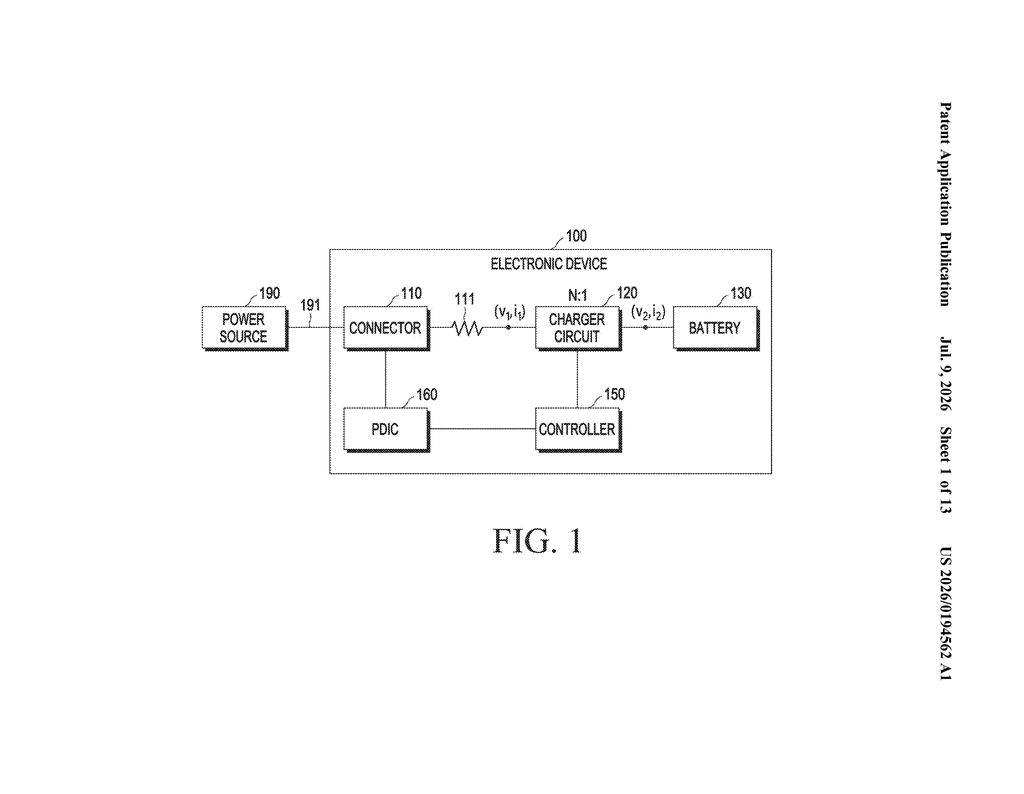
Samsung's patent describes a charging circuit that doesn't just set one voltage conversion ratio and hold it. Instead, the device's controller watches information about the ongoing charge, picks a starting ratio, and then, while charging is already underway, identifies a different ratio that better fits the battery's new state and switches to it.
In plain terms, the charger is more like a driver who shifts gears on a hill than one who drives the whole trip in second gear. The goal is to deliver power more efficiently at each stage, which can mean faster charging overall and less unnecessary heat stress on the battery.
How the controller picks and switches voltage conversion ratios
The patent covers four main hardware pieces working together: a connector (the port you plug into), a charging circuit (the electronics that step voltage up or down), a battery, and a controller with at least one processor.
The controller's job is sequential. It first reads what the patent calls information related to charging, which likely means data like battery level, temperature, and the capabilities of the connected charger. From that, it picks a first voltage conversion ratio and tells the charging circuit to use it.
While charging is happening under that first ratio, the controller keeps watching. It then identifies a second voltage conversion ratio that is explicitly described as different from the first, and hands off control to the new ratio without stopping the charge. This mid-session switching is the core of the invention.
- Voltage conversion ratio controls how the circuit transforms incoming power before sending it to the battery.
- Switching ratios mid-charge lets the system match power delivery to the battery's changing needs as it fills.
- The controller loop can, in principle, run more than once, though the claim as written covers at least one switch.
What this means for phone charging speed and battery health
Modern fast-charging already varies current as a battery fills, but managing the voltage conversion ratio itself mid-charge is a lower-level, more direct form of control over how the charging circuit operates. Done well, that can reduce heat, improve efficiency, and prolong how many charge cycles a battery survives over years of use.
For you as a phone owner, the practical upside would be a device that charges quickly early on, then transitions smoothly to a gentler mode as it approaches full, all without you doing anything. Samsung ships hundreds of millions of Galaxy phones and tablets, so even a modest gain in charging efficiency at scale has real consequences for device longevity and energy consumption.
This is a charging-optimization patent, which is about as unsexy as it gets, but battery longevity is one of the most complained-about smartphone problems in the real world. The technical idea here is specific and implementable, not just a vague goal. Whether it shows up in a Galaxy software update or requires new silicon is the real open question.
Get our take in your Top Stories
Liked this breakdown? Add Patentlyze as a preferred source on Google, and our plain-English take shows up more often in your Top Stories the next time Samsung patent news breaks.
There are more where this came from
We read every patent application Big Tech publishes and send you the ones worth knowing. Plain English, free, every week.
Want this weekly breakdown for a company we don't cover? Patentlyze Pro →