
Samsung Patents a Battery Circuit That Stops Overcharging Once Power Stabilizes
When a chip suddenly demands more power, most converters either overshoot or lag. Samsung's new patent describes a converter that dials up its output on demand and then automatically knows when to stop, based on watching how fast the voltage is climbing.
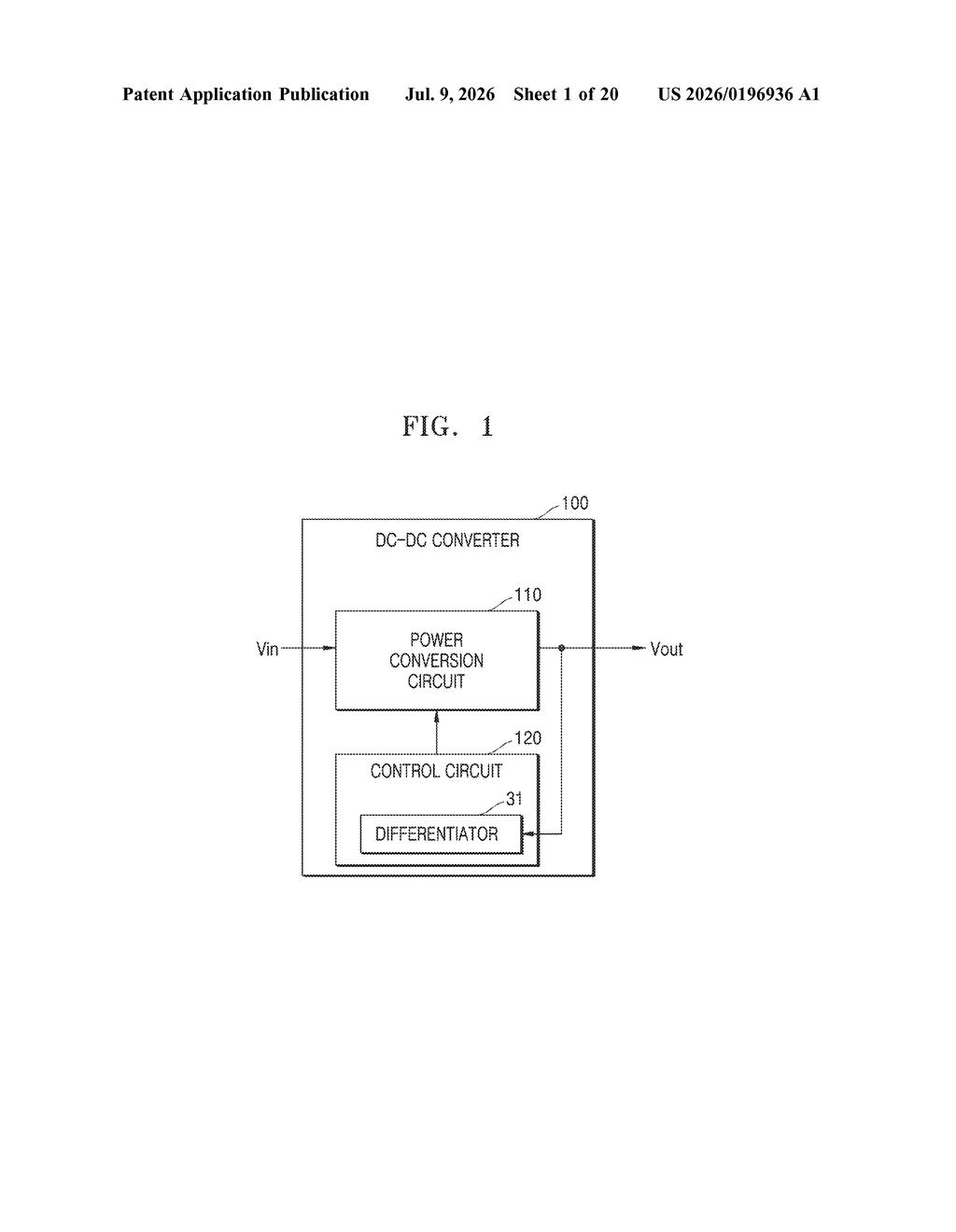
What Samsung's self-adjusting power converter actually does
Imagine your phone is idling and then you launch a heavy game. The chip suddenly needs a lot more power, and the tiny converter responsible for delivering that power has to react fast. If it reacts too slowly, the chip stutters. If it overreacts, voltage spikes in a way that can waste energy or cause instability.
Samsung's patent describes a converter with a built-in "are we there yet" detector. When it senses a big load change, it switches into a boosted mode, sending longer power pulses to close the voltage gap quickly. But instead of running that boost on a fixed timer, it watches the rate of change of the output voltage. Once the voltage stops climbing fast, the detector flips a signal and the converter immediately returns to its normal, efficient rhythm.
The result is a power supply that responds aggressively when it needs to, but doesn't overstay its welcome. That kind of precision matters in anything battery-powered, where every wasted milliwatt shortens your day.
How the pulse logic reads voltage slope to cut the boost
The converter has two main blocks working together: a power conversion circuit (a set of switches that chop up an input voltage to produce a regulated output) and a control circuit that decides how those switches should fire.
Under normal conditions, the control circuit generates a first pulse modulation signal, a repeating on-off pattern whose timing is set by an error amplifier. That amplifier compares the actual output voltage to a reference target and produces an "error voltage" proportional to how far off things are.
When a sudden load hits, the logic switches to a second pulse modulation signal with a longer on-time, pushing more energy per cycle to close the voltage gap faster.
The key innovation is the voltage slew detector, which continuously differentiates (calculates the moment-to-moment rate of change of) the feedback voltage. As long as the voltage is rising quickly, its output stays high. The instant the voltage stops climbing sharply, that signal transitions from on to off. The pulse modulation logic uses that falling edge as its cue to terminate the boosted second signal and return to the first. No fixed timeout, no guesswork: the converter stops boosting exactly when the evidence says the gap is closed.
What this means for chip power delivery in Samsung devices
Efficient DC-DC converters are one of the unsexy workhorses inside every smartphone, tablet, and wearable. A converter that overshoots its boost wastes energy as heat; one that undershoots causes voltage droop that can crash a processor. Samsung's approach aims to nail the timing without needing a carefully tuned fixed-duration override, which has to be re-engineered for every new chip or power profile.
For Samsung's own chip lineup (Exynos SoCs, memory controllers, and the power management ICs it ships inside Galaxy devices), tighter load-transient response translates directly to better battery life under bursty workloads and more stable performance during peak demand. It's unglamorous, but power delivery is often the bottleneck that limits how hard a chip can run.
This is a solid incremental improvement in power-management circuitry, not a headline-grabbing breakthrough. The idea of using voltage slope as a termination signal rather than a fixed timer is genuinely clever and avoids the per-design tuning burden. Whether it makes it into a shipping device or stays in Samsung's patent portfolio as defensive IP is the real question.
Get our take in your Top Stories
Liked this breakdown? Add Patentlyze as a preferred source on Google, and our plain-English take shows up more often in your Top Stories the next time Samsung patent news breaks.
There are more where this came from
We read every patent application Big Tech publishes and send you the ones worth knowing. Plain English, free, every week.
Want this weekly breakdown for a company we don't cover? Patentlyze Pro →