
Amazon Patent Teaches Robotaxi AI to Flag Unfamiliar Objects It Cannot Identify
Most AI systems will confidently misidentify something they've never seen before rather than admit uncertainty. Zoox is filing a patent for a system that catches those moments before they become dangerous driving decisions.
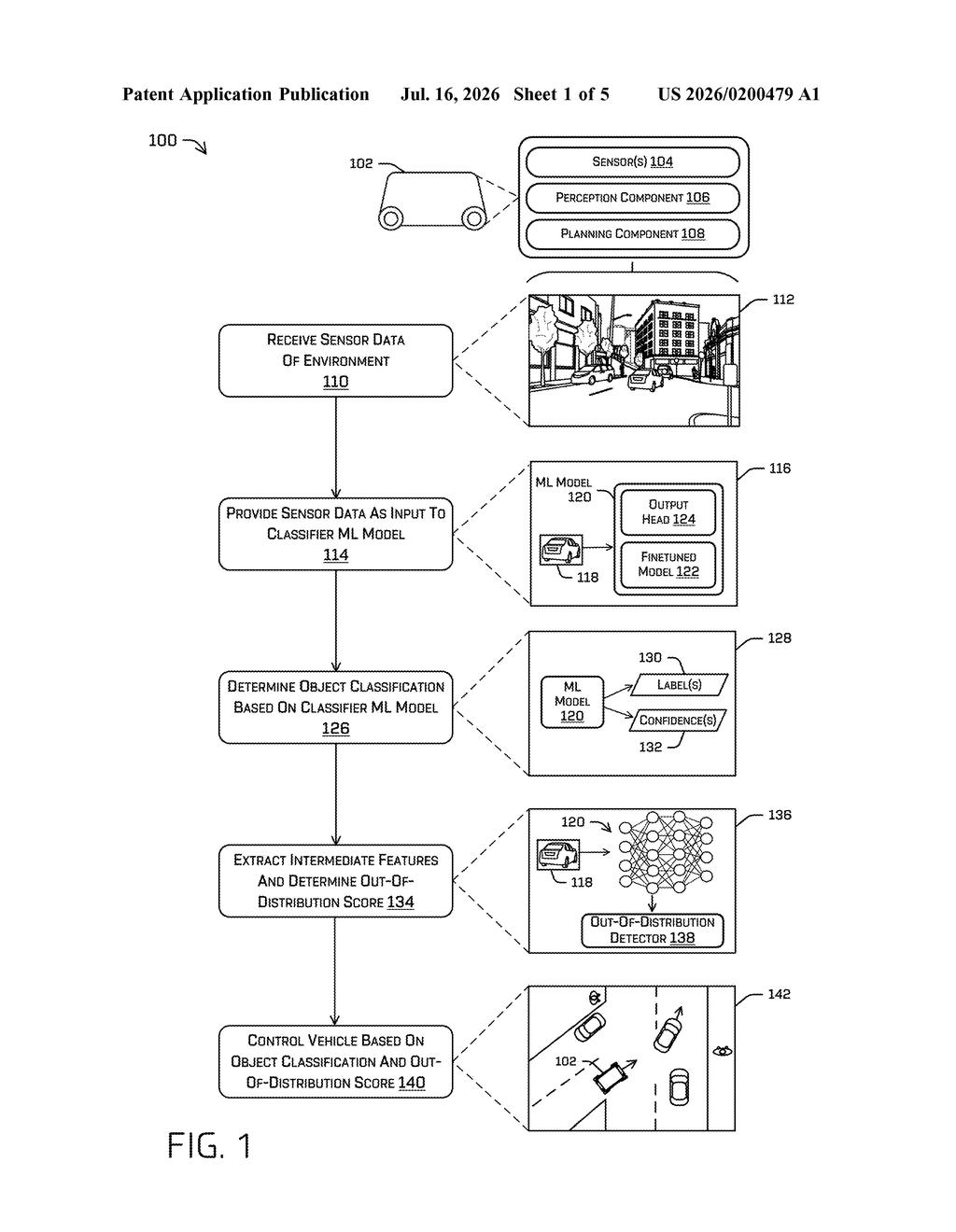
What Zoox's 'I don't recognize that' detector actually does
Imagine a self-driving car encounters a weirdly shaped street vendor cart it has never seen in training. A standard AI might squint at it and say 'probably a pedestrian' with high confidence, even though it's guessing. That's a problem when a real vehicle is reacting to that guess at 30 mph.
Zoox's patent describes a secondary system that runs alongside the main object-detection AI. While the main AI is figuring out what it sees, this side system is asking a different question: is what I'm looking at even the kind of thing I was trained to handle? If the answer is no, it can flag the output as unreliable before it reaches the software making driving decisions.
The result is a car that, at least in theory, knows what it doesn't know. Rather than acting confidently on a bad guess, it can trigger more cautious behavior or hand off to a different system entirely.
How Zoox measures confidence inside its neural network layers
The patent describes a two-part detection pipeline built on top of a standard object-classification neural network used in autonomous vehicles.
The main model takes in sensor data (think lidar, radar, or cameras) and identifies objects in the environment. This part is standard self-driving AI.
The out-of-distribution (OOD) detector is the novel addition. Instead of looking at the final output of the main model, it taps into the middle of the network, reading what are called intermediate feature vectors (essentially the internal numerical patterns the network builds up as it processes an input). It then compares those patterns against a statistical model, called a Gaussian mixture model (a mathematical way of describing what 'normal' inputs look like based on training data), to decide whether the current input looks like anything the system has seen before.
If the current input's internal fingerprint looks unusual compared to training data, the OOD detector assigns a low confidence score. The system combines that score with the main model's object classification output before passing anything downstream to the vehicle's driving logic.
The patent also notes this works with foundation models (large pretrained AI models) that are then fine-tuned for the specific driving task, with a regularization technique that keeps the fine-tuned model from drifting too far from the original pretrained weights.
Why overconfident AI is a real problem for self-driving safety
Self-driving AI is only as trustworthy as its ability to flag its own blind spots. A system that confidently misclassifies a novel object is arguably more dangerous than one that simply fails to detect it, because downstream systems will act on that bad classification. Zoox's approach tries to build an explicit layer of epistemic honesty into the perception stack.
For Zoox specifically, which operates a fully driverless robotaxi service in Las Vegas, this kind of safety architecture is directly relevant to real deployments. The patent signals that the company is working on making its AI more fault-aware in long-tail scenarios (unusual edge cases that didn't appear much in training data) rather than just making the core classifier more accurate.
This is a genuinely important piece of safety infrastructure for autonomous vehicles, even if it doesn't make for flashy headlines. The 'I don't know' problem in AI classifiers is well-documented and underappreciated by the public. Zoox building a formal, patent-level solution into its perception pipeline suggests this is production-bound work, not a research curiosity.
There are more where this came from
We read every patent application Big Tech publishes and send you the ones worth knowing. Plain English, free, every week.
Want this weekly breakdown for a company we don't cover? Patentlyze Pro →