
New Patent Teaches AI to Shrink Images Before Analysis
Nvidia has filed a patent for an AI system that deliberately shrinks high-resolution images before trying to understand them, then rates its own confidence in the answers it produces. The idea is to make AI vision practical on hardware that can't brute-force its way through massive image files.
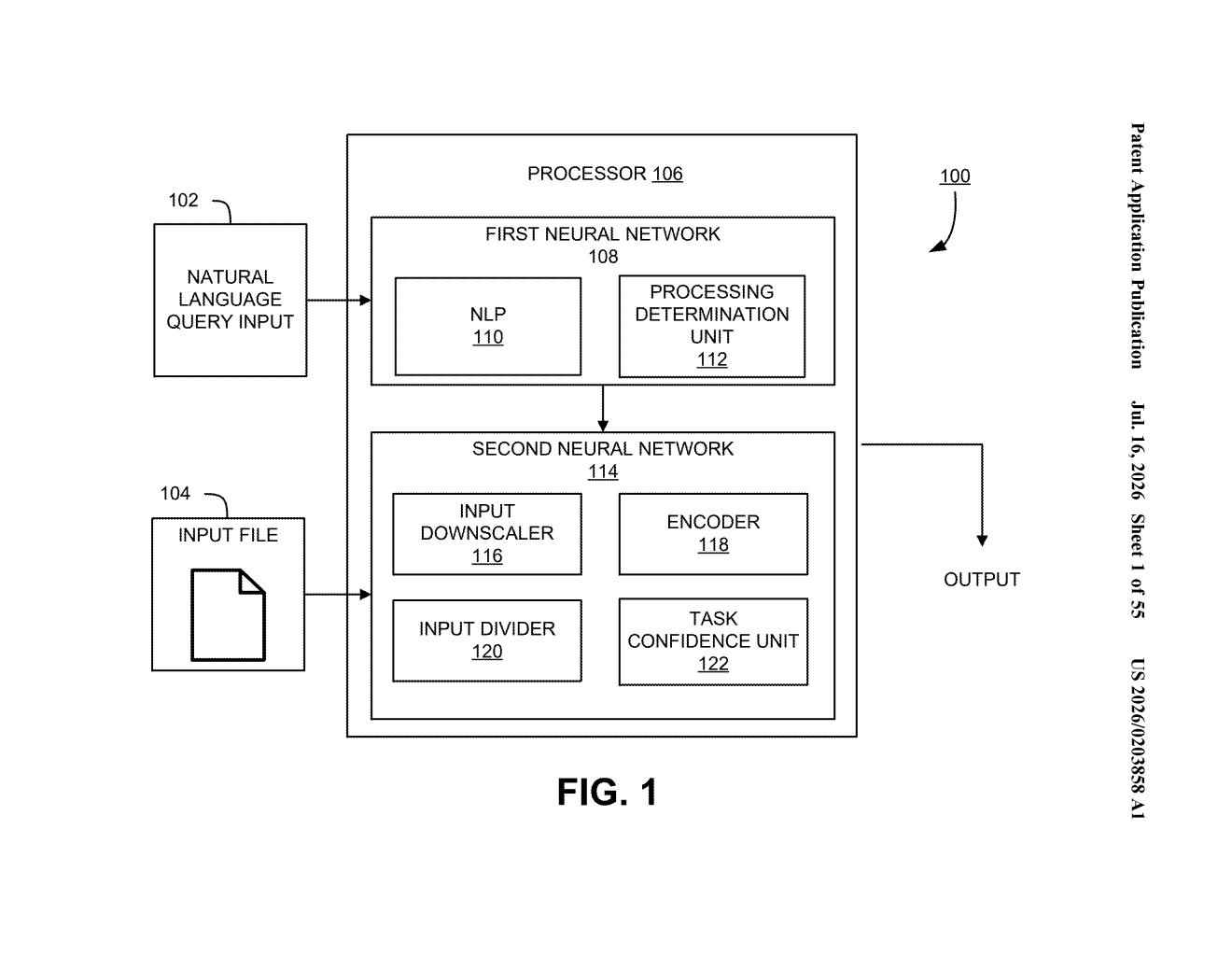
How Nvidia's image-shrinking AI actually works
Imagine asking an AI assistant to describe what's in a photo, but the photo is so large that processing it takes too long or too much memory. Nvidia's patent describes a smarter approach: the AI first shrinks the image down to a more workable size, then answers your question based on that smaller version.
The clever part is that the system also produces a confidence score alongside its answer. So instead of just telling you "there's a cat in this picture," it can also signal how sure it actually is, which helps you (or another system) decide whether to trust the result or ask again.
This kind of self-aware AI output is particularly useful when images vary wildly in resolution, since the system can adapt rather than crash or slow to a crawl on large files.
How the neural network scores its own answers
The patent describes a pipeline where a neural network receives a high-resolution image and a text query from a user (for example, "what objects are in the foreground?"). Rather than processing the full image at original size, the network first downscales it, reducing the pixel count to something more computationally manageable.
Once the scaled image is processed, the system generates two things:
- An answer or set of labels describing what it found in the image
- A confidence score indicating how certain the model is about those findings
The confidence score (essentially a probability estimate attached to each output) lets downstream systems decide how to act on the result. A low-confidence answer might trigger a retry at higher resolution, while a high-confidence answer can pass through immediately.
The patent is credited to Michael Ranzinger, a researcher associated with Nvidia's computer vision work. The claims in this particular publication have been canceled (claims 1-20 are listed as canceled), which is common during patent prosecution when claims are amended or replaced with revised versions.
What this means for AI vision on real hardware
For AI vision systems deployed in the real world, resolution is a constant bottleneck. Security cameras, medical scanners, satellite imagery, and automotive sensors all produce images that are far larger than what a neural network can comfortably process in real time. A system that intelligently downscales input before analysis, and honestly reports its own uncertainty, could make AI vision practical in far more contexts without requiring massive GPU memory.
The confidence score angle is also worth noting. AI systems that know when they don't know something are generally safer and more useful than ones that always output an answer regardless of quality. For Nvidia, which sells both the chips and the software frameworks that run AI vision tasks, owning the method for doing this efficiently is strategically logical.
The core idea here, downscaling images before AI analysis, is not new on its own. What's interesting is the combination with structured confidence scoring, which moves this from a pure speed optimization into something closer to a reliability framework. That said, with claims 1-20 canceled at publication, this patent is in flux and may look quite different if it ever grants.
There are more where this came from
We read every patent application Big Tech publishes and send you the ones worth knowing. Plain English, free, every week.
Want this weekly breakdown for a company we don't cover? Patentlyze Pro →