
Qualcomm Patents a Way to Track Image Edges When the Lighting Shifts
Tracking a moving object in video sounds straightforward until the lighting changes between frames. Qualcomm has filed a patent for a hardware circuit that can pin down the exact position of an edge in an image to finer-than-one-pixel precision, even when brightness shifts throw off the comparison.
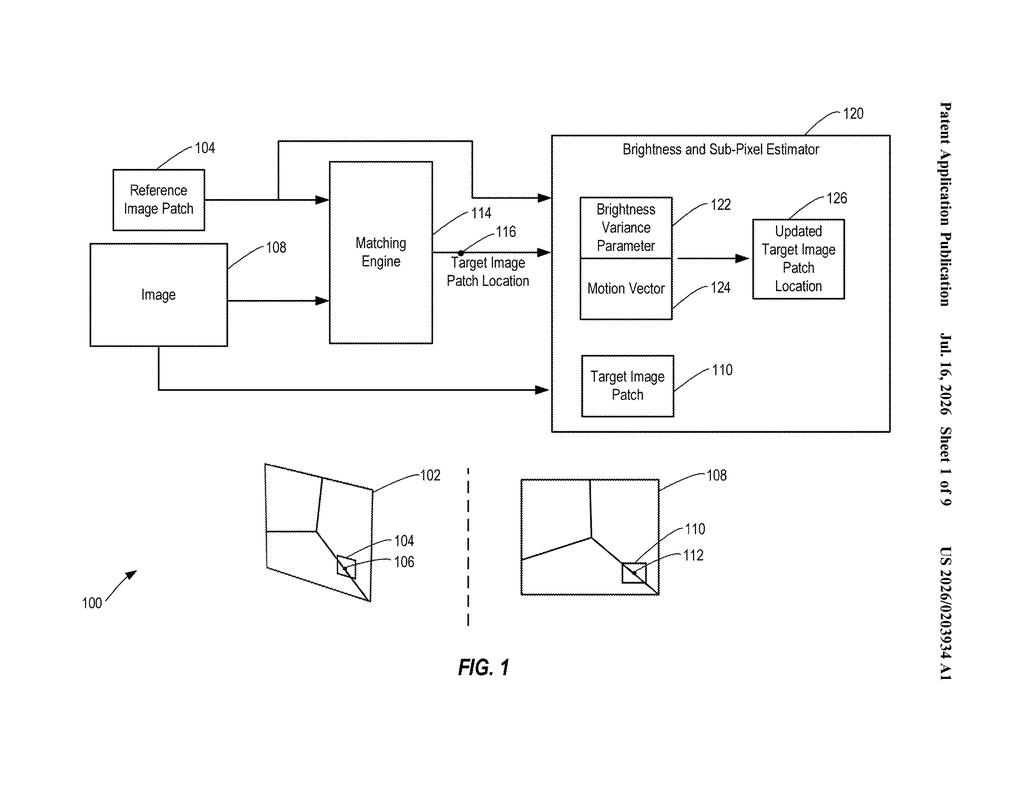
What Qualcomm's sub-pixel edge tracking actually does
Imagine your phone is trying to track the edge of a door frame as you walk through a room. The lights flicker, or you step from shadow into sunlight. Suddenly the same edge looks brighter or darker than it did a moment ago, and the tracking system loses its grip. That's the problem this patent is trying to solve.
Qualcomm's approach is to measure how much the brightness changed between two frames and factor that into the calculation. Instead of assuming the edge should look identical in both images, the system estimates the brightness difference and adjusts for it before deciding where the edge ended up.
The result is a location estimate that's more precise than a single pixel, which matters for anything that needs to know exactly where something is in a frame: augmented reality overlays, camera stabilization, or a robot arm trying to grab an object under changing light.
How the circuit handles brightness shifts mid-track
The patent describes a dedicated hardware circuit (meaning this runs on-chip, not in software running on a general processor) that performs what engineers call sub-pixel estimation, figuring out where a feature sits in an image to a precision finer than one pixel.
The process works in steps:
- The circuit grabs a small reference image patch, a tiny crop of the image showing a specific edge feature.
- It then scans a new frame and finds the closest matching patch, giving an initial location.
- It estimates a brightness variance parameter, essentially, how much brighter or darker the same edge looks in the new frame compared to the reference.
- Using that brightness adjustment alongside the pixel-intensity difference between the two patches, it calculates a motion vector (a direction and distance) to refine the location further.
- Finally, it decides whether the brightness difference is large enough to warrant one more correction pass.
The key insight is that brightness changes between frames are treated as a variable to estimate and correct for, not as noise to ignore. This makes the tracker more stable across real-world lighting conditions.
What this means for AR headsets and phone cameras
Sub-pixel tracking is the backbone of augmented reality, visual odometry (letting a device figure out where it is by watching the world), and high-precision camera stabilization. Today's systems can struggle when lighting shifts between frames because they assume the same feature should look the same in both images. That assumption breaks down indoors, outdoors, or any time exposure settings change automatically.
Qualcomm makes the chips inside a huge portion of Android phones and AR/XR devices. A hardware-level fix for brightness-induced tracking drift could improve how reliably AR overlays stick to real-world surfaces, how well optical image stabilization holds a shot, and how accurately autonomous systems navigate in changing light.
This is a tightly scoped, practical patent aimed at a real and well-known failure mode in computer vision. It's not a flashy AI story, but brightness-induced tracking errors are a genuine pain point in AR and robotics. If Qualcomm bakes this into its Snapdragon line, it's the kind of improvement users will feel without ever knowing why their AR glasses stopped drifting.
There are more where this came from
We read every patent application Big Tech publishes and send you the ones worth knowing. Plain English, free, every week.
Want this weekly breakdown for a company we don't cover? Patentlyze Pro →
Be the first to weigh in