
Samsung Patents a Dust-Blocking Hinge System for Foldable Phones
One of the most persistent complaints about foldable phones is that grit and dust work their way into the hinge over time. Samsung's latest patent is a direct attempt to solve that with a layered sealing system that stays in contact with the hinge housing as the phone folds and unfolds.
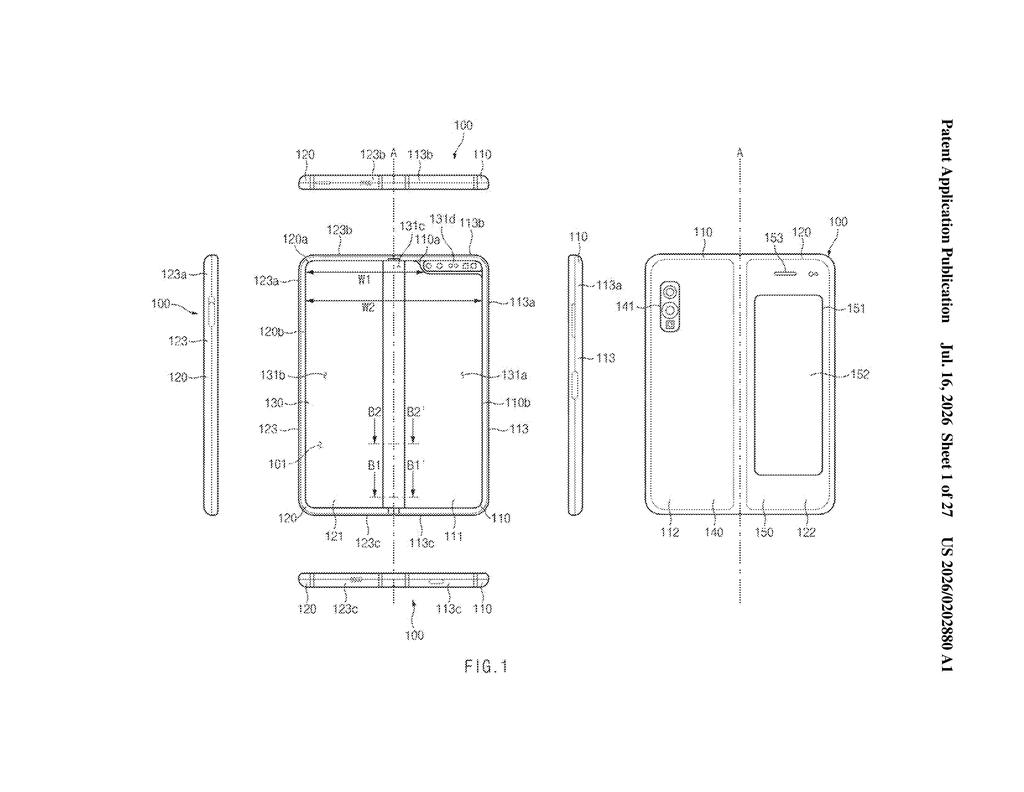
What Samsung's foldable hinge dust seal actually does
Imagine a tiny accordion-style door seal on a fold-out phone. Every time you open or close the device, that crease in the middle has a gap where the two halves meet the hinge, and dust loves to sneak in there over thousands of folds.
Samsung's patent describes a set of small structures placed along the inside edges of both phone halves, right where they meet the hinge. Some of these pieces act as spacers, keeping a controlled gap so parts don't grind against each other. Others act as seals, pressing against the outer surface of the hinge housing as the phone moves, blocking dust from getting inside.
The clever part is that the seals and spacers are lined up in a specific pattern along the fold axis. They're designed so that whether your phone is flat open, folded shut, or anywhere in between, at least part of the seal stays in contact with the hinge. It's a mechanical solution to a very everyday problem.
How the spacers and dustproof layers work together
The patent describes a foldable phone with two housings (the left and right panels) joined by a hinge structure inside a hinge housing (the spine of the device). Along the inner edges where each panel meets that spine, Samsung places two types of structures.
Spacer structures sit on the inner surface of each housing and maintain a precise, controlled gap between the housing and the hinge housing. This prevents the panels from sitting flush against the spine in a way that would cause friction or mechanical binding during folding.
Dustproof structures are aligned parallel to the folding axis alongside those spacers. These are the sealing elements. According to the claim, at least a portion of each dustproof structure is designed to contact the outer surface of the hinge housing as the phone transitions between folded and unfolded states.
The patent also references a support structure placed between the two dustproof structures along the length of the hinge. The geometry is set so that the support structure and the dustproof structures are either touching or separated by a distance smaller than the support structure's own length, ensuring consistent coverage and preventing large gaps from opening up at any fold angle.
What this means for Galaxy Z Fold durability
Dust infiltration is a real-world durability problem for foldable phones. Particles that enter the hinge mechanism can scratch the display, jam the fold, or wear down internal components over time. A reliable mechanical seal that works across the full range of motion addresses this at the hardware level, rather than relying on software workarounds or user behavior.
For Samsung specifically, this is relevant to the Galaxy Z Fold and Z Flip lines. If this approach makes it into production, it could translate into a measurable improvement in long-term durability ratings and fewer warranty complaints about hinge grit, which has been a consistent point of criticism for foldables across the industry.
This is unglamorous engineering work, but it's exactly the kind of thing that separates a foldable phone you'd trust to put in your pocket every day from one you treat like a fragile novelty. Dust resistance is a credibility problem for the foldable category, and a mechanical solution like this is more convincing than any IP rating claim.
Get our take in your Top Stories
Liked this breakdown? Add Patentlyze as a preferred source on Google, and our plain-English take shows up more often in your Top Stories the next time Samsung patent news breaks.
There are more where this came from
We read every patent application Big Tech publishes and send you the ones worth knowing. Plain English, free, every week.
Want this weekly breakdown for a company we don't cover? Patentlyze Pro →