
New Wristband Patent Cuts Noise in Muscle Signal Detection
Meta is building wristbands that can read the electrical signals your muscles produce, and this patent reveals a specific trick for making those readings cleaner and more accurate depending on which side of your arm the sensor is on.
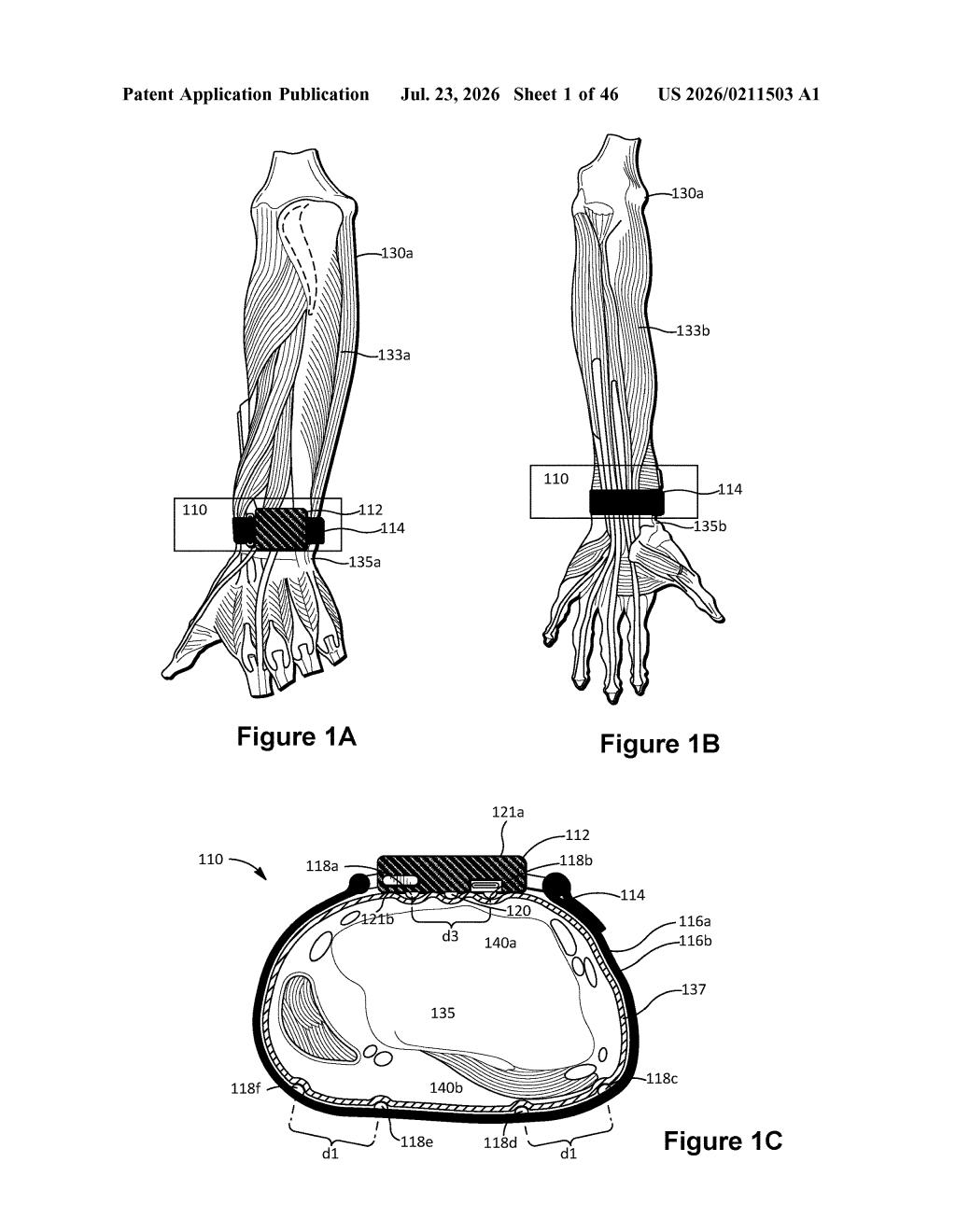
What Meta's muscle-signal wristband actually does
Imagine trying to listen to a quiet conversation in a room full of buzzing fluorescent lights. That's roughly the problem facing any device that tries to pick up the tiny electrical signals your muscles produce when you move your fingers or wrist. The electrical noise from power lines nearby can drown out the signal entirely.
Meta's patent describes a wristband packed with small sensors that sit against your skin. To get a cleaner read, each sensor's electronics are wrapped in a physical metal shield that blocks that outside electrical interference before it can corrupt the data.
But there's a subtler idea here too. The sensors aren't evenly spaced around your wrist. The ones on the top of your forearm (the side with your knuckles) are spaced farther apart, while the ones on the underside (the palm side) are closer together. That asymmetry is intentional: it's designed to match the different muscle structures on each side of your arm so the device captures the most useful signal from each spot.
How the sensor layout and EM shield cut interference
The patent covers two related ideas packaged into one wearable device meant to wrap around a user's forearm or wrist.
Electromagnetic shielding for each sensor channel: Every sensor on the band sits on a small circuit board. The electronic components that process the raw muscle signal (called analog components, meaning they handle the electrical signal before it gets converted to digital data) are mounted on the top of that board, while the sensor itself touches the bottom. A metal enclosure wraps around the sides and over those components, blocking power line interference, the 50 or 60 Hz electrical hum that radiates from household wiring and can look a lot like a biological signal to sensitive electronics.
Asymmetric sensor spacing: The wristband places sensors in two groups based on anatomy:
- Sensors on the dorsal side (back of the forearm, toward the knuckles) are spaced farther apart from each other.
- Sensors on the ventral side (underside, toward the palm) are spaced more closely together.
This spacing difference reflects the fact that the muscles on each side of the forearm are physically arranged differently. Tighter spacing on the palm side helps the device distinguish between closely packed muscle groups there, while wider spacing on the knuckle side captures broader signals from muscles that are more spread out.
What this means for Meta's wrist-control ambitions
Meta has been investing heavily in wrist-worn devices that translate muscle movements into computer commands, particularly for controlling AR glasses without touching a screen. Cleaner neuromuscular signal capture is the foundational problem that has to be solved before any of that works reliably in everyday environments, not just in a quiet lab. This patent addresses exactly that: reducing noise and improving spatial resolution of the sensor array at the same time.
For you as a potential user, this is the kind of under-the-hood work that determines whether a gesture-control wristband feels precise or frustrating. If the sensors can't tell the difference between you flexing your index finger and your middle finger, the device is useless for fine control. Getting the shielding and spacing right is what makes that distinction possible.
This is genuine engineering work on a hard problem. Picking up clean neuromuscular signals from a consumer wristband in a world full of electrical interference is not trivial, and the asymmetric sensor layout shows Meta has gone deep enough into forearm anatomy to tailor the hardware to it. Whether this level of sensor fidelity ever reaches a shipping product is another question, but the underlying thinking here is substantive.
There are more where this came from
We read every patent application Big Tech publishes and send you the ones worth knowing. Plain English, free, every week.
The drawings
46 drawing sheets from US 2026/0211503 A1 · click any drawing to enlarge


Want this weekly breakdown for a company we don't cover? Patentlyze Pro →