
Intel Patent: Edge Hardware Automatically Adjusts Network Settings Based on Connection Quality
When the connection between a remote computing device and a central server gets shaky, most systems just struggle through. Intel's new patent describes a way for those devices to automatically switch their communication settings to match whatever the network can handle.
What Intel's self-adjusting edge network system actually does
Imagine a small computer installed on a factory floor, processing data from sensors and sending results back to a server elsewhere in the building. If the Wi-Fi suddenly gets congested, that little computer doesn't complain or fail silently. Instead, it reads the current network conditions and adjusts how it talks to the server, picking a communication method and a priority order for its messages that fits the situation.
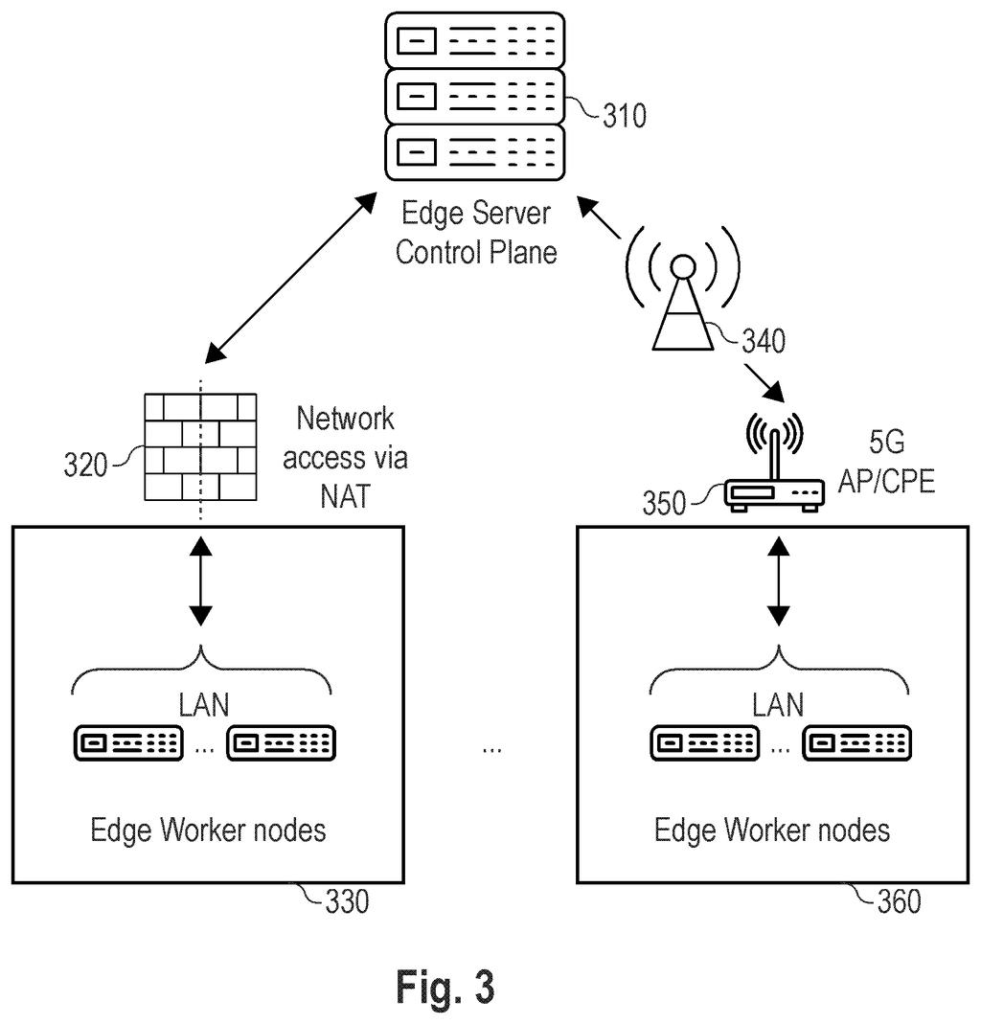
That's the core idea in this Intel patent. It covers what are called "edge worker nodes," which are compact computing devices placed close to where data is created, like in a warehouse, a hospital, or a construction site. These nodes need a reliable link back to an "edge server" that coordinates their work. The patent describes circuitry that checks the health of that link and automatically selects the best network protocol and message-priority strategy for the moment.
The goal is to keep edge computing running smoothly even when the network between devices and servers is unreliable or overloaded, without a human having to step in and reconfigure anything.
How the node reads connection quality and picks a protocol
The patent describes an apparatus built into an edge worker node, a device designed to process data locally rather than sending everything to a distant cloud server. The key function is a three-step loop:
- Measure: The node's processing circuitry continuously gathers information about the quality of its network connection to an edge server, things like bandwidth, packet loss, and latency (how fast data travels back and forth).
- Select: Based on those measurements, the node picks a network configuration. That configuration has two possible components: a network protocol (the set of rules governing how data is packaged and sent, for example choosing a lightweight protocol when bandwidth is tight) and a prioritization strategy (deciding which messages get sent first when the pipe is narrow).
- Communicate: The node then transmits data using whichever configuration it selected.
The same logic applies to the edge server side. A matching patent claim covers a server apparatus that does the mirror-image job: monitoring connection quality from its end and adjusting how it receives and responds to worker nodes.
The patent is protocol-agnostic, meaning it doesn't mandate a specific standard. The value is in the automatic selection mechanism, not the protocol itself.
What this means for factories, hospitals, and edge AI deployments
Edge computing is already deployed in settings where network reliability is far from guaranteed: factory floors with interference from heavy machinery, outdoor infrastructure sites, hospital wings with crowded wireless bands. In those environments, a fixed communication setup that works well under ideal conditions can fall apart under real ones. Intel's approach treats network adaptation as a built-in feature of the hardware, not something that requires a software update or an IT call.
For anyone deploying edge AI inference or real-time sensor processing, automatic protocol switching could mean the difference between a system that degrades gracefully and one that drops data or stalls entirely. This is infrastructure-level work, but the practical payoff is more reliable edge deployments without manual tuning.
This is a sensible, workmanlike patent covering adaptive networking for edge devices. It's not a conceptual leap, but Intel is making a clear bet that edge computing deployments will need self-managing network behavior as they scale into messy real-world environments. The filing is worth tracking if you follow industrial IoT or edge AI infrastructure, but it's unlikely to capture mainstream attention.
There are more where this came from
We read every patent application Big Tech publishes and send you the ones worth knowing. Plain English, free, every week.
The drawings
4 drawing sheets from US 2026/0213994 A1 · click any drawing to enlarge


Want this weekly breakdown for a company we don't cover? Patentlyze Pro →
Be the first to weigh in