
Intel Patents Hardware That Encrypts High-Speed Internet Traffic Directly on the Network Chip
Every time you load a modern website, QUIC — the protocol behind most of today's fast web connections — puts significant encryption work on your CPU. Intel's new patent wants to push that work off the processor and onto the network chip itself.
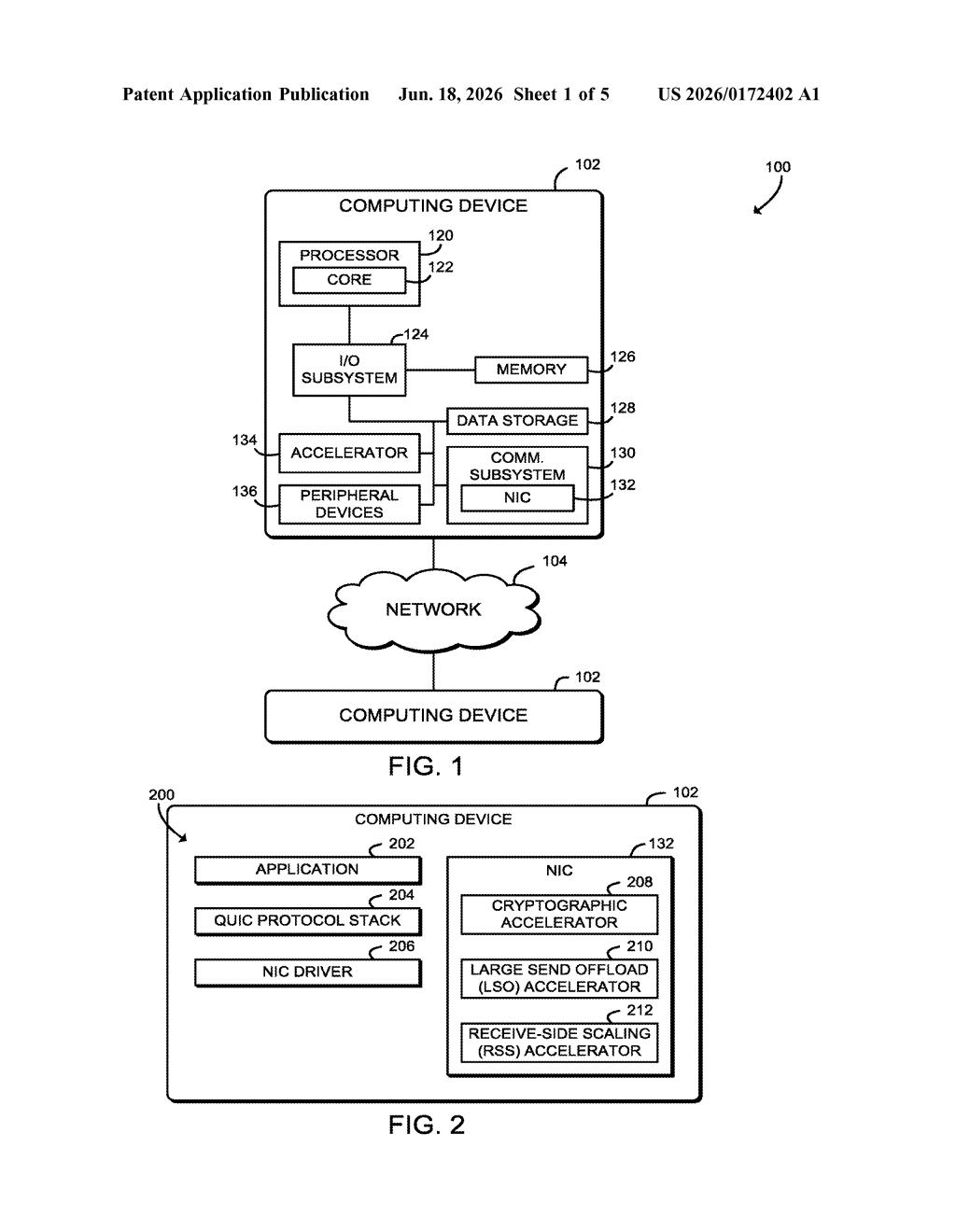
What Intel's hardware QUIC offload actually does
Imagine your computer as a busy restaurant kitchen. Right now, the head chef (your CPU) has to personally wrap every single dish before it leaves — encrypting and packaging each piece of data sent over the internet. That's fine when there's not much traffic, but at data center scale it becomes a real bottleneck.
Intel's patent describes handing that wrapping work to a dedicated station: the network controller chip (the hardware that physically sends and receives data). Instead of your CPU encrypting each packet, the network chip gets loaded with the right encryption keys and handles the whole process on its own — including chopping large chunks of data into smaller pieces before sending them out.
On the receiving end, the network chip also decrypts incoming packets and figures out which processor core should handle each one, routing traffic intelligently so no single core gets overloaded. The result, in theory, is faster throughput with less CPU strain — which matters most in cloud servers and data centers handling millions of connections at once.
How the network chip handles QUIC encryption and routing
QUIC (pronounced "quick") is a modern internet transport protocol — think of it as the plumbing beneath most Google services, many streaming platforms, and a growing share of the web. It bundles encryption directly into the connection, which is great for security but adds CPU overhead every time data is sent or received.
Intel's patent describes a system where the network interface controller (NIC) — the dedicated chip that manages network traffic — takes over the heavy lifting:
- Encryption offload: The CPU programs the NIC with a QUIC session's encryption key, then hands off raw packets. The NIC encrypts them autonomously before transmission, freeing the CPU for other work.
- Segmentation: For large payloads, the NIC splits data into correctly sized QUIC packets before encrypting — similar to how TCP segmentation offload works today, but applied to QUIC's structure.
- Receive-side routing: Incoming encrypted packets are decrypted by the NIC, which then evaluates an assignment function (a formula that uses identifiers inside the packet as a source of variation) to decide which CPU core's receive queue gets each packet. This spreads load evenly across cores.
The architecture mirrors established offload techniques for older protocols but adapts them specifically to QUIC's encryption-first design, which has made hardware acceleration harder to implement until now.
What this means for data centers and web performance
For ordinary users, QUIC is already invisible — it's just what makes websites load fast. But for the cloud providers and data center operators running thousands of servers, CPU cycles spent on encryption are CPU cycles not spent on actual application work. Offloading QUIC to the NIC could meaningfully raise the number of connections a single server handles, or lower the compute cost per connection — both of which eventually affect the economics of cloud services you use every day.
Intel has been pushing NIC-level offloads for years as a way to differentiate its data center networking hardware. This patent extends that strategy to QUIC, which has become the dominant protocol for HTTP/3 traffic. Whether it ships as a feature in future Intel Ethernet controllers is an open question, but the direction is consistent with where the company's infrastructure networking lineup has been heading.
This is solid, unglamorous infrastructure engineering. QUIC offload is a real and recognized problem in data center networking, and Intel filing in this space makes complete sense given its Ethernet controller business. The canceled independent claims (1–19) in this publication are a procedural artifact of patent prosecution, not a sign the patent is dead — dependent claims and continuations often survive. Worth tracking if you follow Intel's networking silicon roadmap.
There are more where this came from
We read every patent application Big Tech publishes and send you the ones worth knowing. Plain English, free, every week.
Want this weekly breakdown for a company we don't cover? Patentlyze Pro →