
Salesforce Patents a Real-Time Dashboard for Watching and Overriding AI Agents
As companies hand more decisions over to AI agents, the obvious question is: who's watching? Salesforce's new patent describes a system that logs every AI decision, explains it in plain English, and lets a human step in when something looks off.
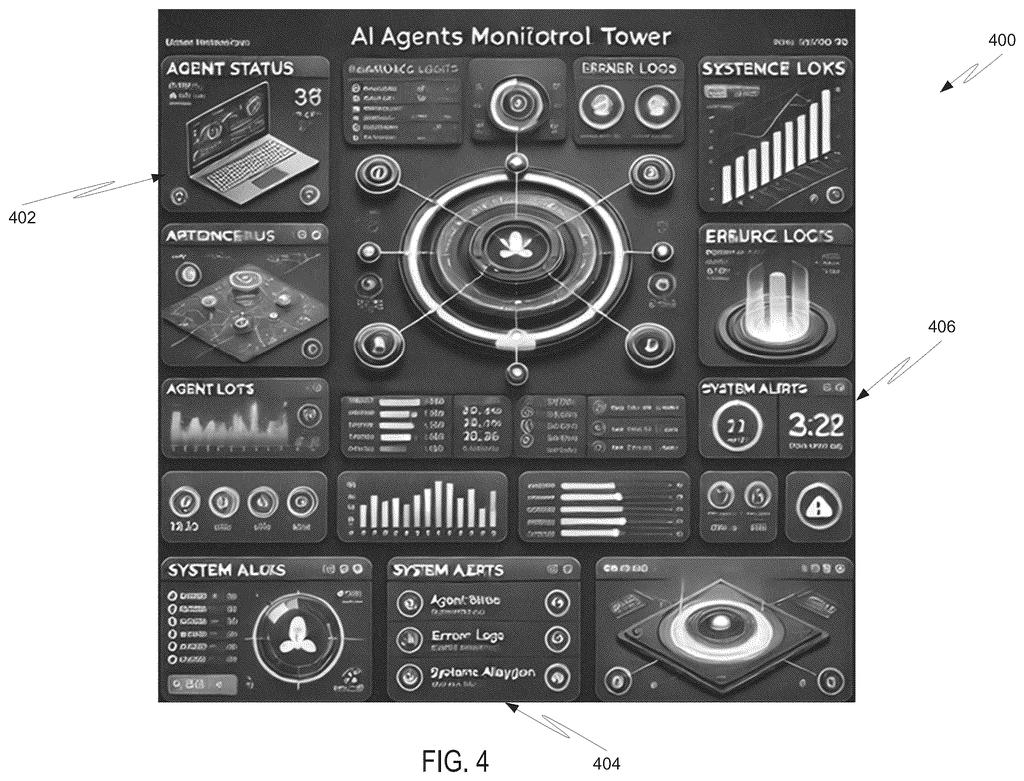
What Salesforce's AI oversight system actually does
Imagine your company has a team of AI agents handling customer service, sales outreach, or data processing. They're making dozens of decisions every minute, but right now you have no easy way to see why they made any given call or catch a mistake before it causes real damage.
Salesforce's patent describes a control panel that watches all those AI agents at once. It records what each agent saw, how it reasoned through a problem, and what it decided to do. Then it translates that reasoning into plain language, so a human manager doesn't need a computer science degree to understand what's going on.
If an agent's behavior drifts outside acceptable limits, the system fires off an alert and lets the human override or correct it on the spot. Think of it less like a kill switch and more like a flight operations center for AI workers.
How the system logs, translates, and flags AI decisions
The patent describes a processor-based system that monitors multiple AI agents simultaneously and exposes their decision-making to human supervisors through a real-time dashboard.
Four core steps make up the process:
- Logging: Every action an agent takes is recorded, including the raw data it received, the internal reasoning steps it followed, and the final decision it reached.
- Translation: The system converts those internal reasoning steps into human-readable explanations, so a non-technical manager can read a plain-language summary of why the agent did what it did.
- Feature detection: The system identifies which specific data points most influenced each decision, essentially highlighting the evidence the agent found most compelling.
- Alerting and control: Decisions are compared against pre-set performance standards. When a decision falls outside those standards, an alert fires and the human can intervene directly from the same interface.
The patent frames this as a closed loop: humans see what AI agents are doing, understand why, and can pull the lever when needed. The logging architecture is designed to capture decision processes, not just outcomes, which is the part that makes the plain-language translation possible.
What this means for businesses running AI agents
Businesses are deploying AI agents in Salesforce's own CRM and automation tools to handle tasks that used to require human judgment. Without a clear audit trail and override mechanism, a miscalibrated agent can make bad calls at scale before anyone notices. This patent addresses exactly that gap by treating AI oversight as a first-class feature rather than an afterthought.
For enterprise customers, this kind of explainability is increasingly a legal and compliance requirement, not just a nice-to-have. Regulators in the EU and parts of the US are already asking companies to demonstrate they understand what their automated systems are doing. A built-in audit-and-override layer would make that conversation a lot easier.
This is a sensible, practical patent that addresses a real problem without overpromising. AI agent oversight is one of the most pressing enterprise software challenges right now, and Salesforce is in a strong position to bake it into its Agentforce platform. The concept is not exotic, but execution at scale in a live CRM environment is genuinely hard, and the combination of real-time logging, plain-language translation, and threshold-based alerting in one interface is a coherent design.
There are more where this came from
We read every patent application Big Tech publishes and send you the ones worth knowing. Plain English, free, every week.
The drawings
7 drawing sheets from US 2026/0212230 A1 · click any drawing to enlarge


Want this weekly breakdown for a company we don't cover? Patentlyze Pro →