
Microsoft Patent Proposes Plain English Rules to Govern AI Agent Access
Right now, telling an AI agent what it's allowed to access requires writing rigid code-based rules. Microsoft wants to replace that with plain English, letting a language model itself figure out which doors the agent can open.
What Microsoft's natural-language AI permissions actually do
Imagine you're a manager onboarding a new contractor. Instead of handing IT a spreadsheet of folder permissions, you just write: "This assistant can see sales reports from the last two quarters, but nothing from HR." Microsoft's patent describes a system that works exactly like that, but for AI agents.
Today, granting an AI agent access to specific files or data usually means a developer writes precise technical rules. Microsoft's approach lets those rules be written in ordinary language. A built-in language model reads the description, figures out which actual files or systems match the intent, and grants access accordingly.
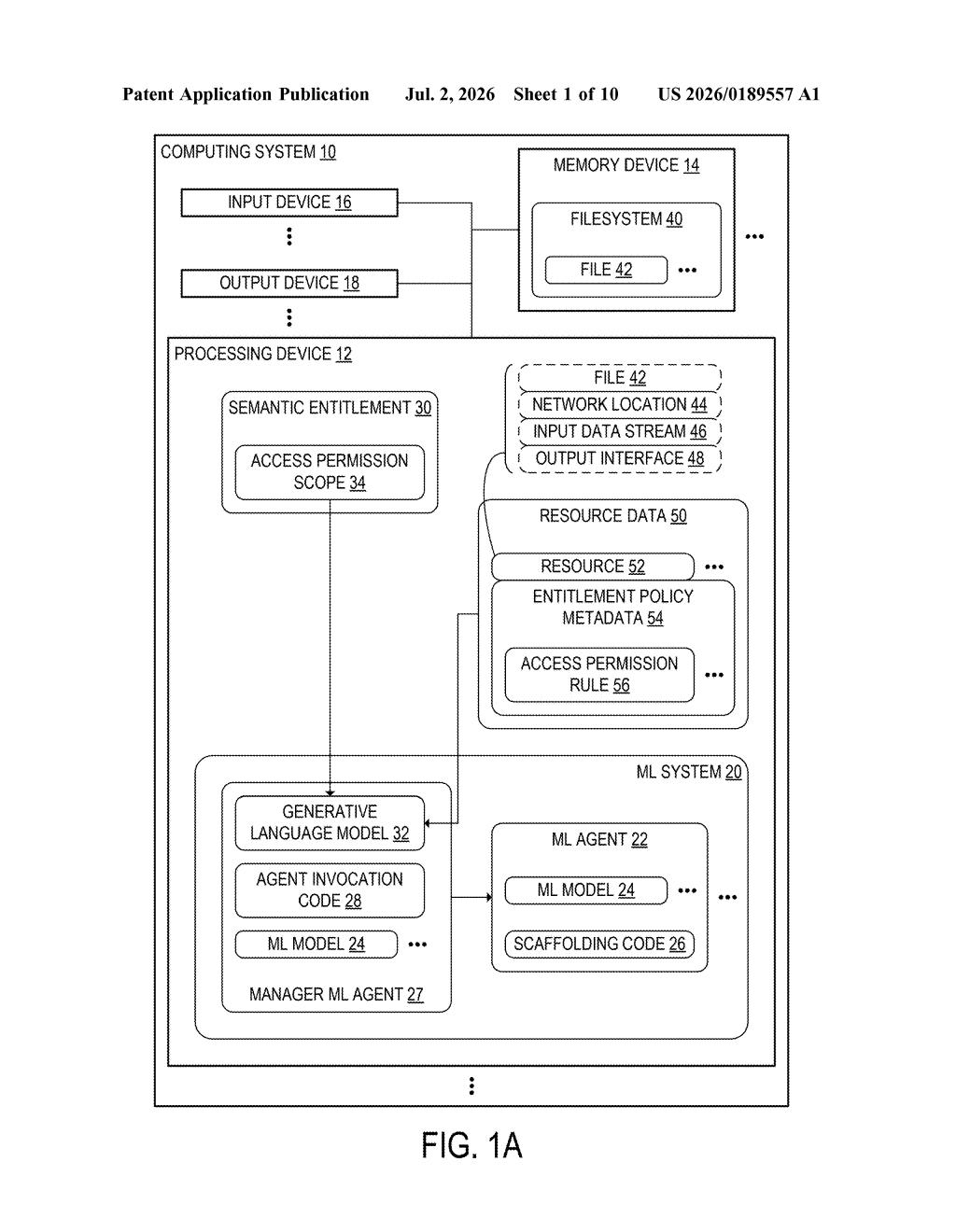
The agent then does its job using only what it's been allowed to see, and passes its results on to whatever asked for them. The permission scope travels with the agent as a semantic entitlement, a plain-language description of what it's allowed to do.
How the system translates plain-English rules into resource access
The patent describes a computing system built around what Microsoft calls a semantic entitlement: a permission definition written in natural language (plain English) rather than in code or rigid policy syntax.
Here's how the pipeline works:
- An administrator or system writes a natural-language description of what an ML agent is allowed to access, for example, "read access to customer tickets from the past 30 days."
- A generative language model (an AI model trained to understand text, similar to GPT-style systems) processes that description and interprets which actual data sources, files, or services fall within the described scope.
- The system grants the specific ML agent access only to those identified resources.
- The agent computes its output using the permitted resources, then passes the result to another process or user.
The key technical claim is that access control doesn't need to be pre-coded for every possible resource. Instead, the language model does the matching at runtime, interpreting the intent of the permission and resolving it against whatever resources are actually available. This makes permissions flexible and portable across different environments without requiring rule rewrites.
What this means for businesses running AI agents on sensitive data
Enterprises deploying AI agents inside their systems face a real headache: every agent needs carefully scoped permissions so it doesn't accidentally read payroll data when it was only supposed to summarize support tickets. Today that scoping is largely manual and technical. A natural-language permission layer could let non-technical administrators define agent boundaries in plain terms, reducing both the bottleneck on IT teams and the risk of misconfigured access.
For Microsoft, this fits directly into its Copilot and Azure AI strategy, where AI agents are being woven into enterprise workflows across Office, Teams, and cloud services. If agents can carry their own human-readable permission rules, deploying them across different clients or projects becomes much less brittle.
This is a genuinely practical problem in enterprise AI, and Microsoft is one of the few companies with both the distribution and the model infrastructure to actually ship this kind of solution. The interesting bet here is that a language model is trustworthy enough to correctly interpret permission intent, which is a non-trivial assumption when the stakes involve access to sensitive business data. Worth watching closely as AI agent deployments scale.
Get our take in your Top Stories
Liked this breakdown? Add Patentlyze as a preferred source on Google, and our plain-English take shows up more often in your Top Stories the next time Microsoft patent news breaks.
There are more where this came from
We read every patent application Big Tech publishes and send you the ones worth knowing. Plain English, free, every week.
Want this weekly breakdown for a company we don't cover? Patentlyze Pro →