
Nvidia Patent Teaches Virtual Characters to Move and Think with Hybrid AI
Getting a video game character to walk, run, and climb stairs without looking like a puppet is genuinely hard. Nvidia's new patent describes a training method that first teaches an AI to copy human movement, then pushes it to figure out those moves on its own.
How Nvidia's two-phase character animation training works
Imagine teaching someone to dance by first showing them a video of an expert, then telling them to perform on a stage with no video, only a score for how convincing they look. That's roughly what this patent describes, but for virtual characters controlled by AI.
Nvidia's system trains one AI model in two stages. First, it watches recorded human motion (like motion-capture data) and learns to copy it, earning points for accuracy. Then, a second AI acts as a judge, watching the character move toward a goal like reaching a target or picking up an object, and grading whether the movement looks natural, even without a specific clip to compare to.
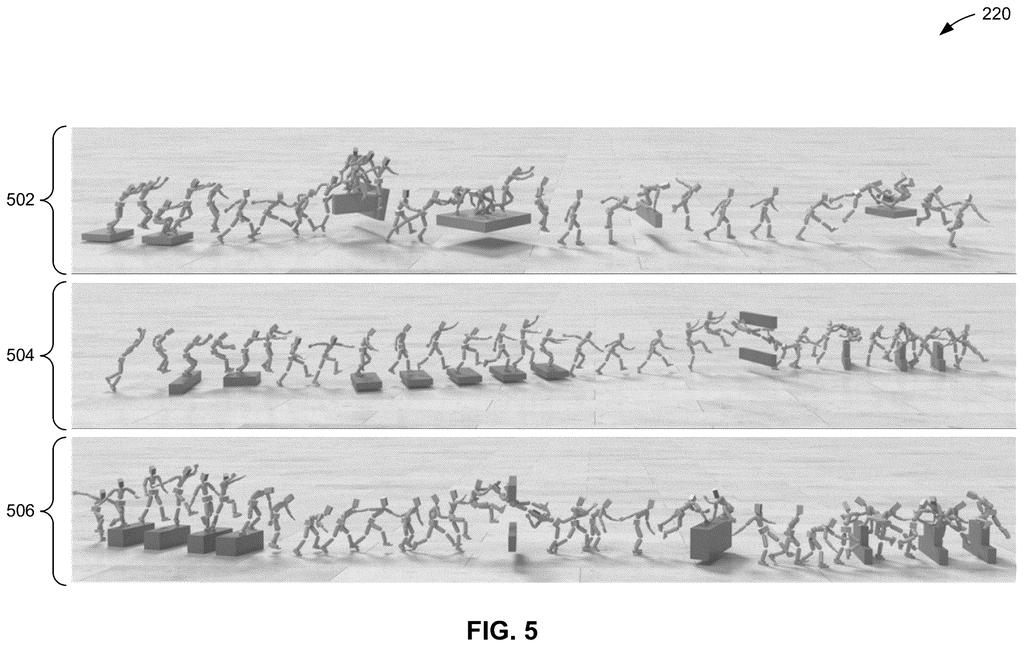
The result is a character that moves fluidly in situations it was never directly shown. For you as a player or viewer, that means characters that feel less robotic and more believable, especially when doing something the animators never manually captured.
Inside the discriminator-and-reward training loop
The patent describes a hybrid imitation learning framework that trains a single policy model (the AI brain that decides how a character moves) using two distinct feedback signals.
- Phase 1 (reference tracking): The policy generates movements, and those movements are scored by comparing them directly to a recorded reference motion, like motion-capture footage of a real person walking. The closer the match, the higher the reward.
- Phase 2 (goal-conditioned generation): The policy is given a task goal (say, move to a point on the map) but no reference clip to copy. Instead, a second AI called a discriminator (a model trained to tell real human movement from fake movement) watches the output and scores how natural it looks. High scores go to motion that passes as human; low scores go to stiff or unnatural motion.
Both sets of scores are combined to update the policy's internal parameters. Over thousands of iterations, the model gets better at producing human-like motion even in novel situations where no reference footage exists. The discriminator acts as an always-on quality filter, meaning the character can't get away with awkward shortcuts just because nobody filmed a human doing that exact thing.
What this means for games, robots, and AI-driven animation
For game studios and animation pipelines, this matters because hand-animating every possible action a character might take is expensive and time-consuming. A system that learns the feel of human movement, not just specific clips, can fill in gaps automatically. Characters could react to unexpected terrain, unusual player inputs, or complex physics without artists having to script every frame.
The same principle applies to robotics: physical robots face exactly this problem, needing to generalize from training examples to messy real-world situations. Nvidia has a strong stake in both markets through its simulation platform Omniverse and its Isaac robotics stack, so this kind of research feeds directly into those products.
This is solid, meaningful research in a competitive area that includes academic labs and companies like DeepMind and OpenAI. The hybrid approach (copy first, generalize second) is a sensible architectural choice, and the discriminator-as-judge setup is well-established enough that a granted patent here would likely cover the specific implementation details rather than the broad concept. Worth watching, especially if you follow robotics or game AI.
There are more where this came from
We read every patent application Big Tech publishes and send you the ones worth knowing. Plain English, free, every week.
The drawings
8 drawing sheets from US 2026/0212573 A1 · click any drawing to enlarge


Want this weekly breakdown for a company we don't cover? Patentlyze Pro →