
Nvidia Patent Reveals How Simulated Video Could Train Future Humanoid Robots
Instead of filming millions of hours of real-world footage to teach robots how to move, Nvidia wants to generate that footage entirely on computers and feed it into AI training on a massive, continuous loop.
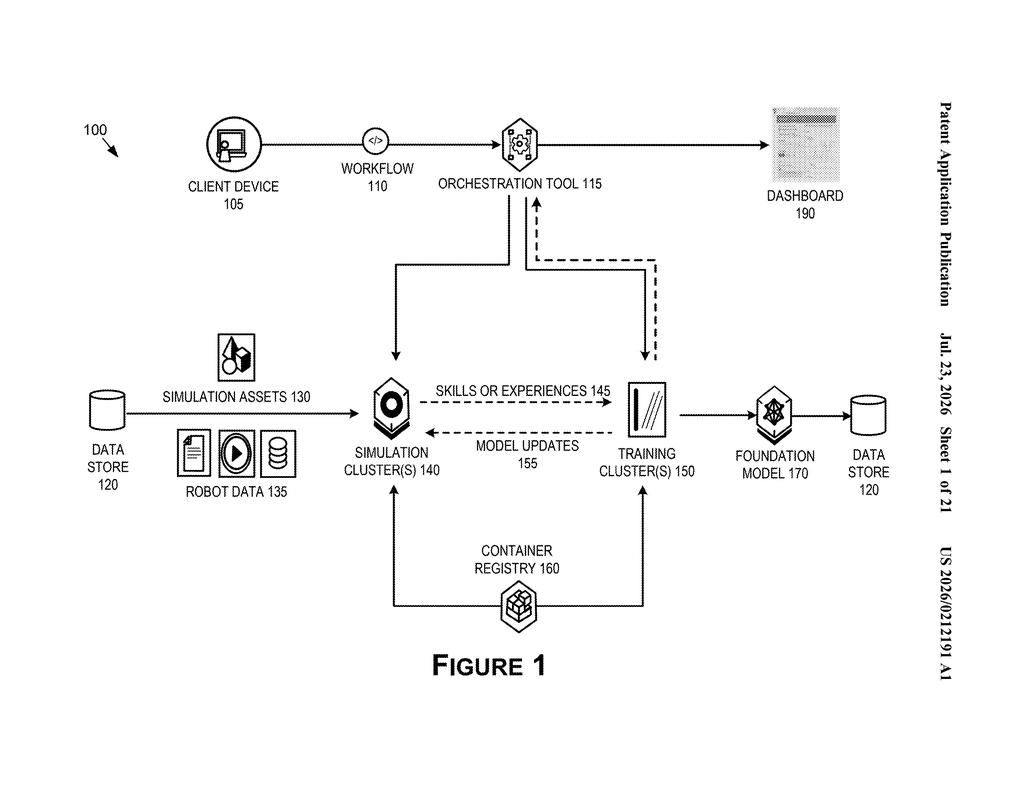
How Nvidia's robot brain factory actually works
Imagine trying to teach a new employee every possible thing that could go wrong on a factory floor. You could film years of real footage, or you could just run a video game simulation and generate millions of realistic scenarios in an afternoon. That's essentially what Nvidia is patenting here.
Nvidia's system uses a network of data centers arranged like a bicycle wheel: one central "hub" that stores everything, and multiple "spoke" facilities that each run simulated environments. Those spoke facilities crank out synthetic videos showing robots doing tasks, and that footage is instantly used to train AI models at the hub. As soon as the AI gets an update, the new model gets tested against fresh simulations, and the cycle repeats.
The goal is to train humanoid robots and other physical AI systems without needing real-world data, which is expensive and slow to collect. By running simulations and training in parallel, the system never really stops learning.
Inside the hub-and-spoke simulation pipeline
The patent describes a cyclic workflow built across a hub-and-spoke data center architecture. Here's how the pieces fit together:
- Simulation clusters (the spokes): Multiple data centers each run many simultaneous instances of a simulation environment (Nvidia specifically names Isaac Sim, its own robotics simulation platform). These generate synthetic video footage of robots performing tasks in virtual environments.
- Networked file system (the hub): All that synthetic video flows into a shared, high-bandwidth file system sitting at the central hub data center. Think of it as a constantly filling reservoir of training material.
- Training clusters (the hub or spokes): Separate clusters pull video from that file system and run supervised learning (a training technique where the AI learns by comparing its outputs to labeled correct answers) on multiple copies of a robotics foundation model simultaneously.
The key innovation is that neither side waits for the other. Simulation keeps generating new synthetic data while training keeps consuming it, producing updated model versions in a continuous loop. Each iteration feeds the next, so the AI is always training on the freshest possible simulated footage rather than a fixed dataset that goes stale.
What this means for the race to build humanoid robots
Training a physical AI, like a humanoid robot, requires enormous amounts of varied data: the robot needs to see thousands of scenarios, lighting conditions, object placements, and failure modes before it can handle the real world reliably. Collecting that data in the real world is slow and costly. A system that generates and consumes synthetic training data at data-center scale could dramatically cut the time it takes to get a capable robot model.
Nvidia already sells simulation tools and AI training hardware, so this architecture plays directly into its existing business. If the approach works at scale, it could give Nvidia's robotics customers a significant head start over anyone still relying on real-world data collection pipelines.
This is infrastructure plumbing, but important plumbing: the gap between a robot that works in a lab and one that works in a warehouse is largely a data problem, and Nvidia is directly attacking it. The continuous simulation-train loop is a logical extension of techniques already used in game-playing AI, and applying it at data-center scale for physical robots is a serious engineering bet worth watching.
Get our take in your Top Stories
Liked this breakdown? Add Patentlyze as a preferred source on Google, and our plain-English take shows up more often in your Top Stories the next time Nvidia patent news breaks.
There are more where this came from
We read every patent application Big Tech publishes and send you the ones worth knowing. Plain English, free, every week.
The drawings
21 drawing sheets from US 2026/0212191 A1 · click any drawing to enlarge


Show the other 13 sheets


Want this weekly breakdown for a company we don't cover? Patentlyze Pro →