
Nvidia Patents AI That Predicts How a Robot's Body Will Move
Training a robot in simulation only helps if the simulation is accurate. Nvidia is patenting a neural network that learns to predict robot physics well enough to transfer that knowledge across completely different tasks and environments.
How Nvidia's robot physics simulator actually works
Imagine you're trying to teach someone to catch a ball by only showing them videos. The tricky part isn't showing them the motion, it's making sure the rules of physics in those videos match real life closely enough that the lessons stick. Robots have exactly this problem.
Nvidia's patent describes a system where a neural network learns to simulate how a robot's body behaves, meaning how its joints move, how it makes contact with objects, and what forces are acting on it at any given moment. Instead of relying on hand-coded physics equations, the network learns those rules from data.
The key promise here is generalization: the same simulator is supposed to work whether the robot is sorting packages, assembling parts, or navigating a warehouse floor. That flexibility is the hard part, and it's exactly what this patent is trying to solve.
… generating, via execution of a machine learning model and based on the set of state attributes and the set of contact features, a change to a first state of the articulated object at the current time step …
Translation: An AI model calculates how a robot's body position will shift based on its current status and physical contacts.
How the neural model predicts each robot's next move
The patent describes a neural simulator that takes a robot's current physical state and predicts what that state will look like one time step into the future. Think of it like a very fast, learned weather forecast, but for a robot's joints and body instead of clouds.
At each step, the system gathers several types of input:
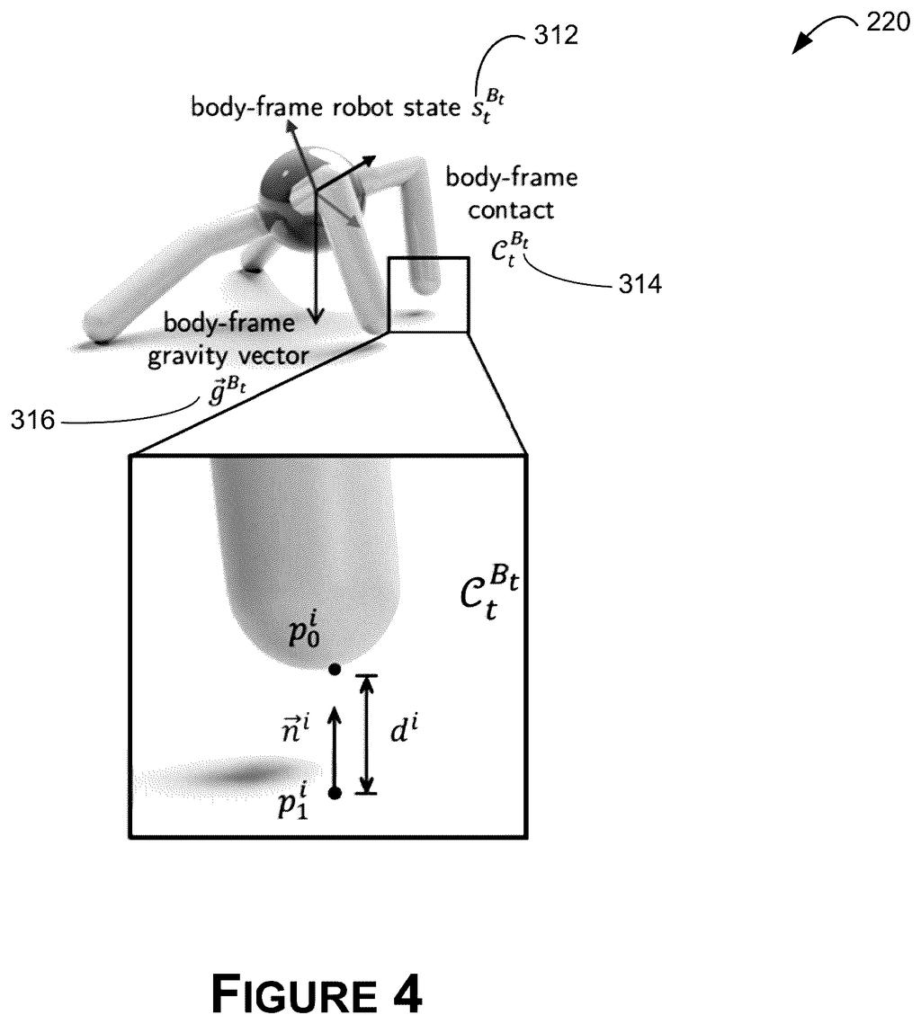
- Spatial state: the robot's position, orientation, joint angles, and velocities, all converted into a coordinate frame that doesn't depend on where in the world the robot happens to be sitting (called a spatially invariant representation, meaning the math stays the same whether the robot is in Tokyo or Texas).
- Joint torques: the forces being applied to each joint by the controller (the software telling the robot what to do).
- Contact features: information about what the robot is touching, where, and with how much force.
- Projected gravity: which way "down" is, relative to the robot's current orientation.
Given those inputs, a machine learning model outputs a predicted change in the robot's state. That predicted change is then added to the current state to produce the next state. The loop repeats, step by step, simulating the robot's motion forward in time.
… the neural simulator generates corresponding output that includes a difference between the robot state for the current time step and the robot state for the next time step …
Translation: The virtual simulator predicts how the robot's physical configuration changes from one moment to the next.
What this means for real-world robot deployment
Physical simulators for robots have traditionally been built by hand, encoding the laws of physics explicitly. That works reasonably well in controlled environments, but breaks down when surfaces are irregular, objects are deformable, or conditions change in ways the programmers didn't anticipate. A learned simulator can, in theory, capture those messy real-world effects more accurately because it trained on actual data rather than idealized equations.
For Nvidia, whose Isaac robotics platform already depends heavily on simulation-based training, a more generalizable physics model could mean robots that transfer from the simulator to the real world with fewer failures. That gap, known in robotics as the "sim-to-real" problem, is one of the biggest practical obstacles between today's research robots and tomorrow's warehouse or factory workers.
This is serious robotics infrastructure work, not a headline product feature. The sim-to-real gap is a real and stubborn problem, and a learned physics model that generalizes across tasks would be genuinely useful. The claim of broad generalization across controllers, environments, and tasks is ambitious, and the patent doesn't show how well it actually performs in practice, but the approach is well-grounded in current robotics research.
There are more where this came from
We read every patent application Big Tech publishes and send you the ones worth knowing. Plain English, free, every week.
The drawings
13 drawing sheets from US 2026/0225241 A1 · click any drawing to enlarge


Want this weekly breakdown for a company we don't cover? Patentlyze Pro →
Be the first to weigh in