
Nvidia Patents a Smarter Denoising Filter for Ray-Traced Shadows
Ray-traced shadows look stunning, but cleaning up their noise is expensive. Nvidia's patent describes a way to skip that cleanup work entirely in areas where it wouldn't matter anyway.
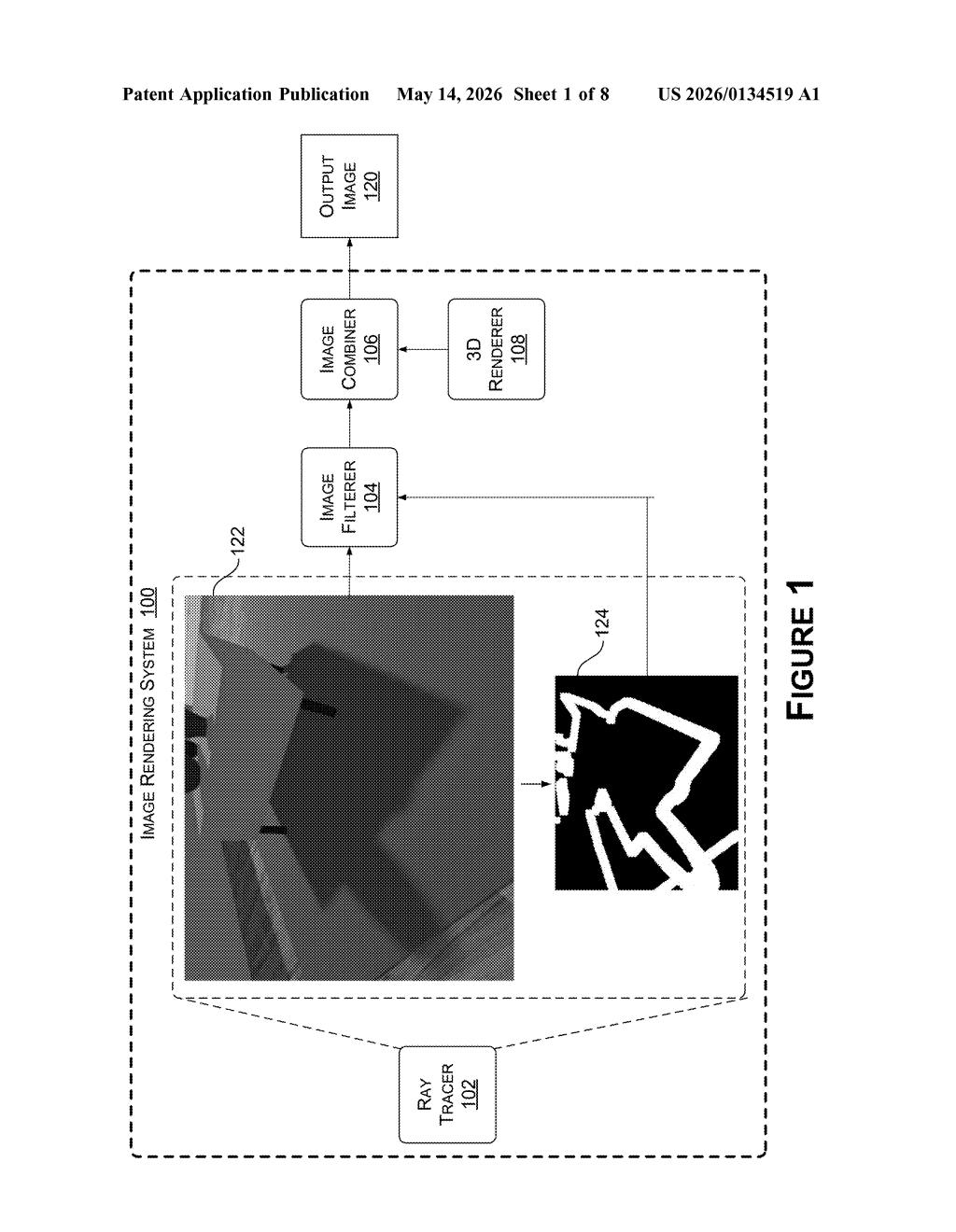
How Nvidia skips unnecessary shadow smoothing in ray tracing
Imagine you're playing a game with ray-traced lighting. The edges of shadows — the soft, blurry zones where light partially reaches — are called penumbras. Those are the only areas that actually need noise reduction after ray tracing calculates them. The fully lit spots and the fully dark spots? They're already clean.
Nvidia's patent describes a method where the GPU figures out, before doing any expensive filtering work, which areas of the screen fall inside a penumbra and which don't. It does this by having groups of threads share their shadow-sampling results with each other on the fly, so the whole group can collectively decide whether their pixels are in a 'soft edge' zone worth processing.
The upshot is that the denoising filter — which smooths out the grainy look of ray-traced shadows — only runs where it's actually needed. That saves GPU time and potentially translates into better frame rates or higher quality at the same performance cost.
How the warp detects penumbra regions before denoising
The patent describes a GPU scheduling trick built around how parallel processors group their work. On Nvidia hardware, threads are bundled into units called warps (AMD calls them wavefronts) — small clusters of threads that execute together in lockstep.
Each thread in a warp corresponds to a pixel in the rendered image. Each thread casts one or more rays from its pixel's position toward a light source to test visibility — basically asking 'can this pixel see the light?' The results of those ray casts are the first values the patent refers to.
Here's the clever part: using a wave intrinsic function (a low-level GPU instruction that lets threads within the same warp instantly read each other's data without going through slow memory), the threads share their visibility results. The warp collectively computes a second value that classifies their shared region as:
- Fully lit — no denoising needed
- Fully in shadow — no denoising needed
- In a penumbra (partially lit, soft edge) — denoising required
Only regions flagged as penumbras get passed to the denoising filter. Fully lit or fully shadowed regions are skipped entirely, avoiding unnecessary compute on pixels whose values are already stable.
What this means for real-time ray-traced lighting performance
Ray-traced shadows are one of the most computationally demanding parts of modern real-time rendering. Denoising — the post-process step that smooths out the statistical noise inherent in stochastic ray tracing — is itself expensive. Any technique that narrows down where that work happens matters a lot in a frame budget measured in milliseconds.
For you as a player or developer, this is the kind of optimization that quietly enables better shadow quality at the same frame rate, or helps ray tracing run on mid-range GPUs that don't have the headroom to brute-force denoise every pixel. It's also worth noting this is a continuation of a patent chain going back to 2021, which suggests the underlying technique is already shipping in some form — possibly inside Nvidia's existing RTX denoising stack.
This is genuinely useful infrastructure work, not a flashy research demo. The penumbra-detection shortcut is elegant because it exploits something the GPU hardware already does — thread-level data sharing within a warp — rather than adding new passes or memory overhead. The fact that this is a continuation of a 2021 filing that already resulted in two granted patents (11,727,535 and 12,505,515) strongly suggests this is real shipping technology, not speculative IP.
Get our take in your Top Stories
Liked this breakdown? Add Patentlyze as a preferred source on Google, and our plain-English take shows up more often in your Top Stories the next time Nvidia patent news breaks.
There are more where this came from
We read every patent application Big Tech publishes and send you the ones worth knowing. Plain English, free, every week.
Want this weekly breakdown for a company we don't cover? Patentlyze Pro →