
Samsung Patents a Cooling Assembly That Pulls Heat Away From Refrigerator Components
Samsung is patenting a specific way to hold the hot and cold sides of a thermoelectric cooling unit firmly in place inside a refrigerator, using a pair of interlocking support structures and fasteners.
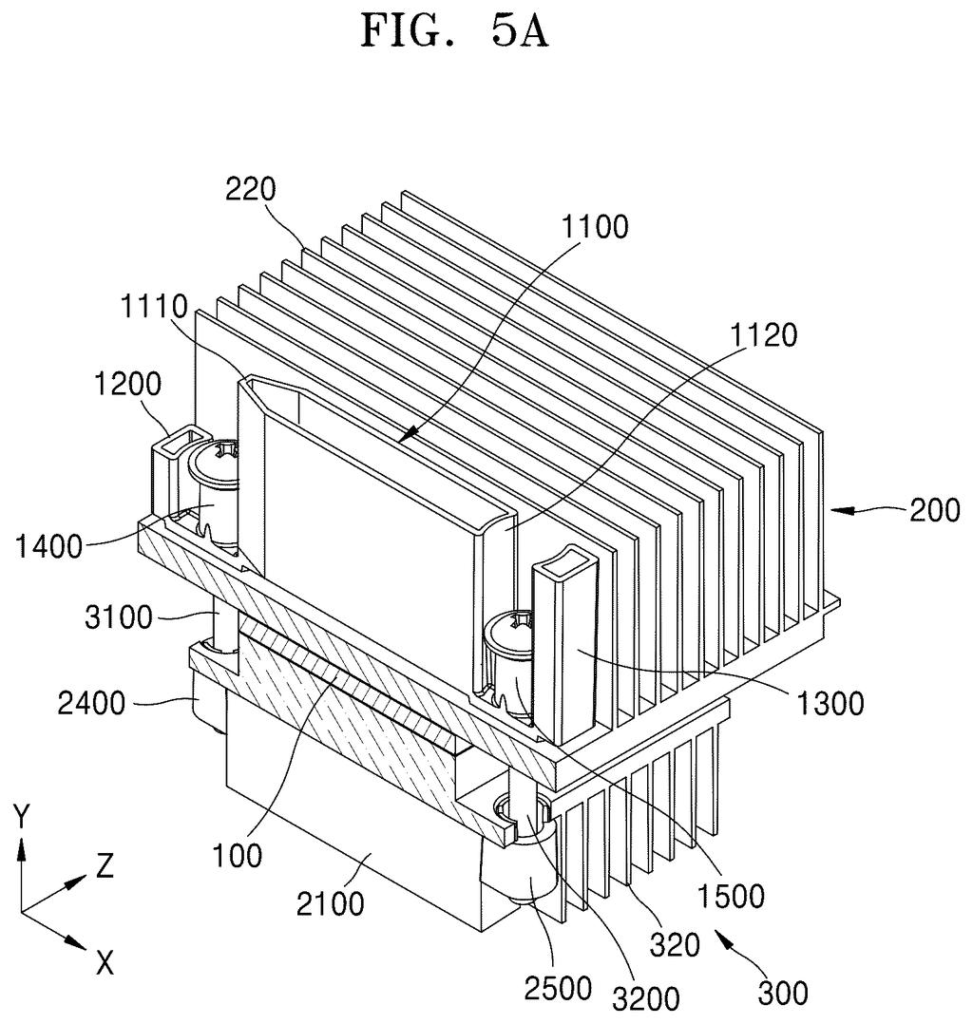
What Samsung's fin-clamping cooling assembly actually does
Imagine the cooling element inside your refrigerator as a thin slab with one side that gets hot and one side that stays cold. Rows of metal fins are attached to each side to spread that heat or cold more efficiently, but keeping those fins locked in exactly the right position is harder than it sounds.
Samsung's patent describes a bracketing system that slots between those fin rows on both sides and then clamps the whole assembly together with two fasteners. Think of it like a sandwich clip: one bracket sits between the hot-side fins, another sits between the cold-side fins, and bolts pull them toward each other so nothing shifts.
The goal is to keep the cooling element and its fins in firm, stable contact during everyday use, which helps heat move where it's supposed to go and cold stay where you need it.
How the support structures hold the fin arrays in place
The patent centers on a cooling element module, a flat plate with two opposite faces: one that radiates heat outward and one that absorbs heat from inside the refrigerator compartment. This is consistent with a thermoelectric cooler (a solid-state device that moves heat using electricity, with no refrigerant or compressor required).
On the heat-radiating face sits a first heat sink made of metal fins. On the heat-absorbing face sits a second heat sink made of cooling fins. Both sets of fins need to stay pressed firmly against the module to work properly.
- A first support structure threads between the hot-side fins and includes three radiator supports arranged in the direction airflow enters, plus two fastening tabs on either side.
- A second support structure threads between the cold-side fins and includes two fastening tabs spaced in the same airflow direction, with a central support running along the cold face.
- A first fastening device and a second fastening device bolt these two structures together perpendicular to the airflow direction, clamping both fin arrays tightly against the module.
The perpendicular fastening direction is notable: it lets the bolts pull the hot and cold sides toward each other without interfering with the direction air flows through the fins.
What this means for refrigerator cooling reliability
Thermoelectric coolers are attractive for refrigerators because they have no moving parts and no refrigerant, but they are sensitive to how well their heat sinks are attached. Even small gaps between the fin array and the cooling element surface reduce efficiency noticeably. A rigid, two-sided clamping structure like this one helps maintain consistent contact over years of vibration and temperature cycling.
For consumers, this kind of mechanical detail rarely shows up in a product spec sheet, but it directly affects whether a refrigerator runs efficiently, and without the hot-and-cold inconsistencies that plague cheaper thermoelectric designs. Samsung's refrigerator lineup already includes models using thermoelectric elements in wine coolers and specialty compartments, so this is incremental but practical engineering work.
This is an unglamorous assembly patent about brackets and bolts, and there is no reason to pretend otherwise. That said, thermoelectric refrigeration is a real growth area for premium and specialty appliances, and mechanical stability is a genuine engineering problem in that space. It is not exciting reading, but it is the kind of detail that separates a product that lasts from one that doesn't.
There are more where this came from
We read every patent application Big Tech publishes and send you the ones worth knowing. Plain English, free, every week.
The drawings
39 drawing sheets from US 2026/0210589 A1 · click any drawing to enlarge


Want this weekly breakdown for a company we don't cover? Patentlyze Pro →
Be the first to weigh in