
Samsung Patents Display Technology That Dims Each Dot Precisely by Cutting Its Power at Exact Moments
Samsung is patenting a new way to control individual pixels in inorganic LED displays, using a self-timing circuit that cuts power to each light at precisely the right moment based on a small charge building up inside the pixel itself.
How Samsung's timed pixel cutoff controls LED screens
Imagine a tiny light switch inside every single dot on a display. Samsung's patent describes a circuit that controls exactly when each of those dots turns off, without needing the main processor to micromanage every one of them.
The trick is a small electrical component inside each pixel that slowly charges up like a mini battery. Once it hits a set voltage, it automatically blocks the current flowing to the light. The pixel turns off on its own schedule, not because something external told it to.
Why does that matter? In displays made from inorganic LEDs (think next-generation screens that are brighter and more durable than OLED), precise control of each pixel's on-time is critical for accurate brightness. This approach offloads that timing work to the pixel itself, which could make displays more efficient and accurate.
How the capacitor charge triggers the switching transistor
The patent describes pixel circuitry split into two cooperating parts.
- First circuitry includes a switching transistor (a tiny gate that controls whether current flows to the LED). It supplies the actual light-producing current based on a control voltage sent from a central driving unit.
- Second circuitry includes a charging element (essentially a capacitor, a component that stores electrical charge) connected to the gate of that switching transistor. It charges up using a separate, independently controlled current.
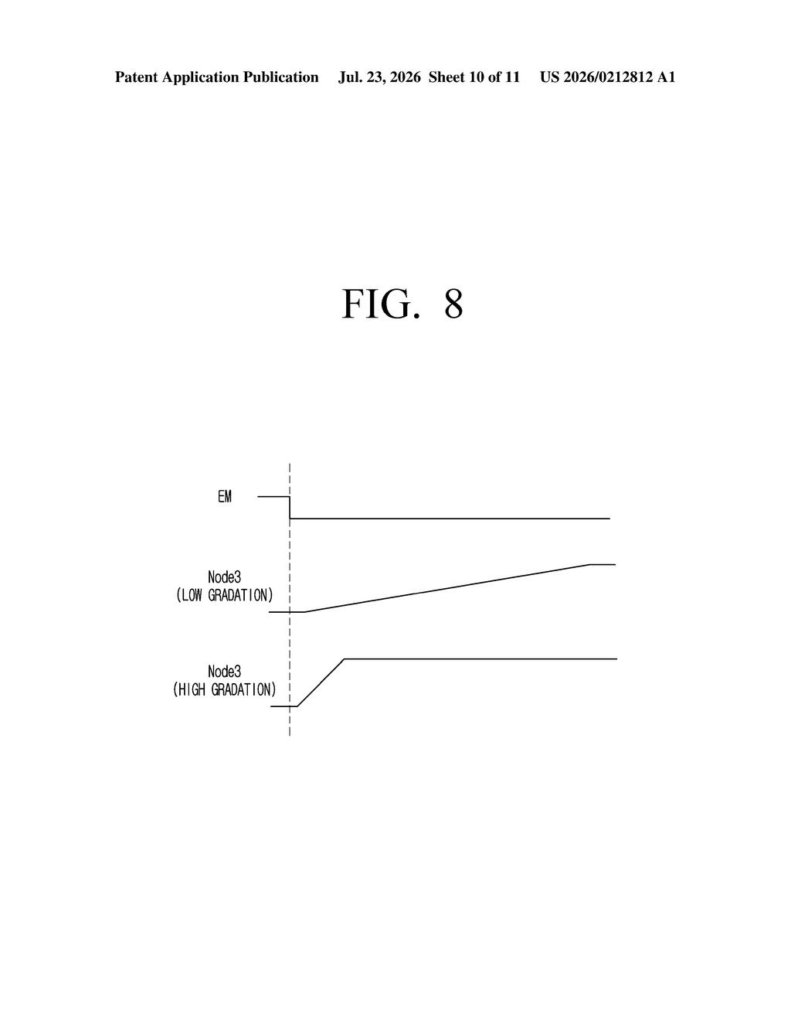
The key behavior: once the capacitor charges up to a predetermined voltage level, it forces the switching transistor to block, which cuts off the current to the LED. The light turns off at a moment defined by how fast the capacitor charges, not by a direct command from outside the pixel.
This means the timing of each pixel's off-state is encoded in the charging rate rather than in continuous external signaling. The driving unit sets up the conditions (the two control voltages), and the pixel's own internal circuit handles the precise cutoff moment autonomously.
What this means for micro-LED and inorganic display panels
Inorganic LEDs (including micro-LEDs, which Samsung has invested heavily in for premium TVs and displays) require much tighter per-pixel control than traditional LCD or even OLED panels. If the current runs even slightly too long, brightness uniformity suffers. A circuit that handles its own shutoff timing at the pixel level could make large inorganic LED displays more practical to manufacture and drive.
For you as a consumer, the downstream effect would be more consistent brightness and potentially lower power draw in future Samsung screens. This is the kind of foundational display engineering that rarely makes headlines but determines whether next-generation screen technology actually works at scale.
This is display engineering at its most granular, and it's not a flashy filing. But Samsung's micro-LED ambitions are real, and patents like this are the unsexy groundwork that determines whether those ambitions ship as products. Worth filing mentally under 'watch this space' rather than 'exciting news today.'
There are more where this came from
We read every patent application Big Tech publishes and send you the ones worth knowing. Plain English, free, every week.
The drawings
11 drawing sheets from US 2026/0212812 A1 · click any drawing to enlarge


Want this weekly breakdown for a company we don't cover? Patentlyze Pro →
Be the first to weigh in