
Samsung Patents a TV That Tells Its Source Box What to Stream Next During Split-Screen
Split-screen TV sounds simple, but keeping two or more video feeds smooth at the same time is a juggling act. Samsung's latest patent describes a display that solves the problem by talking back to whatever box is feeding it content.
What Samsung's split-screen buffer trick actually does
Imagine you're watching a sports game on one half of your screen and a news channel on the other. Each feed needs a steady flow of video data to stay smooth. If one half starts running low on buffered content, you get a stutter or freeze on that side while the other half plays fine.
Samsung's patent describes a TV (or display) that watches its own internal storage for each feed. When one of those storage areas gets low, the display sends a message back to the source device (think: a set-top box or streaming hub) telling it to prioritize sending data for that feed before the others.
The result is that the display itself becomes an active participant in managing what comes in, instead of just passively receiving whatever the source box decides to send. Each split-screen window gets its own dedicated storage, and the whole system adjusts on the fly to keep every window playing without interruption.
How the display monitors buffers and reorders incoming data
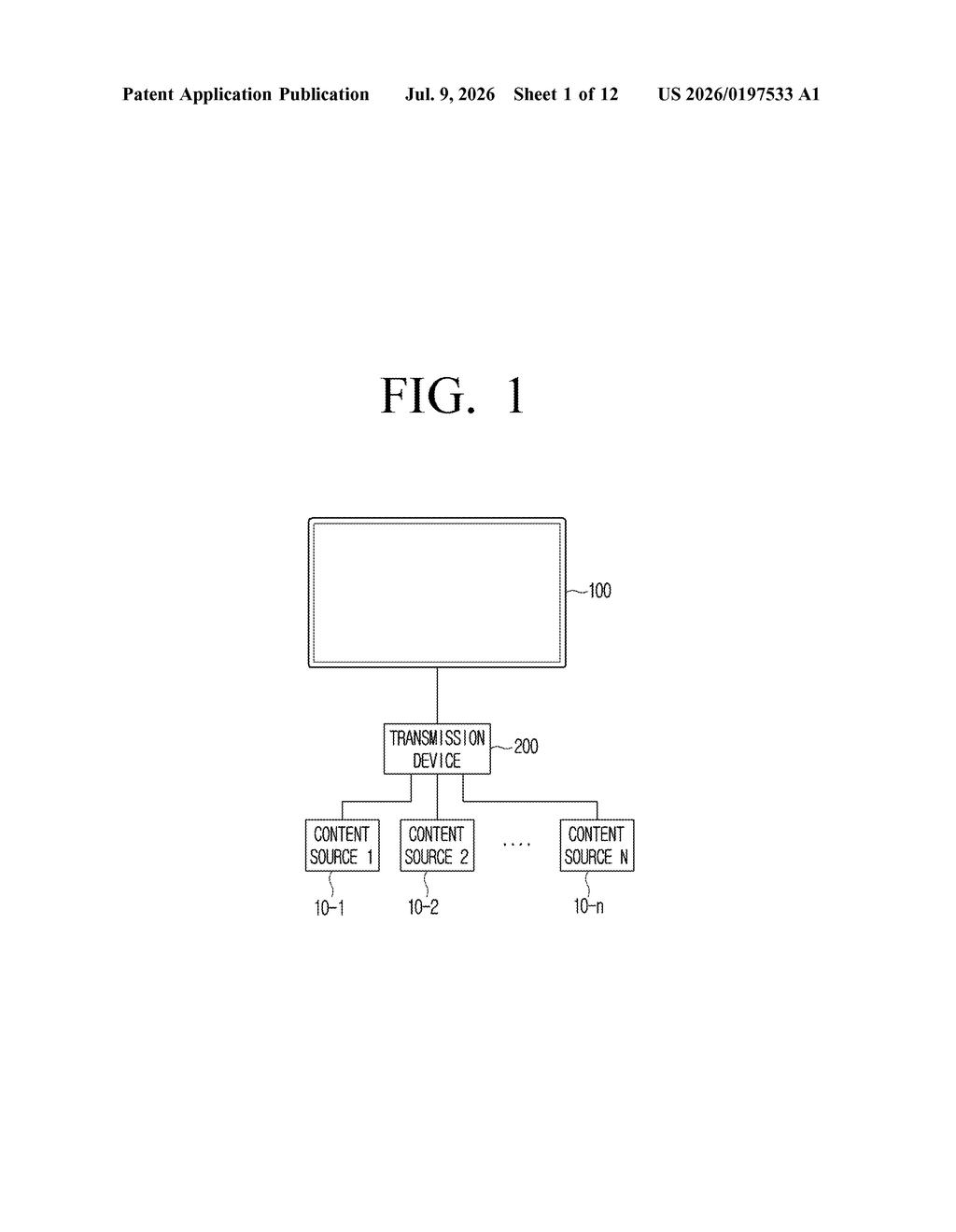
The patent describes a display device that runs a multi-view (split-screen) mode by maintaining a separate buffer (a small temporary storage area) for each content feed. Those feeds come from a connected transmission device, such as a set-top box or media hub, which itself pulls from multiple content sources simultaneously.
The key mechanism is buffer-level monitoring. The display's processor continuously checks how full each buffer is. When it detects that a specific buffer has dropped below a defined reference level (essentially a low-water mark), it sends a control signal back to the transmission device. That signal instructs the source to adjust its transmission order, meaning it should front-load data destined for the depleted buffer before sending more data for the others.
- Each content feed gets its own dedicated buffer inside the display.
- A processor monitors all buffers in parallel.
- A low-buffer detection triggers a feedback signal to the upstream source device.
- The source device re-prioritizes which feed's data it sends next.
This is a feedback loop between the display and its source, rather than a one-way pipeline. The display effectively becomes a traffic controller for its own incoming data.
What this means for multi-source TV setups
Today's multi-view TVs typically rely on the source device to decide how to distribute data across feeds, with no input from the display about what it actually needs. That passive approach works when all feeds are healthy, but it can cause one window to freeze or stutter when network conditions or content complexity shifts unexpectedly. Samsung's approach gives the display a voice in that negotiation, which could make split-screen modes noticeably more reliable in real-world conditions.
For Samsung, this fits a broader push to make its high-end TVs and monitors capable of managing multiple HDMI or wireless sources simultaneously, a feature that appears increasingly in its premium lineup. If this technique ships, you as a viewer would likely never notice the mechanism itself, but you'd notice that your multi-view screen rarely stutters.
This is a focused, practical patent rather than a flashy concept. Buffer management feedback loops are a known technique in streaming, but applying that logic directly between a display and its source box for multi-view scenarios is a concrete engineering contribution. It won't make headlines, but it's exactly the kind of low-level polish that separates a frustrating split-screen experience from a reliable one.
Get our take in your Top Stories
Liked this breakdown? Add Patentlyze as a preferred source on Google, and our plain-English take shows up more often in your Top Stories the next time Samsung patent news breaks.
There are more where this came from
We read every patent application Big Tech publishes and send you the ones worth knowing. Plain English, free, every week.
Want this weekly breakdown for a company we don't cover? Patentlyze Pro →