
Google AI Patent Teaches Recommendation Systems to Think in Groups
Most recommendation systems treat every result as if you evaluated it in a vacuum. This Google patent trains an AI that knows a result looks more or less appealing depending on what's sitting next to it.
How Google's AI learns from what you click together
Imagine Google shows you five search results or five YouTube videos. Right now, most AI models score each one independently, as if the others don't exist. But in reality, if you already clicked the first result, you're less likely to click a very similar second one. The items on a list influence each other.
This patent describes a training method that teaches a model to account for that. Instead of just asking "how likely is the user to click this item?", the system also asks "how likely is the user to click this item given what else is on the list?" That second question is the key addition.
The practical payoff could be a recommendation feed or search results page that stops showing you five variations of the same thing, because the model now understands that once you've seen one, the others lose value. It's a more realistic picture of how people actually browse.
How the marginal and joint networks split the prediction work
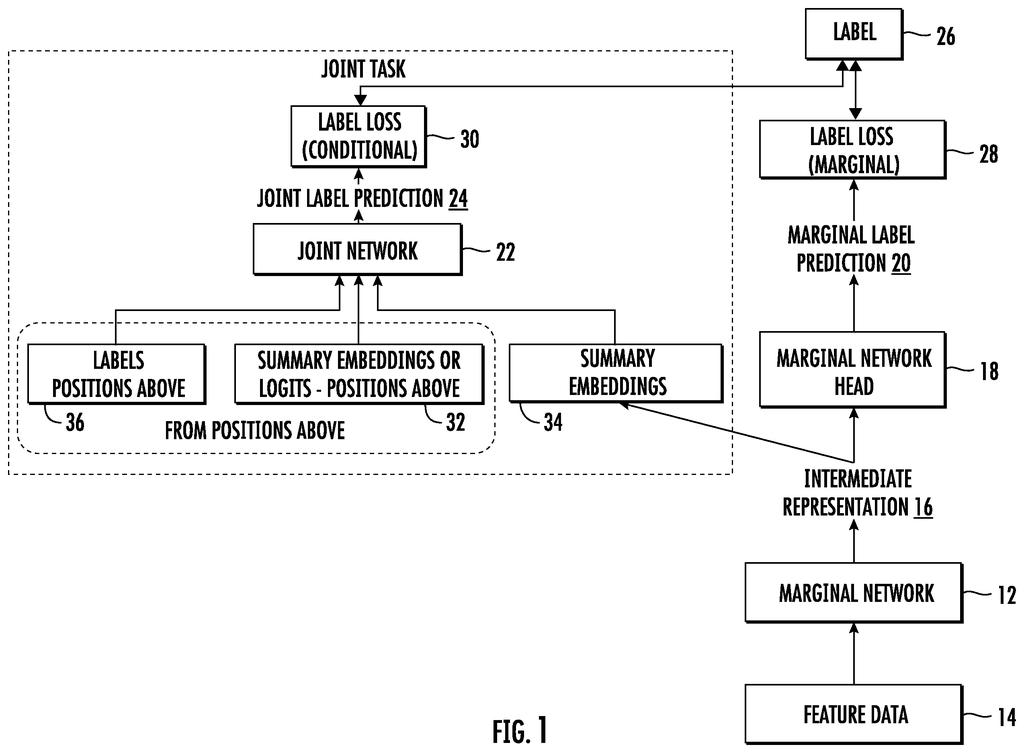
The patent describes a machine learning training method built around a two-part neural network.
The marginal network handles the baseline job: it takes a single item's features and produces a standard engagement prediction (think: "there's a 12% chance this user clicks this video"). That's roughly what current systems already do.
The joint network is the new piece. It takes the same item's internal representation and combines it with information about the other items already selected or shown alongside it. This lets the model produce a conditional prediction ("given that the first two results were already shown, what's the click probability for result three?"). Chaining these conditional probabilities together gives you the full joint probability for the whole list, which is a much more accurate picture than multiplying independent probabilities.
During training, both networks share parameters and are updated together using a combined loss function that penalizes errors in both the individual predictions and the list-level joint predictions. The patent also notes the approach applies to ranking and knowledge distillation (the process of compressing a large model's behavior into a smaller, faster one) without needing to manually balance two separate loss terms, which has been a pain point in prior art.
What this means for Google Search and YouTube recommendations
For Google, the stakes here are the quality of every surface that shows lists: Search, YouTube, Google Discover, Google Shopping, Play Store. A model that understands list-level engagement dynamics could reduce redundancy in results and surface more diverse, complementary items rather than near-duplicates.
For you as a user, the difference would show up as a feed that feels less repetitive. For advertisers and publishers, it changes how content competes for attention because placement relative to other items would factor into the model's predictions, not just absolute item quality. This is a fairly specialized training-time improvement, so don't expect a visible UI change, but it's the kind of foundational work that shifts how well ranking systems actually perform.
This is unglamorous infrastructure work that sits several layers below anything a user would notice, but it addresses a real and well-known weakness in how recommender systems are trained. The idea of modeling joint label probabilities instead of approximating them from marginals is technically sound and the claim that it avoids manual loss-balancing is a meaningful practical benefit for teams building these systems. Worth tracking if you follow ML for ranking.
There are more where this came from
We read every patent application Big Tech publishes and send you the ones worth knowing. Plain English, free, every week.
The drawings
9 drawing sheets from US 2026/0220504 A1 · click any drawing to enlarge


Want this weekly breakdown for a company we don't cover? Patentlyze Pro →
Be the first to weigh in