
Apple Patents On-Screen UI Elements That Squash and Stretch Based on How You Swipe
Apple is patenting on-screen buttons and interface objects that behave like soft physical materials, stretching in the direction you push and compressing at right angles, depending entirely on how you move your finger.
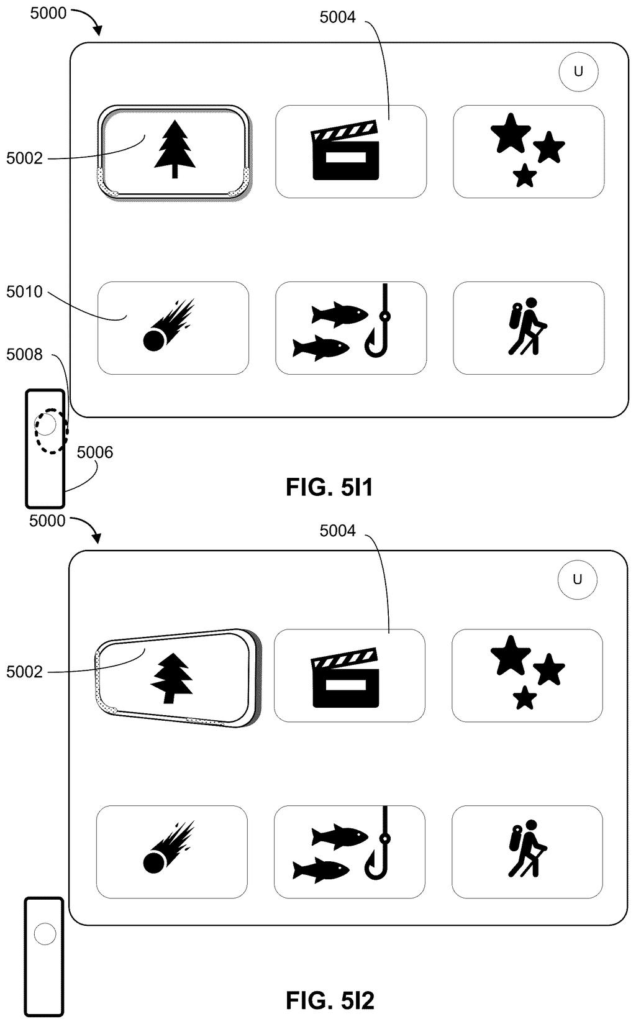
What Apple's stretchy interface material actually does
Imagine pressing your thumb against a lump of clay. The clay squishes outward in the direction you push, and pulls inward from the sides at the same time. Apple is describing exactly that behavior, but for things you see on your screen.
When you drag or swipe toward an on-screen button or panel in one direction, that element stretches along that axis and compresses along the perpendicular one. Drag in a different direction, and it stretches and compresses in a correspondingly different way. The element reacts to your gesture like a physical object would.
This goes beyond the simple 'bounce' you already see when you over-scroll a list on your iPhone. Apple is describing a full directional material-physics model, where every gesture has a corresponding stretch-and-squeeze response tuned to the exact angle of your input.
How the stretch and compression directions are calculated
The patent describes a system where any user interface object (a button, a card, a panel, a region within a view) has at least one defined region that responds to touch or pointer input with paired stretch-and-compress transformations.
The key mechanic is the pairing:
- Input moving in direction A triggers a stretch along one axis and a compression along a different axis.
- Input moving in direction B (a different angle) triggers a stretch along a correspondingly different axis and a compression along yet another axis.
This mirrors how real elastic or soft materials behave under stress, a concept called material deformation (the physical principle that when you pull something in one direction, it tends to thin out in the crossing direction). The patent claims this response is tied to the specific movement direction of the input, not just whether the user is touching at all.
The claim covers a broad class of devices: anything with 'one or more input devices' and 'one or more display generation components,' which covers iPhones, iPads, Macs with trackpads, and potentially Vision Pro.
What this means for the feel of Apple's touchscreens
The practical payoff is tactile believability. When on-screen elements respond to gesture direction with physically plausible deformation, the interface feels less like a flat grid of tap targets and more like something you're actually manipulating. That's the goal Apple has been chasing with spring animations and haptic feedback for years, and this patent extends it into directional material physics.
For you as a user, the most visible application would probably be in springy over-drag effects, interactive widgets, or any place Apple wants an interface to feel grounded and physical rather than digital and flat. Given the inventor list includes Alan Dye (Apple's longtime VP of Human Interface Design), this is clearly a core UI research investment, not a side experiment.
This is genuine foundational UI work from the people who have defined how Apple's interfaces feel for two decades. It's not a flashy consumer feature announcement, but the physics model here is the kind of thing that shapes every gesture interaction on a platform for the next ten years. Worth paying attention to.
There are more where this came from
We read every patent application Big Tech publishes and send you the ones worth knowing. Plain English, free, every week.
The drawings
99 drawing sheets from US 2026/0219758 A1 · click any drawing to enlarge


Want this weekly breakdown for a company we don't cover? Patentlyze Pro →
Be the first to weigh in