
Google Patents AI System That Recommends Gene Modifications to Boost Biological Yields
X Development, Alphabet's moonshot lab, has filed a patent for a system that uses AI to recommend specific genetic changes to living cells, with the goal of making those cells produce more of whatever useful substance they're engineered to make.
What X Development's AI-driven cell optimizer actually does
Imagine you're trying to breed a tomato plant that produces twice as many tomatoes. You'd want to read every farming study ever published and consult your own private greenhouse records before deciding which seeds to cross. That's essentially what this system does, except the plant is a microorganism and the tomatoes are something like a medicine, fuel, or industrial chemical.
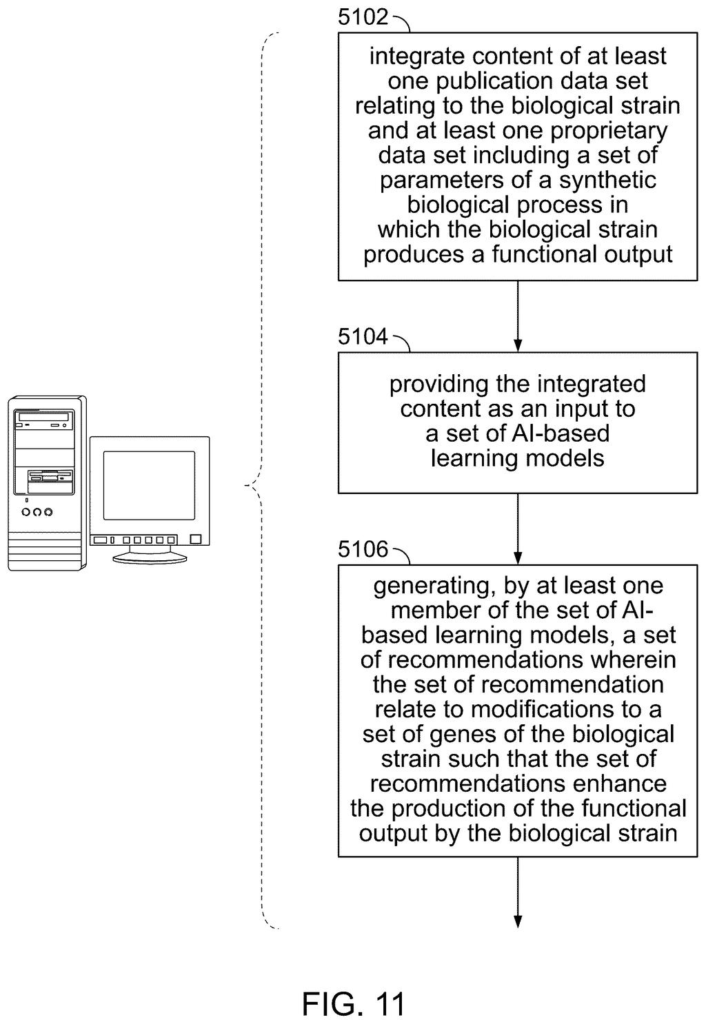
The platform pulls together two streams of information: publicly available scientific research about a particular biological strain, and a company's own private data from running synthetic biology experiments. It feeds all of that into a set of AI models, which then generate a ranked list of recommended genetic modifications designed to increase how much of the target substance those cells produce.
Instead of relying on scientists to manually sift through thousands of papers and internal datasets before making a guess, this system tries to automate that synthesis step, turning raw knowledge into actionable suggestions for which genes to tweak.
How the system blends published science with private lab data
The patent describes a platform with two main parts working in sequence.
First, a data integration layer ingests at least two types of information: public scientific literature about a specific biological strain (think journal articles, gene databases, research preprints) and a private dataset containing parameters from the company's own synthetic biology experiments. These could include things like fermentation conditions, nutrient concentrations, and yield measurements from past production runs.
Second, the integrated dataset becomes the input for a set of AI-based learning models. Those models are trained to find patterns across both the public and proprietary information, then output a set of recommendations specifying which genes in the target organism should be modified and in what way, so that the organism produces more of a desired functional output (a chemical, a protein, a fuel compound, etc.).
The key design choice is treating published science and internal lab data as equally valid signals, rather than relying on one or the other. The AI acts as the bridge, translating combined knowledge into concrete genetic engineering instructions that a lab team can then test.
What this means for AI-driven biotech and Alphabet's ambitions
Synthetic biology, the practice of engineering microbes to manufacture useful compounds, is already used to produce everything from insulin to sustainable jet fuel. The bottleneck is usually the optimization loop: scientists have to read enormous amounts of research, design experiments, run them, and iterate. A system that automates the recommendation step could compress years of trial-and-error into weeks.
For Alphabet, this signals continued investment through X Development in AI-for-science infrastructure, an area where Google's DeepMind (with AlphaFold) has already made a major mark. If this platform works as described, it could become foundational tooling for internal biotech programs or licensed to pharmaceutical and agricultural companies trying to speed up their own cell-engineering pipelines.
This is a genuinely interesting patent because it sits at the intersection of two areas where Alphabet has real assets: large-scale data integration and biological AI. The concept of fusing public literature with proprietary experimental data isn't new in academic biotech, but patenting a unified platform architecture for doing it at scale suggests X Development is building something they intend to productize or defend. Worth watching, though the claim language is broad enough that real-world usefulness will depend entirely on what those AI models can actually do.
There are more where this came from
We read every patent application Big Tech publishes and send you the ones worth knowing. Plain English, free, every week.
The drawings
52 drawing sheets from US 2026/0221223 A1 · click any drawing to enlarge


Want this weekly breakdown for a company we don't cover? Patentlyze Pro →
Be the first to weigh in