
Samsung Patents a Display That Narrows Its Viewing Angle Only Where Your Private Content Is
Most privacy screens dim the entire display, making it hard to show someone a photo while hiding a notification. Samsung's new patent targets only the parts of the screen that need protecting, leaving the rest fully visible.
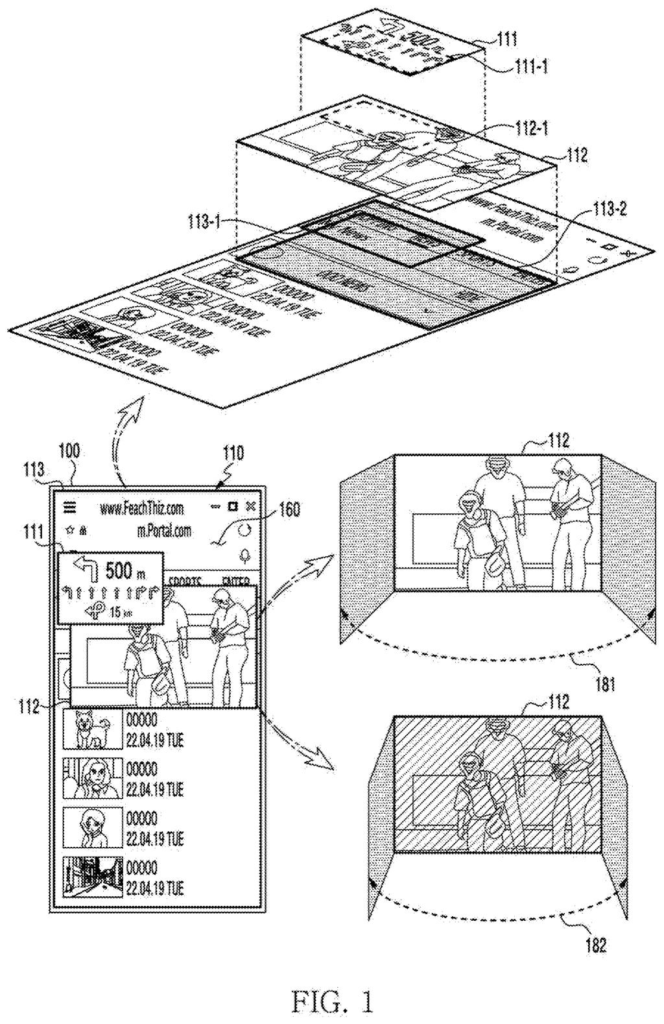
What Samsung's layer-aware privacy screen actually does
Imagine you're on the subway, phone in hand, looking at a map. A text message notification pops up over the map. With a standard privacy screen, the whole display goes dark and narrow-angle, so the map becomes harder to read too. That's the trade-off Samsung is trying to fix.
This patent describes a display that can narrow the viewing angle on specific parts of the screen at the same time as keeping other parts fully bright and wide-open. So your notification, and only your notification, becomes invisible to the person sitting next to you, while the rest of your screen looks completely normal.
The clever part is how it handles overlapping elements. If a translucent or see-through layer sits on top of a private piece of content, the system recognizes that the layer above also leaks the private information underneath, so it applies the privacy filter to both layers together. You get precise, content-aware privacy without having to darken everything on screen.
How the driver circuit finds and filters overlapping screen layers
Modern smartphone screens can physically adjust their viewing angle (how wide the cone of light is that other people can see from the side) by applying a voltage filter to individual pixels. Samsung's patent automates and refines where that filter gets applied.
The display driver circuit receives two things from the phone's main processor: the image itself, and a composition list, which is a structured description of every layer that makes up that image (think of layers like transparent sheets stacked on top of each other in design software like Photoshop). The driver reads the list to figure out which layers have been flagged for privacy protection.
Here is where it gets precise:
- It finds the private layer (say, a password field or a notification).
- It checks whether any transparent or semi-transparent layer sits on top of it and overlaps it, because see-through layers still reveal what's underneath.
- It applies pixel-level processing to both layers simultaneously, narrowing only the pixels that correspond to either layer.
- Any part of the screen that is neither the private content nor overlapping it keeps its full, wide viewing angle.
The result is a display that can show a narrow-angle privacy zone and a normal-angle zone at the same time, handled entirely in the display driver hardware rather than as a software overlay.
What this means for privacy on Samsung phones and tablets
For anyone who uses their phone in public, this is a more practical version of the privacy screen concept. Today's privacy screen accessories and software modes apply one blanket setting to the whole display. Samsung's approach would let you keep a map, photo, or video fully visible to a friend standing beside you while a message or banking app notification stays invisible to strangers nearby.
It also hints at where Samsung's foldable and tablet displays could go. A large screen is exactly where you want selective privacy, not a one-size-fits-all dimming filter. If this makes it into production hardware, the functionality would most likely be managed automatically by the operating system based on app-level privacy flags, requiring no manual action from you.
This is a genuinely useful incremental improvement on an existing feature rather than a conceptual leap, but incremental improvements to privacy screens are worth paying attention to because the existing solutions are so blunt. The real value here is in the layer-aware logic: automatically catching that a translucent overlay also leaks the private content beneath it is the kind of edge case that trips up simpler implementations.
There are more where this came from
We read every patent application Big Tech publishes and send you the ones worth knowing. Plain English, free, every week.
The drawings
19 drawing sheets from US 2026/0221087 A1 · click any drawing to enlarge


Want this weekly breakdown for a company we don't cover? Patentlyze Pro →
Be the first to weigh in